Why The Strait Of Hormuz Is So Important. Iran Followed The Law And Got A Coup. Wednesday’s Edition.
The Long Chain: The Strait of Hormuz. Series 32 #2
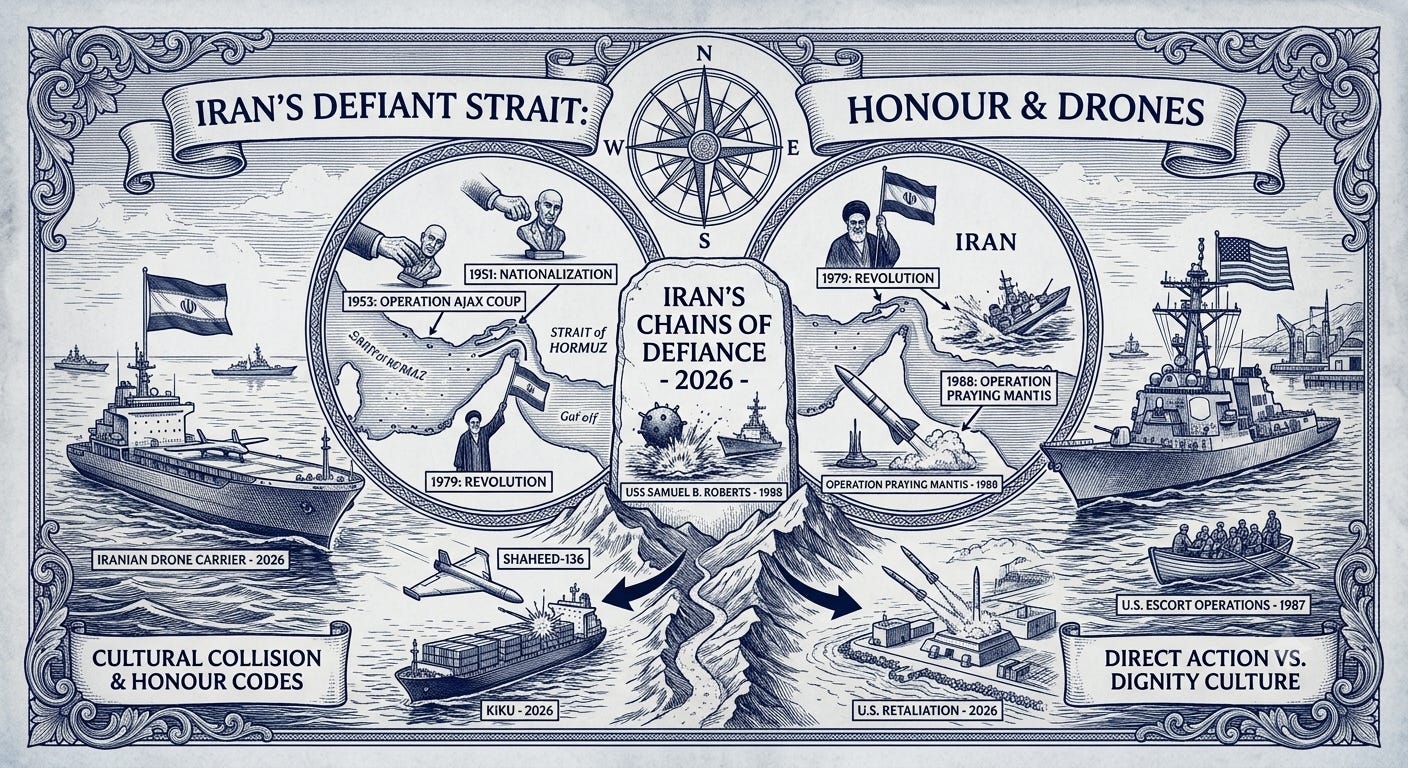
On Saturday, June 27, 2026, at 4:30 in the morning, an Iranian drone hit the Kiku, a Panama-flagged tanker carrying more than two million barrels of crude oil near the Strait of Hormuz. The United States struck back within hours, hitting Iranian air defense sites, drone stores, and the equipment Iran uses to lay sea mines. A ceasefire signed barely a week earlier, meant to end the war between the two countries, had already collapsed.
This is how Iran deals with the Strait now. And here is why: Iran learned that if it plays by Western rules, follows international law, and adheres to treaties, the US and Britain will break the rules, ignore international law, and dissolve treaties if Iran does not do what they want. Seventy-five years ago, Iran tried to get its oil and its honor back through the law and by following the rules. And it won. So Britain and the US overthrew the Iranian government and installed a puppet pro-Anglo regime.
Monday’s Edition showed that because Persia (Iran) was weak and Britain needed the Persian Gulf to guard its sea route to India, Persia lost the battle for the Gulf to the British. Then, an impoverished Persia sold the oil rights to a British company to raise cash. In an honor culture, where a nation’s worth depends on the respect of others, foreign control of its own oil and the Gulf was a humiliation, and honor demands that what was taken be returned.
After the Second World War, the United States built a new world order of rules and became the most powerful nation. Because rules now governed the world, Iran saw it could use them to get its oil, the Gulf, and honor back. Iran took the first step in 1951, when its parliament passed the Oil Nationalization Law and made Mohammad Mossadegh prime minister. Mossadegh canceled the rights of Britain’s Anglo-Iranian Oil Company and moved Iran's oil into a new state firm, the National Iranian Oil Company. This prompted Britain to take Iran to the World Court, but in 1952 the court ruled in favor of Iran.
Unable to win legally, Britain went back to using force. In 1953, Britain’s spy service and the American CIA launched Operation Ajax to remove Mossadegh. The coup hit on August 19, 1953, when paid crowds and army units toppled Mossadegh after a day of street fighting that killed about 300 people. Britain and the US put Shah Mohammad Reza Pahlavi in power, and he quickly gave Iran’s oil back to Britain and a large share to the Americans
Iran learned that the West follows the rules only when they are in its favor, and that the Western concept of dignity culture does not apply to other nations when the West wants their resources. This made it clear to Iran and much of the Middle East that the West could not be trusted and that only direct action would produce results.
For the next 26 years, the Shah ruled as a king, kept in place by the foreign powers. His secret police jailed and killed his opponents. This sparked intense anger across Iran, leading to the 1979 revolution. The Shah fled, and the religious leader Ayatollah Khomeini took power. The revolution ended Iran’s role as a Western client state and made it an open enemy of the West.
The revolution also left Iran weak and isolated. In 1980, Iraq used that situation to invade, starting the eight-year Iran-Iraq War. By the mid-1980s both sides were attacking the oil tankers in the Gulf to destroy each other’s trade. Iran’s attacks on shipping forced the United States to take action: in 1987 it put American flags on Kuwait’s tankers and sent warships to escort them through the strait. Iran answered with sea mines, and on April 14, 1988, one mine nearly sank the American frigate USS Samuel B. Roberts. The United States struck back four days later in Operation Praying Mantis, sinking or wrecking about half of Iran’s working navy in a few hours. That defeat pushed Iran to accept a United Nations ceasefire, and the war ended on August 20, 1988.
This is the chain of events that put Iran in the position it is today. It uses the strait as its weapon, because it knows the West does not follow its own law, and direct action fits its honor culture. The drone that hit the Kiku on June 27 and the American missiles that followed are the latest collision of the two cultural perspectives that first met in 1820. The situation won’t be resolved until both sides take the time to understand and work with each other’s cultural perspective.
Friday’s Edition takes us to today: what Iran is most likely to do at the strait next, how far it will go, and what happens to the world’s oil if it follows the logic of this chain.
If you enjoyed this article, help support my work by becoming a paid subscriber or “Buy me a coffee.”
Get a solid understanding of Trompenaars’ cultural dimensions by purchasing the guide or subscribing to Cultural Perspective (free or paid) and receiving the guide for free.


