

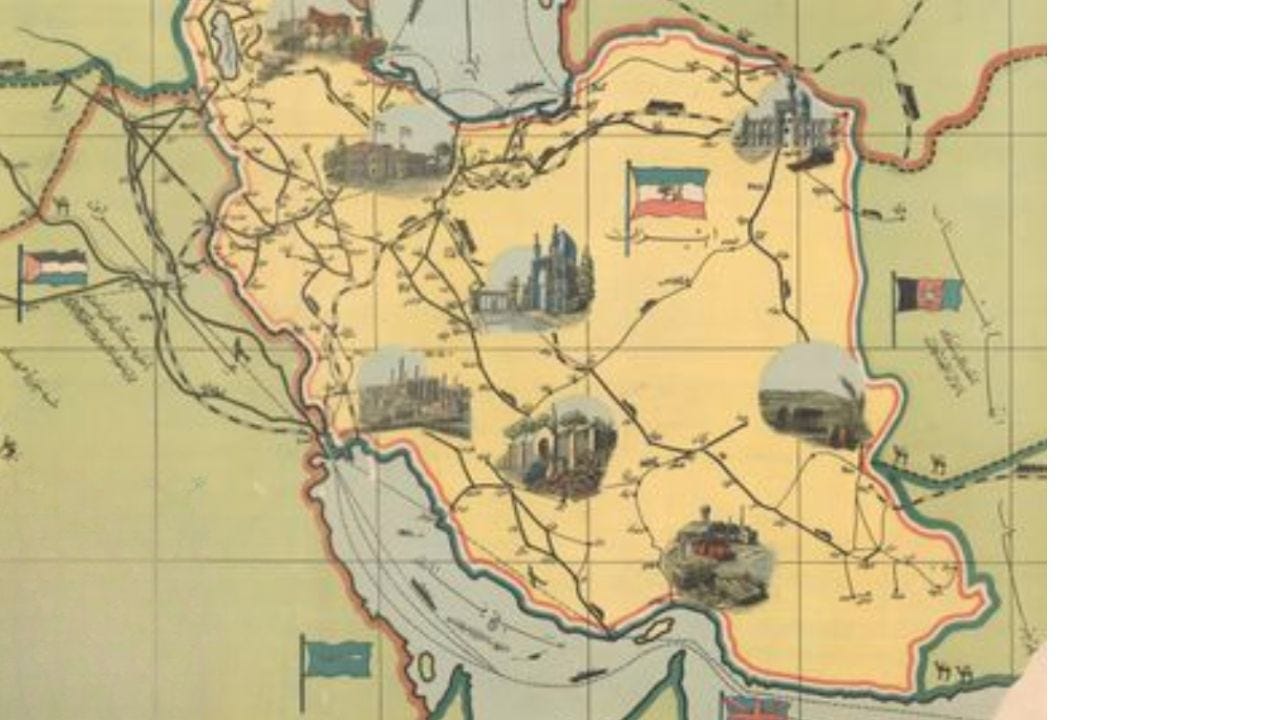
America began bombing Iran on February 28. The 82nd Airborne is en route to the Gulf. Marines are in the water. Iran rejected a 45-day ceasefire proposal from Egyptian, Pakistani, and Turkish mediators, but now has opened the Strait in exchange for a 2-week ceasefire.
But the question remains, will the U.S. invade Iran? To answer the question, we’ll look at three frameworks: historical patterns from Vietnam, Iraq, and Afghanistan; M.J. Hornby’s archetypes; and Hofstede’s and Trompenaars’ cultural dimensions.
What “Invasion” Means
“Invasion” means a military offensive intended to establish control over territory. Troops in Iran are not an invasion unless the objective is to hold territory.
The Historical Pattern
Step One: make up a reason for the war. In Vietnam, the second Gulf of Tonkin incident was fully manufactured. In Afghanistan, the September 11 attacks were real, but the hijackers were Saudi’s and Afghanistan offered to hand over Bin Laden. The United States framed Afghanistan as the culprit anyway. In Iraq, weapons of “mass destruction” never existed. In Iran, the IAEA never confirmed a nuclear weapons program existed in the first place. The JCPOA froze Iran's enrichment program and placed it under IAEA monitoring. Trump still bombed suspected sites and said, "Iran's key nuclear enrichment facilities have been completely and totally obliterated." Then Trump claimed Iran restarted its nuclear weapons program, but America’s own intelligence agencies said that was false.
Step two: authorize an invasion. In Vietnam, the Gulf of Tonkin Resolution passed with an overwhelming majority. In Iraq, the Iraq Resolution authorized the President to use “all necessary and appropriate force.” In Afghanistan, it was the Authorization for Use of Military Force, passed three days after September 11. In Iran, as of today, no Congressional authorization exists for a ground invasion.
Step three: bombing. Operation Rolling Thunder began in Vietnam in March 1965. In Iraq, bombing began on March 19, 2003. In Afghanistan, airstrikes began on October 7, 2001. In Iran, the bombing campaign began on February 28, 2026.
Step four: advisers and special forces. In Vietnam, military advisors escalated from 900 under Eisenhower to 16,000 under Kennedy before the war formally began. In Afghanistan, roughly 1,000 special operations personnel were deployed alongside the Northern Alliance. In Iraq, CIA paramilitary teams and special forces preceded the main invasion. In Iran, the Pentagon is planning raids on Kharg Island and coastal installations near the Strait of Hormuz.
Step five: conventional ground troops (invasion). In Vietnam, 3,500 Marines landed at Da Nang six days after the bombing began. In Afghanistan, conventional forces arrived within weeks of special forces. In Iraq, 130,000 ground troops crossed the border the day after bombing began. In Iran, the time gap between bombing and invasion is by far the longest.
Step six: failure and withdrawal. Roughly 2.7 million Americans went to Vietnam, and 58,000 died. It cost over $1 trillion in today's dollars. Ten years later, the U.S. had lost the war. About 800,000 American troops fought in Afghanistan, 2,400 died, and it cost the nation over $2 trillion. Twenty years later, the U.S. had lost the war. In Iraq, roughly 1.5 million troops went through the country, 4,500 Americans died, and over and over $2 trillion was spent. Eight years later, the U.S. left the nation worse off than before it invaded.
If you are enjoying this article, help support my work by becoming a paid subscriber or “buy me a coffee.”
As of April 8, 2026, Iran sits between steps four and five and has a two-week ceasefire in effect. Special forces operations are still in position. Every previous American war that reached step four continued to step six. The historical pattern is the strongest argument for invasion. But this time, Trump has no Congressional authorization, the time between bombing and invasion is unprecedented, but the person making the decision is erratic, unpredictable, and makes decisions impulsively without regard to the consequences.
The Archetype
Trump aligns firmly with what Hornby terms the North power-seeker archetype, and Trump is an extreme version of it. The Power-seeker is socially ambitious, domineering, self-centered, unreflective, and dismissive of anyone who challenges him. The North type uses people and ideas that serve their personal agenda and discards everything else. He dominates the narrative, measures success by visible wins, and talks tough, but often backs down. What he wants is all that matters; the cost of the war or the number of dead Americans is not his concern. But what makes Trump particularly dangerous is his shallow understanding of the material.
The North archetype needs to win regardless of the outcome. Bombing a site is a win, even if it does nothing strategically. Killing Khamenei is a win, even if it strengthens and unites Iran. The North archetype needs to declare victory and move on. A sustained ground campaign with no clear win is intolerable for this profile.
The North archetype cannot be seen as weak. If Iran’s actions are framed as humiliation, the loss of face will force a reaction in Trump. An impulsive reaction without consideration of consequences, as long as it can be seen as a win.
The need for a quick win and fear of losing pull in opposite directions. Which one wins determines whether this war becomes an invasion.
The Cultural Programming
America is a highly individualistic country. It is firmly short-term and achievement/success-oriented. This means the culture rewards competition and decisive action with material achievement and praise. Trump operates at the extreme end of all three. He is transactional; he needs quick results that he can clearly show off. He does not want an extended campaign without a clear victory.
Trump is also a particularist operating in a universalist system. Rules apply to others but not him. He makes decisions based on loyalty and deals.
The Other Issues
Iran is roughly 5 times the size of Vietnam, 2.5 times the size of Afghanistan, and nearly 4 times the size of Iraq, and is ringed by the Zagros and Alborz mountain ranges, with peaks above 4,000 meters. The U.S. failed in Vietnam, Afghanistan, and Iraq, where size and geography were far more favorable. Holding even a portion of Iran would require something close to 500,000 troops, more than a third of America’s active forces.
The domestic numbers are another constraint. Sixty-six percent of Americans disapprove of the military action. Seventy-one percent oppose $200 billion in war funding. Trump’s approval rating on Iran sits at roughly a third, the lowest of any war in U.S. history.
The Pentagon has publicly described its planned ground operations as limited raids, coastal strikes, and island seizures. They are not designed to take and hold Iranian territory.
Polymarket traders are currently putting the chance of invasion before 2027 at roughly 55 percent.
The Call And The Probability
The historical pattern is clear; we know where an invasion will lead. Trump’s psychological and cultural programming creates a tension between invading to prove his power and not invading because it will be neither quick nor a win. The geography is a natural fortress. Domestic opposition is overwhelming. An invasion requires an intent to occupy, and nothing in the current military posture suggests that objective.
But the North archetype refuses to accept humiliation or loss. If Iran inflicts a visible blow, more downed aircraft, a sunk ship, a strike on American personnel, the calculus shifts. The loss-of-face trigger is the wildcard.
