Singapore! The Three Shocks That Built The Modern State. Wednesday’s Edition.
The Long Chain: Singapore. Series 33 #2
From 29 to 31 May 2026, the defense ministers of Asia, Europe, and the Americas met in Singapore at the Shangri-La Dialogue, Asia’s main security summit. Delegations from 44 countries attended, with 54 ministers and at least 42 armed-forces chiefs. For three days they argued over Asia’s wars and alliances.
Monday's Edition traced how wind, a free port, and migration made colonial Singapore rich. Wednesday's Edition covers how those same three forces forced Singapore to build a modern state.
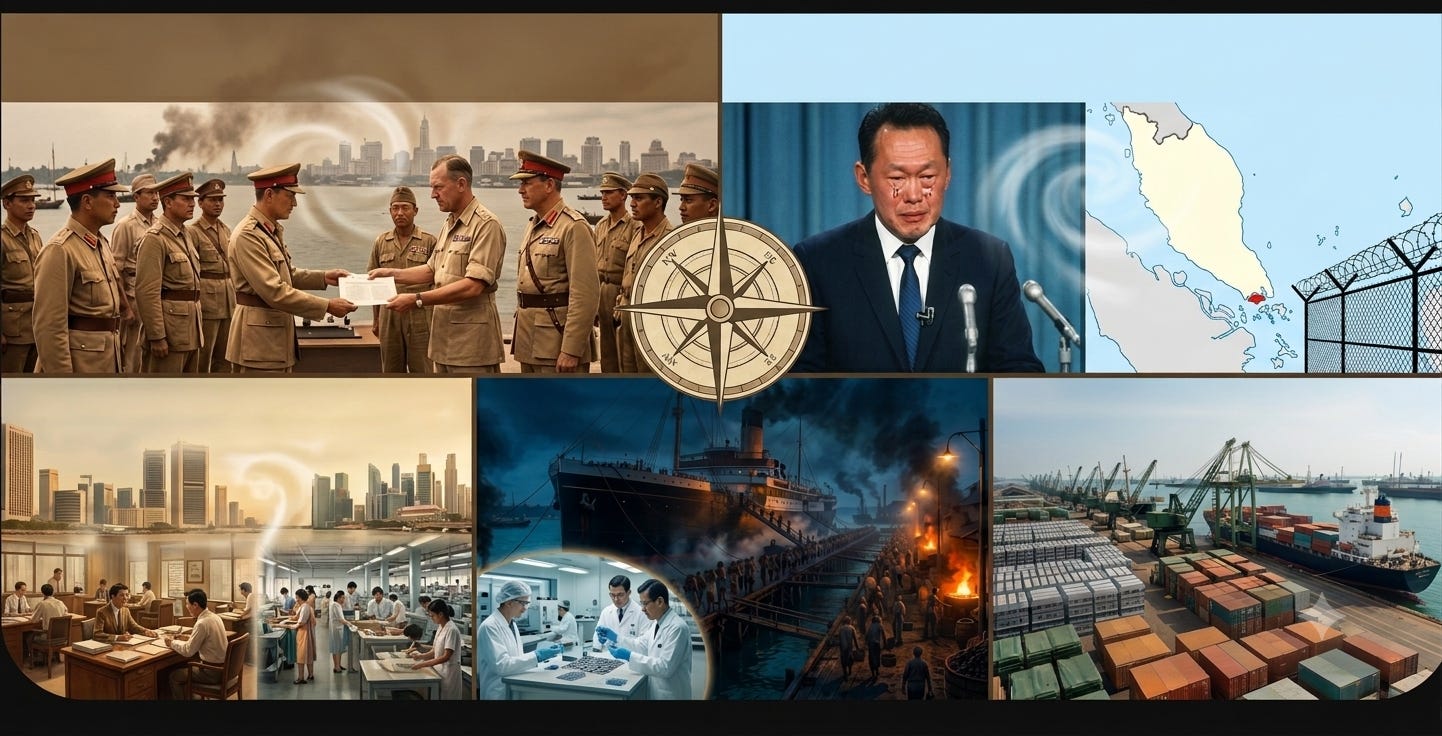
Britain called Singapore “the Gibraltar of the East,” meaning a fortress too strong to fall, fortified it with a naval base in 1938, and planned to send a fleet if Japan attacked by sea. Japan did attack, but not by sea, rather through the Malay Peninsula in December 1941. Britain did send a “fleet”, two warships that were sunk within days. On 15 February 1942, the British commander, Arthur Percival, surrendered Singapore and about 80,000 troops to a smaller Japanese force. That surrender was the largest in British history.
That surrender was the first shock in the chain that made Singapore what it is today because it ended Singaporeans’ belief that Britain could protect them. After the war, their demand for self-government grew until Britain granted it in 1959. Under the terms, Singaporeans ran daily affairs, and Britain kept defense and foreign relations. Singapore’s first prime minister was a 35-year-old lawyer named Lee Kuan Yew,
Self-government left defense and foreign policy in Britain's hands, and Lee's government knew the island was too small to survive on its own. This led Lee to secure Singapore's entry into the new Federation of Malaysia in September 1963. But the union failed over one question: whether Chinese, Malays, and Indians would have equal political rights. Lee's campaign for equal rights threatened the Malays' legal advantages in government jobs, education, and land, which were written into the constitution. The Malaysian prime minister, Tunku Abdul Rahman, chose to remove Singapore from the federation. The Malaysian parliament voted 126-0 to expel Singapore on 9 August 1965. Lee announced the separation on television in tears.
This was the second shock, and Lee was in tears because he knew Singapore had little chance of surviving on its own. Indonesia bombed it in March 1965. Malaysia controlled its water. The island had no farming, no water, no oil, and a small army.
A threat on that scale creates a Tight Culture in which there are many rules that are strictly enforced, and violators are harshly punished. This is the opposite of a Loose Culture, where rules are few and lightly enforced. Nations under threat from war, crowding, or scarcity become Tight. Singapore in 1965 matches the model: compulsory military service, heavy fines for rule violations, caning as a court-imposed punishment, and a single dominant party. Singapore already held the lowest recorded score for fear of uncertainty and change (low Uncertainty Avoidance, Monday’s Edition). Singapore is a Tight Culture in which the people are unafraid to change the rules. That cultural perspective drove the decisions that came next.
The loss of the Malaysian market forced a new plan. Albert Winsemius, the Dutch economist who led a United Nations mission to Singapore in 1960 and stayed as economic adviser, urged the government to invite foreign companies to build factories and sell their products to the world. This was the opposite of what many newly independent states were doing: seizing foreign companies.
The plan had barely started when Britain delivered the third shock: it announced in January 1968 that its forces would leave by 1971. Those British bases produced about a fifth of Singapore's national income and tens of thousands of jobs. The deadline forced Singapore to make in just four years the kind of decisions that normally take 25 or 30 years. Britain handed the naval dockyard to Singapore for one Singapore dollar; it reopened as a commercial ship-repair yard. Texas Instruments, one of the world's biggest semiconductor makers, set up in Singapore in December 1968 and was producing chips within three months. The government abolished its tax on foreigners' bank deposit interest in August 1968, and foreign money flowed in. The port began building a container terminal in February 1969, the first in Southeast Asia. The first container ship to use it, the MV Nihon, docked from Rotterdam on 23 June 1972.
Singapore made decisions quickly and enforced them strictly, which is what a tight culture with little fear of change produces. This cultural perspective is why the three shocks that could have ended Singapore made it richer instead.
Japan’s conquest in 1942 ended the belief that Britain could protect Singapore, and that loss drove the demand for self-rule that made Lee prime minister in 1959. The need for a market drove Singapore into Malaysia in 1963, and the fight over equal rights drove it out again in 1965. Expulsion, Indonesian bombs, and lack of resources meant a constant threat. That threat made the culture tight. Britain’s withdrawal, announced in 1968, then forced the Tight, Low Uncertainty Avoidance nation to decide fast: foreign factories, foreign money, and a container port, all in place by 1972.
Friday’s Edition covers how those decisions built on one another for sixty years, homes, forced savings, the port, the money of the world’s rich, and predicts what Singapore does next.
If you enjoyed this article, help support my work by becoming a paid subscriber or “Buy me a coffee.”
Get a solid understanding of Trompenaars’ cultural dimensions by purchasing the guide or subscribing to Cultural Perspective (free or paid) and receiving the guide for free.


