What’s Next For The EU? The Wars That Forced Europe Together. Wednesday’s Edition.
The Long Chain: The European Union. Series 34 #2
In 2026, Germany is spending about €108 billion on its military, its largest budget since the Second World War. The Defense Ministry has procurement plan to buy up to 1,000 new battle tanks, roughly 2,500 armored vehicles, and more fighter jets, and a government fiscal plan to raise military spending to about €152 billion a year by 2029. Germany is rearming because Russia invaded Ukraine, and Trump and the Republicans are cutting U.S. forces in Europe and have made it clear they may not help defend Europe if it is attacked.
Monday’s Edition traced this back to 1648, when the Peace of Westphalia granted each nation the right to self-rule. Over the next centuries, people began to identify with their nation, the in-group they would fight and die for. But this led Europeans to see other nations as rivals, which in turn led to war.
The nations that would fight those wars were themselves created by war. Napoleon Bonaparte seized power in France in 1799 and sought to control all of Europe. He conquered most of the continent but ultimately failed. By 1815, the other powers of Europe had defeated him, but to raise his armies and hold his conquests, Napoleon spread the idea that a people should rule themselves as one nation rather than serve a king as subjects. Napoleon failed to conquer Europe by force, but he created something more lasting: national identity.
Napoleon’s defeat brought the great powers together at the Congress of Vienna in 1815. They redrew the map to balance European power, so no single nation would dominate.
In his conquest, Napoleon had reduced the hundreds of German states to a few dozen. The Congress of Vienna kept that map and organized the remaining states into the German Confederation. Eventually, Prussia, the strongest of the German states, united them by force and treaty. Then it went to war with and defeated France in 1871. It proclaimed the German Empire at the Palace of Versailles on French soil. The new Germany took the French border regions of Alsace and part of Lorraine. A single, large, and powerful German nation now sat at the center of the continent. This changed the balance of power established by the Congress of Vienna, and the loss of Alsace-Lorraine created hostility between France and Germany.
That hostility between France and Germany shaped the alliances of other natioins. France signed a military alliance with Russia in 1894 and settled its colonial disputes with Britain in 1904. Germany, now facing enemies on two sides, tied itself to Austria-Hungary. Europe was split into two armed blocs. When Austria-Hungary attacked Serbia in 1914, the alliances pulled every major power into the war within six weeks. It killed more than fifteen million people, and Germany lost.
The victors forced Germany to accept blame for the war and pay for the damage. The Allies rescheduled the payments twice, in 1924 and 1929, and canceled them in 1932. What lasted was the anger. Germans across the political spectrum rejected the blame clause and called the treaty a national humiliation. When the Great Depression hit in 1929 and unemployment skyrocketed, Hitler ran on that anger and won power in 1933. He rearmed Germany, and in 1939, he invaded Poland. It was the third war between France and Germany in seventy years. It killed 70 to 85 million people worldwide and left Europe in ruins.
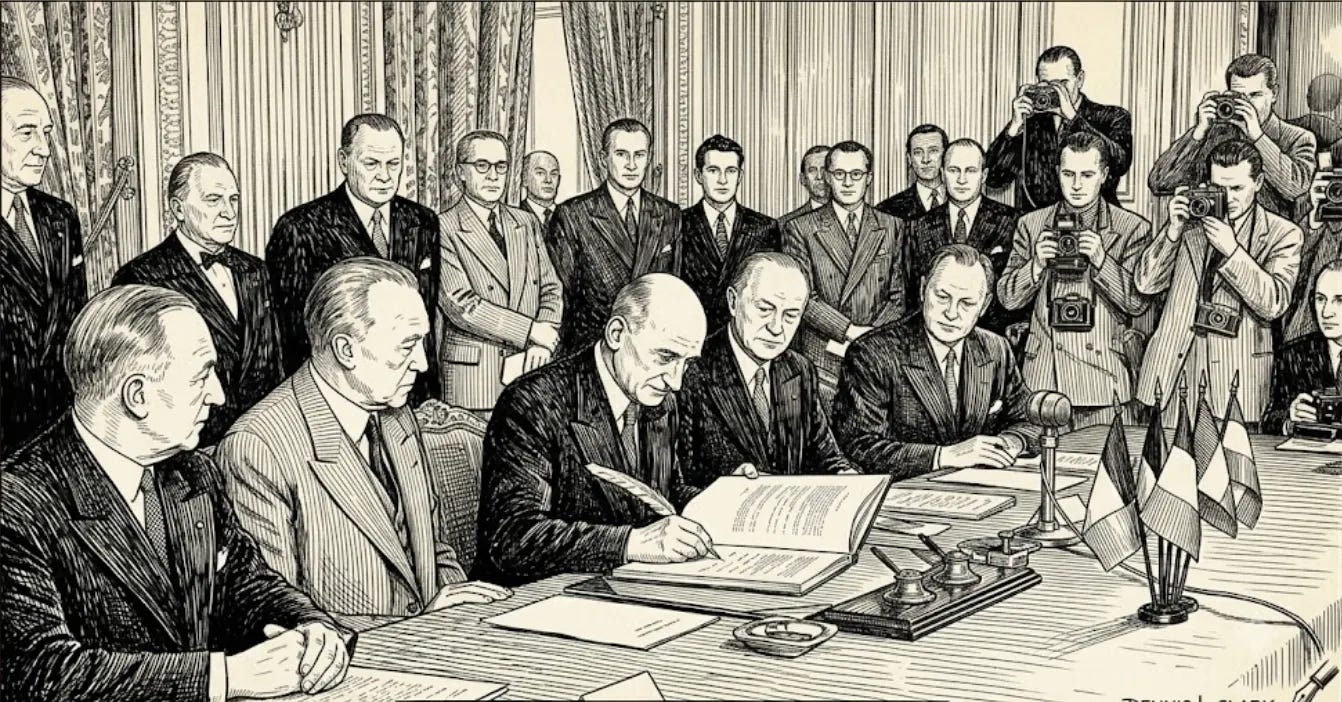
The destruction convinced leaders that the wars were caused by the system of independent nations. As long as each nation was fully independant and competing with all the other nations Europe would keep going to war. In 1950, the French foreign minister Robert Schuman, acting on a plan by Jean Monnet, proposed a fix. France and Germany would place their coal and steel production, the raw materials for war, under a joint board. Schuman said this would make war between France and Germany “not merely unthinkable, but materially impossible.”
The European Coal and Steel Community began in 1951 with six countries: France, West Germany, Italy, Belgium, the Netherlands, and Luxembourg. It worked so well that in 1957, the six nations expanded it into a common market for all goods. That market grew and expanded to include six more countries. A treaty signed in the Dutch city of Maastricht in 1992 created the European Union and set the path to a common currency, the euro, and continued economic integraton. But the EU kept its militaries seperate and built a foreign policy structure that allowed any nation to veto a policy. EU foreign policy requires unanimity and produces nothing when members disagree.
The Union brought together markets and money, sectors that made sense to combine because doing so yielded substantial benefits with only a relatively minor loss of sovereignty. But nations were not willing to combine their militaries or foreign policy decisions. Most nations were still operating from an in-group cultural perspective; they were loyal to and protective of their nations, not the Union.
Napoleon spread the idea of the nation, which drove the German states to unite in 1871 and annex Alsace-Lorraine, making France and Germany enemies and bringing about the First World War. That war led to Germany being punished, which in turn brought the Second World War. The devastation of that war convinced Europe’s leaders to bind France and Germany together through their coal and steel, which grew into the common market and then the European Union. They bound the economies, not the armies or foreign policy.
That is the Union that exists today: one market, one currency (for most members), twenty-seven nations, but no single army or foreign policy. The EU was built to end the wars between its members by integrating economies, and it worked. But it was not built to defend itself or act together with other nations, because the United States did that for them.
Friday’s edition brings this story to the present and beyond. With the Americans pulling out, can a union of sovereign nations finally become a federation that can defend itself and act under a united policy, or will it break apart into rival nations?
If you enjoyed this article, help support my work by becoming a paid subscriber or “Buy me a coffee.”
Get a solid understanding of Trompenaars’ cultural dimensions by purchasing the guide or subscribing to Cultural Perspective (free or paid) and receiving the guide for free.


