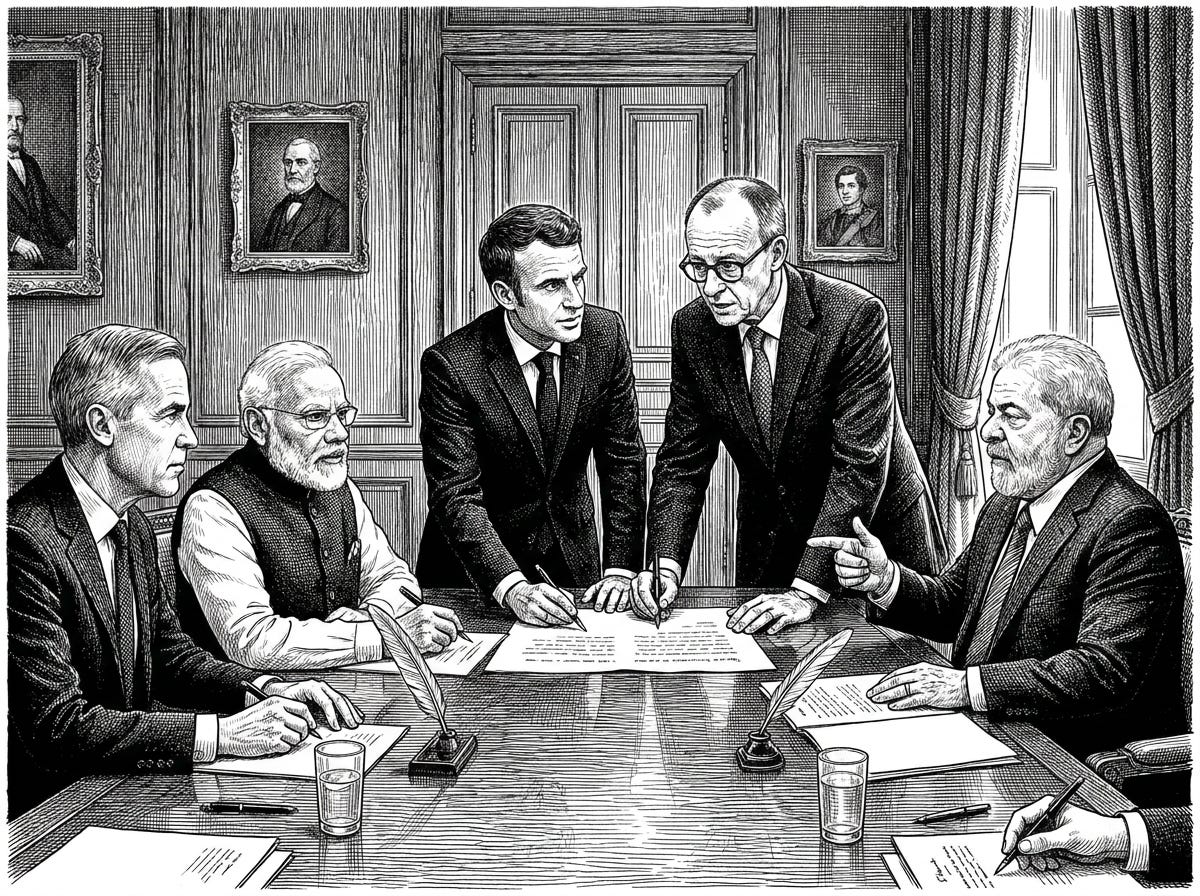
The Post-American Order: Macron and Merz Building the European Core. Friday’s Edition.
Building the system that comes next. Series 27 #3
Monday’s edition argued that the United States is no longer the center of the global system, and that five leaders are building its replacement. Wednesday’s edition showed Modi and Lula writing the rules for trade and money. Today covers the two leaders building the European core: Emmanuel Macron in France and Friedrich Merz in Germany.
Modi and Lula keep each deal flexible. They judge every relationship on its own terms and leave room to change course. Macron and Merz do the opposite. They build permanent structures, written into law and doctrine, that a future election cannot easily undo. One cultural perspective explains the difference: Hofstede’s uncertainty avoidance.
Uncertainty avoidance measures how a culture handles the unknown. High uncertainty-avoidance cultures feel threatened by uncertainty and respond by making rules, plans, and clear structures. France and Germany are both high uncertainty-avoidance cultures. They produce rules, laws, procedures, and institutions to mitigate the dangers and unpredictability of the world.
Friedrich Merz, Germany’s Chancellor, met the danger of Trump and the Republicans pulling back as a security guarantor, leaving Europe exposed with a rule change. Germany’s constitution capped government borrowing through a measure called the debt brake. In March 2025, Merz pushed through a constitutional amendment that exempts defense spending above 1 percent of GDP from that cap. Germany can now borrow without limit to fund its military, freeing it to rebuild into the strongest conventional army in Europe.
In May 2025, the first German brigade permanently stationed abroad since 1945 was established in Viliunis, Lithuania. Until then, NATO guarded the Baltic states with troops that rotated in and out every few months. Germany replaced that rotation with a more certain permanent garrison of 4,800 soldiers and 2,000 vehicles.
Amending the constitution and creating permanent deployment is the high uncertainty-avoidance answer to an uncertain world.
Emmanuel Macron, France’s President, met the same danger by writing doctrine. France is the European Union’s only nuclear power. For sixty years, that arsenal protected only France. Macron is extending it to cover European partners. In March 2026, he announced a new doctrine he calls Forward Deterrence: more warheads and, for the first time, French nuclear weapons based outside of France. Eight countries have asked to be included. That is how high uncertainty avoidance cultures work: Macron did not give a passionate speech or threaten Russia; he wrote a doctrine.
Macron introduced the Military Programming Law, which funds the military through a binding seven-year law. Most governments set defense budgets annually, so the money can be cut whenever priorities change. France’s Military Programming Law reduces that uncertainty.
The post-American order is being built by five leaders.
Carney is bringing together an alliance of middle nations, networks, trade pacts, and defense financing that bypass the U.S. (Monday’s Edition).
Modi and Lula are changing how trade and money flows, settling payments outside the dollar. (Wednesday’s Edition).
Macron and Merz are building Europe's permanent defense structure.
They operate from different cultural perspectives. This is what we should expect in a multi-polar world. The leaders who will succeed in the post-American world will be those who are knowledgeable and flexible enough to work across cultures.
If you enjoyed this article, help support my work by becoming a paid subscriber or “buy me a coffee.”
Get a solid understanding of Trompenaars’ cultural dimension by purchasing the guide or subscribing to Cultural Perspective (free or paid) and receive the guide free.


