The New Trade Map - No Americans Allowed. Monday's Edition
The trade map America isn’t on - Series 14 #1
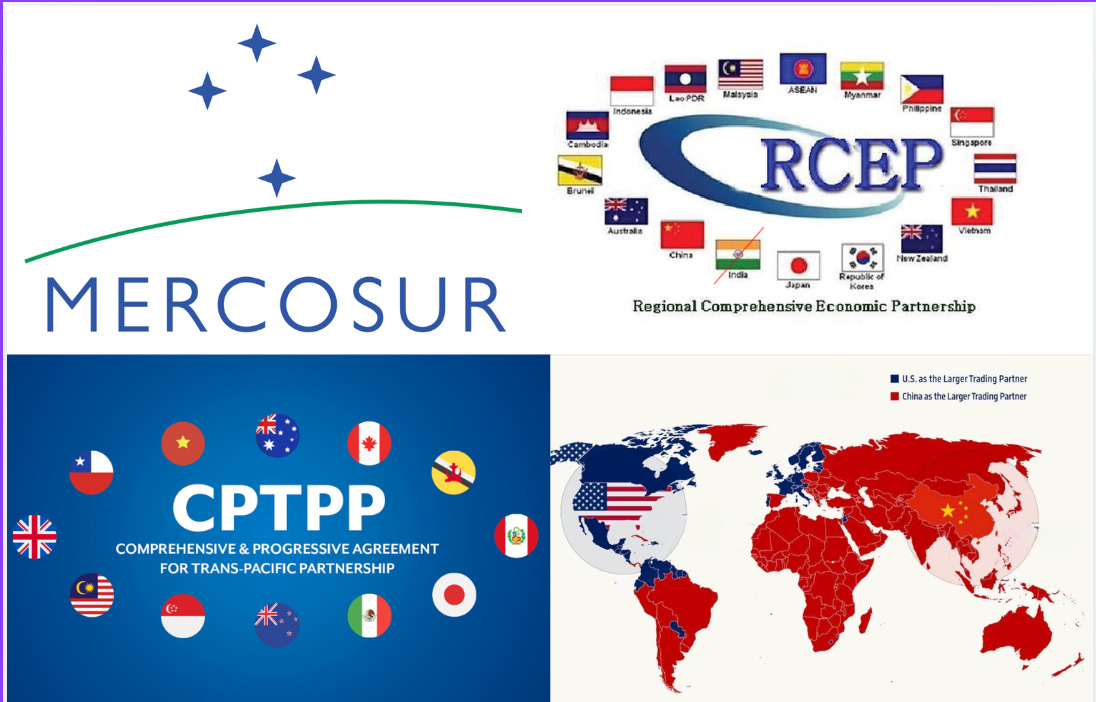
In October 2025, fifteen Asian nations met at the ASEAN summit in Malaysia. President Trump flew in, signed trade deals with only two of them, Malaysia and Cambodia, and declared victory for American workers. After he left, those fifteen nations continued negotiating RCEP, the Regional Comprehensive Economic Partnership, the world's largest trade bloc. RCEP was designed as an alternative to American-led trade and therefore does not include the United States.
The United States cannot join RCEP.
China proposed RCEP in 2011 as an alternative to the American-led Trans-Pacific Partnership. The United States was never included. RCEP now covers 30% of global GDP: China, Japan, South Korea, Australia, and all of Southeast Asia operating under common rules. It’s a significant loss for American companies and the US economy.
This pattern repeats across three continents.
The Trans-Pacific Partnership (TPP) that Trump abandoned evolved into the Comprehensive and Progressive Agreement for Trans-Pacific Partnership (CPTPP) and kept expanding. The UK joined in December 2024, the first European member. Costa Rica is preparing to join. Indonesia, the Philippines, and the United Arab Emirates may follow in 2026, and China and Taiwan have both applied. The U.S. designed the TPP specifically to increase American influence in the region, counter China’s growing influence, and boost the US economy. The TTP started with George W. Bush, was supported by Obama, and then Trump killed it. Now other nations are building on that foundation, gaining influence and economic power while American corporations watch with envy.
In January 2026, the European Union will signed a trade deal with Mercosur, the South American bloc of Argentina, Brazil, Paraguay, and Uruguay. After 25 years of stalled negotiations, Trump’s tariffs provided the final push. EU officials said it openly: this is diversification away from American protectionism. The agreement creates a free trade zone covering 780 million people.
China posted a record $1.2 trillion trade surplus in 2025. Exports to Latin America, Africa, and the Middle East grew faster than the global average. Trump's tariffs created the opportunity for China to build trade relationships with nations that Trump alienated.
Why is America being excluded from the world’s largest multilateral trade agreements? It’s America’s cultural perspective, and specifically that of Trump and the Republican Party. American trade policy operates on what cultural theorist Fons Trompenaars calls internal direction, the belief that forcing others gets results. While this worked in the past, it no longer works today; the world has moved on from coercion to cooperation. Trump’s tariffs are an extreme example of a throwback to that era of coercion that no longer exists.
The countries building these new trade networks without the U.S. operate under external direction. They work with circumstances rather than against them, and cooperation is preferred over bullying. Trump raised barriers, so they found other partners. China restricted rare earths, so Europe secured alternative sources in South America. The environment changed, and they adapted to it.
RCEP's membership includes historic rivals: Japan and South Korea, Japan and China, China and Vietnam, all trading under common rules. This reflects the collectivist and long-term oriented cultures that dominate the bloc. Hofstede's research shows these nations prioritize group harmony over confrontation and future positioning over past grievances. The diplomatic expression is what scholars call the ASEAN Way: consensus over coercion, economic cooperation compartmentalized from political disputes. They didn't resolve their conflicts, they agreed that trade mattered more than ancient history.
The material stakes are significant. RCEP covers 2.2 billion people and $29.7 trillion in combined GDP. The CPTPP connects 500 million people and $13.6 trillion. EU-Mercosur links 780 million people and roughly $20 trillion. The scale is unprecedented and leaves out American goods, American banks, American power, and the American people.
This week examines each development in detail. Tuesday covers RCEP, the trade bloc America cannot join. Wednesday looks at CPTPP, the deal America designed and Trump abandoned. Thursday examines EU-Mercosur, Europe’s hedge against both the U.S. and China. Friday analyzes China’s export pivot to the Global South. Saturday’s Core Brief asks what happens when countries trade without America, and what that means for the next several decades.
The trade map is being redrawn, and the U.S. is not on it
If you enjoyed this article, buy me a coffee!


American arrogance in assuming we’re the top influence is the wrong attitude. So much has been dismantled so fast and nothing but problems remain. Building is so much harder than tearing things apart.
Very well written clear article way better than most I have seen so far on any subject !