Singapore! The Wind, The Strait, And The Free Port. Monday’s Edition.
The Long Chain: Singapore. Series 33 #1
In January 2026, Singapore’s Maritime and Port Authority announced the port had moved 44.66 million container units, each counted as one twenty-foot box, the most in its history. The ships that stopped there bought a record 56.77 million tonnes of fuel while in port.
Singapore pumps no oil, digs no ore, and farms almost no land, yet its economy produces over $90,000 US dollars per person a year, the highest in Asia, one of the highest in the world. The usual story credits one man: Lee Kuan Yew, prime minister from 1959, said to have transformed a poor fishing village into a rich city. That’s not the whole story or, in many ways, the true story, because Singapore’s fortune began with the wind.
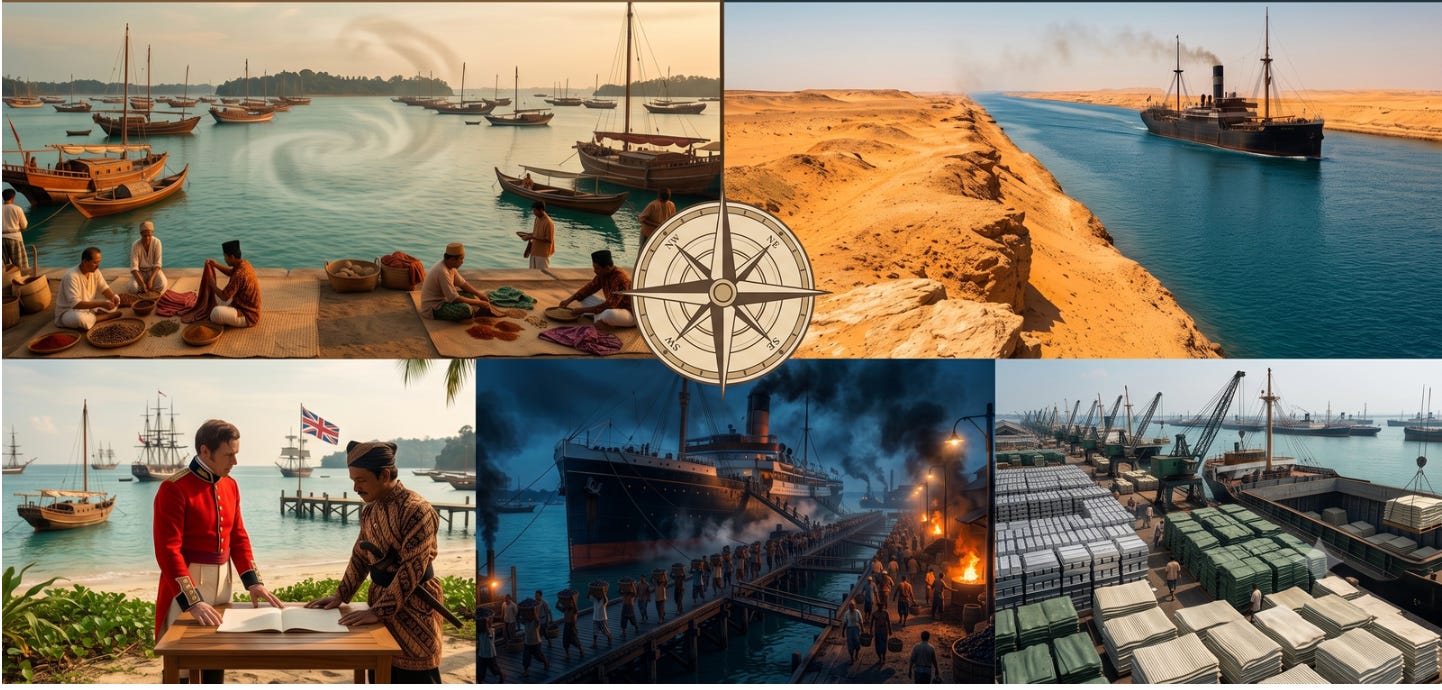
The winds over the Strait of Malacca, the strait between Malaysia and the Indonesian island of Sumatra, reverse twice a year: northeast in the winter, southwest in summer. A trading ship could sail with one wind from China or India down to the strait, but it could not sail home until the wind turned. That forced wait kept foreign traders in the strait’s harbors, and their trading made whichever port controlled the strait’s trade rich.
That wealth is why a series of powers wanted to control the strait’s shores. The kingdom of Srivijaya ruled the strait’s trade from Sumatra between the 600s and the 1200s. A walled trading town called Temasek stood on Singapore Island itself in the 1300s; a Chinese trader named Wang Dayuan described it in the 1330s, and archaeologists at Fort Canning Hill have dug up its Chinese ceramics, coins, and gold jewelry. Melaka, founded on the Malaysian shore about 1400, became the strait’s main trading city.
Because of Melaka’s wealth, Portugal seized the city in 1511; the Netherlands seized it from Portugal in 1641; and each taxed trade and kept rival ships out of its ports. British ships sailing between India and China paid fees to the Dutch in Dutch-controlled ports. Those fees drove Britain to build a port on the strait that it controlled. It sent Stamford Raffles, an official of the East India Company, Britain’s trading company in Asia, to establish a British controlled port. Raffles signed a treaty with the island’s Malay rulers on 6 February 1819 and opened Singapore as a free port: it charged no fees on goods that passed through.
Because it was a free port, traders moved from the Dutch ports to British Singapore. Singapore’s trade grew from 400,000 Spanish silver dollars, the currency of the time, in 1819 to about 8 million by 1821. Singapore’s first census, in January 1824, counted 10,683 people, nearly all of them newcomers, on an island where fewer than a thousand had lived five years earlier.
The ships in the early 1800s were wind-powered, but steamships and a canal were about to make Singapore much richer. The Suez Canal opened in November 1869, reducing the time between Europe and Asia by about a third; the shortest route now ran straight through the Strait of Malacca. The new coal-burning steamships on the new route had to refuel along the way, and Singapore, the route’s midpoint, was where they refueled. Singapore’s trade nearly doubled in one year, from 39 million dollars in 1869 to 71 million in 1870, and the number of ships stopping in Singapore rose from 164 a year to 623 within a decade.
Singapore also became a port for exporting raw materials. The Malay Peninsula produced more than half the world’s tin by about 1904. Henry Ridley, the director of Singapore’s Botanic Gardens, persuaded planters to grow rubber trees, producing more than half the world’s rubber by 1920. Most of these raw materials were sent to Singapore for shipment. By the early 1900s, Singapore was the world’s seventh-busiest port and a key component of the British Empire.
But the driving force behind Singapore’s success today is tied to the people. The population had grown from 10,683 in 1824 to 557,745 in 1931, with almost all of that growth due to new arrivals. Chinese, Indian, and Malay traders and laborers came to Singapore for opportunities but with no guarantees. That produced a population with a distinct cultural perspective: extremely low Uncertainty Avoidance. A trading port, where people come and go daily, most customers are strangers, and with people from distinctly different parts of the world, rewards exactly that cultural perspective, and the port kept attracting people who had it.
In the days of sailing ships, the winds forced traders to wait at the strait, which made the ports rich. One of the wealthiest ports was Melaka, and its riches are why Portugal and the Netherlands seized it. Their taxes drove Britain to open a duty-free port in 1819, and the free port took the region’s trade from the Dutch ports. The Suez Canal and the steamship increased trade, and the peninsula’s tin and rubber increased it even further, until the island was the world’s seventh-largest port. This attracted people who came with no certainty of work or success, people who accepted change, the unknown, and risk-taking. And that cultural perspective is what eventually produces a port that moved 44.66 million container units last year.
Wednesday’s Edition covers the three shocks that forced the rich port to build a modern state: Japan’s conquest in 1942, Malaysia’s expulsion of Singapore in 1965, and Britain’s 1968 announcement that its forces would leave.
If you enjoyed this article, help support my work by becoming a paid subscriber or “Buy me a coffee.”
Get a solid understanding of Trompenaars’ cultural dimensions by purchasing the guide or subscribing to Cultural Perspective (free or paid) and receiving the guide for free.


