Developmental State - The Transformation Model: Friday's Edition
Four government systems the deliver results
Western political theory preaches that democracy comes before prosperity. Establish rights, hold elections, build institutions, and success follows. This sequence feels natural to those from countries that industrialized a century ago.
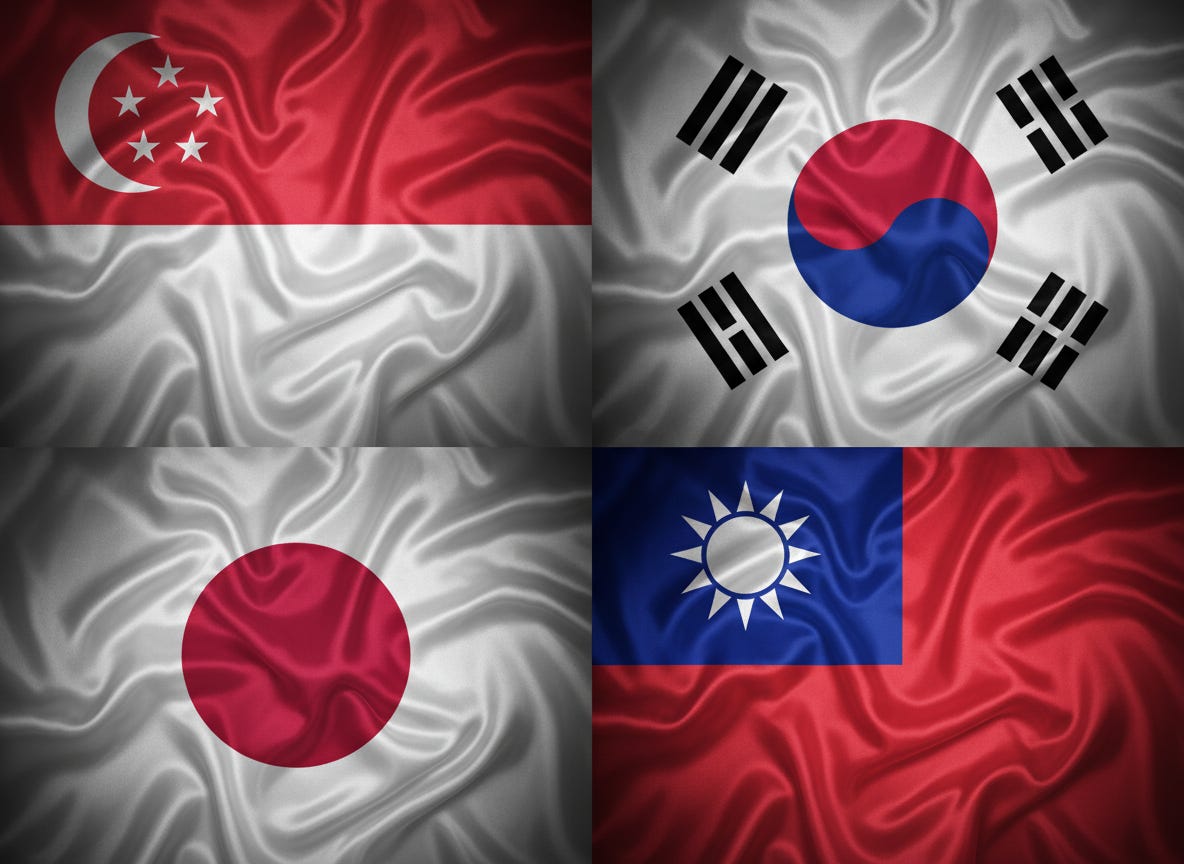
Singapore, South Korea, Japan, and Taiwan ignored this script. They grew rich first. Democracy came later.
These countries did not wait for democratic institutions. They built economies under centralized, technocratic leadership that made decisions quickly, planned in decades rather than election cycles, and prioritized national development over individual political expression. The results were the fastest economic transformations in human history.
Japan rebuilt from wartime devastation to become the world’s second-largest economy. South Korea went from a per-capita income lower than Ghana’s in 1960 to a G20 member with Samsung, Hyundai, and LG. Taiwan transformed from an agricultural economy to a semiconductor powerhouse that manufactures chips the entire world depends on. Singapore went from a small trading port expelled from Malaysia to a global financial center with one of the highest per-capita incomes on earth.
The defining factor is rapid development. These systems optimize for transformation: turning poor countries into wealthy ones within a single generation. What took Western nations a century, developmental states accomplished in thirty years.
These results did not emerge from copying Western models. They emerged from cultural alignment.
Hofstede’s research shows these societies score high on power distance. Citizens accept hierarchical leadership. A technocratic elite making economic decisions is not tyranny, it’s competent management in these cultures. Lee Kuan Yew governed Singapore for three decades. Park Chung-hee drove South Korea’s industrialization. These leaders exercised authority that would trigger revolt in low power distance countries. In high power distance cultures, it triggered compliance that worked.
Hofstede’s long-term orientation also applies. These cultures plan for and measure success across generations. A leader can sacrifice current consumption for future capacity. Citizens accept delayed gratification because the cultural expectation is that children will live better than their parents. Japan’s Ministry of International Trade and Industry planned industrial policy decades ahead. Singapore’s sovereign wealth fund invests for citizens not yet born.
Trompenaars identifies high collectivism in these societies. Individual political expression matters less than national advancement. The group, whether it be the family, company, or nation, is more important than the individual. Workers accepted long hours and modest wages because the collective project mattered more than personal comfort. This would be intolerable in individualist cultures. In collectivist cultures, it’s patriotism.
Hall’s high-context communication also plays a role. Government and business coordinated through relationships, informal guidance, and shared understanding rather than explicit contracts and regulations. Japan’s “administrative guidance” worked because bureaucrats and executives shared cultural assumptions. Written rules mattered less than mutual obligation.
These cultural traits map onto Hornby’s archetypes. The North (Power-seeker) archetype exercises authority and pursues social ambition through organizations. They rejected ideas that did not serve the national agenda and demanded results from their governments and citizens. The West (Sage) archetype values knowledge, precision, and expertise. Technocratic governance depends on educated planners making evidence-based decisions. Ministries staffed with the nation’s best graduates designed industrial policy based on data, not ideology.
The model has trade-offs. Political freedoms were restricted. Opposition was suppressed. Dissent was punished. South Korea’s industrialization occurred under military rule. Taiwan was governed under martial law until 1987. Singapore still restricts press freedom and political competition. The price of rapid development was paid in a loss of rights.
Three of these four nations have transitioned to democracy. Japan democratized after World War II, but retained developmental state economic coordination. South Korea held free elections in 1987 after achieving industrialization. Taiwan lifted martial law and became a full democracy. The developmental phase was temporary, not permanent. Singapore remains the exception, maintaining technocratic governance while delivering first-world outcomes.
This is the point. The Developmental State works where the culture already accepts hierarchical authority, long-term sacrifice, and collective success over individual expression. The institutions did not create these cultural perspectives. The cultural perspectives made the institutions.
Export this model to a short-term oriented culture that expects immediate results, a low power distance culture that questions authority, and an individualist culture that expects personal rights, and the machinery triggers revolt rather than compliance. The same restrictions that felt like discipline in Seoul would feel like oppression in Stockholm.
Tomorrow: What citizens should actually look for when evaluating governance.


