

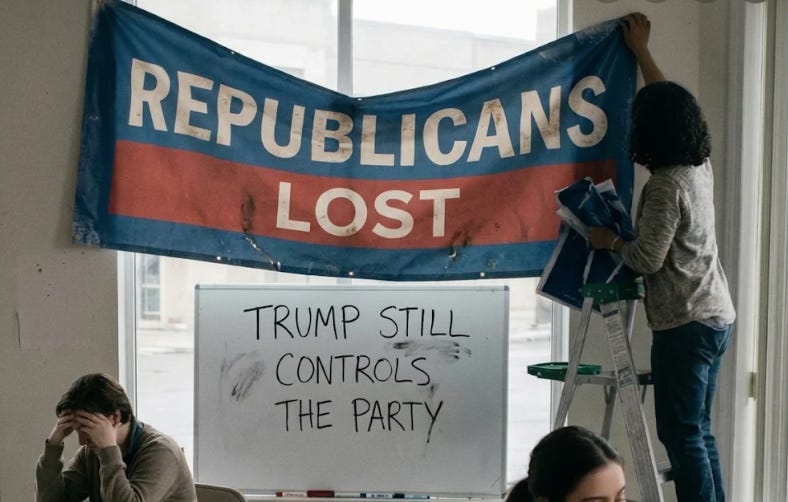
The Republicans lost Congress. Now the struggle is over who controls the Republican Party, and the first serious rebellion against Trump has begun.
Two days after Republicans lost control of Congress, KC Crosbie challenged Joe Gruters. This is pivotal because Gruters is Trump’s handpicked chairman of the Republican National Committee.
Crosbie demanded an accounting for the election defeat, which Trump knows will reflect poorly on him. Not surprisingly, Trump and Gruters’ supporters don’t like this. (Associated Press, 15 November 2026)
The fight matters because the RNC runs the party’s national election operation and helps determine the rules for selecting its next presidential nominee.
But here is the surprising part.
Crosbie is still a Trump supporter. She supports his MAGA agenda. She wants to replace Trump’s pick for chairman without abandoning Trump’s movement that caused the Republicans to lose.
Republicans are challenging Trump’s authority while defending his policies.
And that is their problem.
Republicans lost because of Trump’s tariffs and Trump’s war, which show up as higher prices for groceries, gas especially, and just about everything else. (Reuters, 22 November 2026)
Reuters examined 62 competitive congressional races and found that Republican candidates in 41 had broken with Trump on policy or played down their ties to him.
They knew associating with Trump could cost them the election. They tried to distance themselves from Trump without breaking with Trumpism. They lost anyway. (Reuters, 7 October 2026)
Trump has built a Republican Party where loyalty to him matters more than winning elections.
Republicans who challenge him risk losing their positions. They know their political careers depend on loyalty to Trump, even when they disagree with him. It’s Party before people.
Why is this happehing? It goes beyond politics. It is rooted in culture.
It’s High Power Distance, where leaders expect loyalty and followers are can’t challenge their authority.
The opposite is Low Power Distance, where leaders are challenged, have to answer for their decisions, and can be replaced when they fail.
This is why even after the Republicans lost Congress, they remain loyal to Trump, who led them to defeat. Now those same politicians face the consequences of remaining loyal.
That is the conflict between political survival and obedience to authority.
Another cultural perspective involves Uncertainty Avoidance, the degree to which people seek predictability and feel threatened by unfamiliar situations.
For Republican politicians, breaking with Trump means confronting an uncertain future.
They know what Trump does to those who turn him and it does not end well.
What they do not know is what happens to the Republican Party without Trump. So staying loyal avoids uncertainty, but it produces electoral losses.
Thus, Republicans face two dangers.
Challenge Trump and suffer the consequences.
Remain loyal and risk losing the voters they need to win elections.
America has seen this conflict before.
In August 1974, President Richard Nixon was fighting to survive the Watergate scandal.
For months, many Republicans defended him. But evidence of his involvement in the cover-up destroyed his support in Congress.
On 7 August, senior Republicans, Senator Barry Goldwater, Senate Republican leader Hugh Scott, and House Republican leader John Rhodes went to the White House to tell Nixon that his support in Congress had collapsed and that he faced certain removal if impeachment proceeded.
The following evening, Nixon announced his resignation. (Gerald R. Ford Presidential Library)
Nixon lost the presidency when his own party’s leaders stopped protecting him.
They did not abandon conservatism or the Republican Party. They separated their political identity from their loyalty to the president.
That is precisely what Republicans are struggling to do today.
The circumstances are different, but the cultural conflict is the same:
High-Power Distance against Low-Power Distance and High-Uncertainty Avoidance against Low-Uncertainty Avoidance.
The Republicans of 1974 eventually chose the party’s survival and their constitutional responsibilities above loyalty to Nixon.
Today’s Republicans have thus far chosen loyalty to Trump over the Constitution and at the peril of their party.
The Republican Party cannot solve the problem by changing the party chairman or even the president — the Republican Party must change.
That is why Power Distance and questioning authority matter. They help explain whether party members follow Trump, whose decisions have produced failure, or continue following him because of his position.
The most important consequence of the 2026 election is not that Democrats won power; it is that Republicans cannot regain power until they change the political culture that caused them to lose it.
If you enjoyed this article, help support my work by becoming a paid subscriber or “Buy me a coffee.”
Get a solid understanding of Trompenaars’ cultural dimensions by purchasing the guide or subscribing to Cultural Perspective (free or paid) and receiving the guide for free.
