

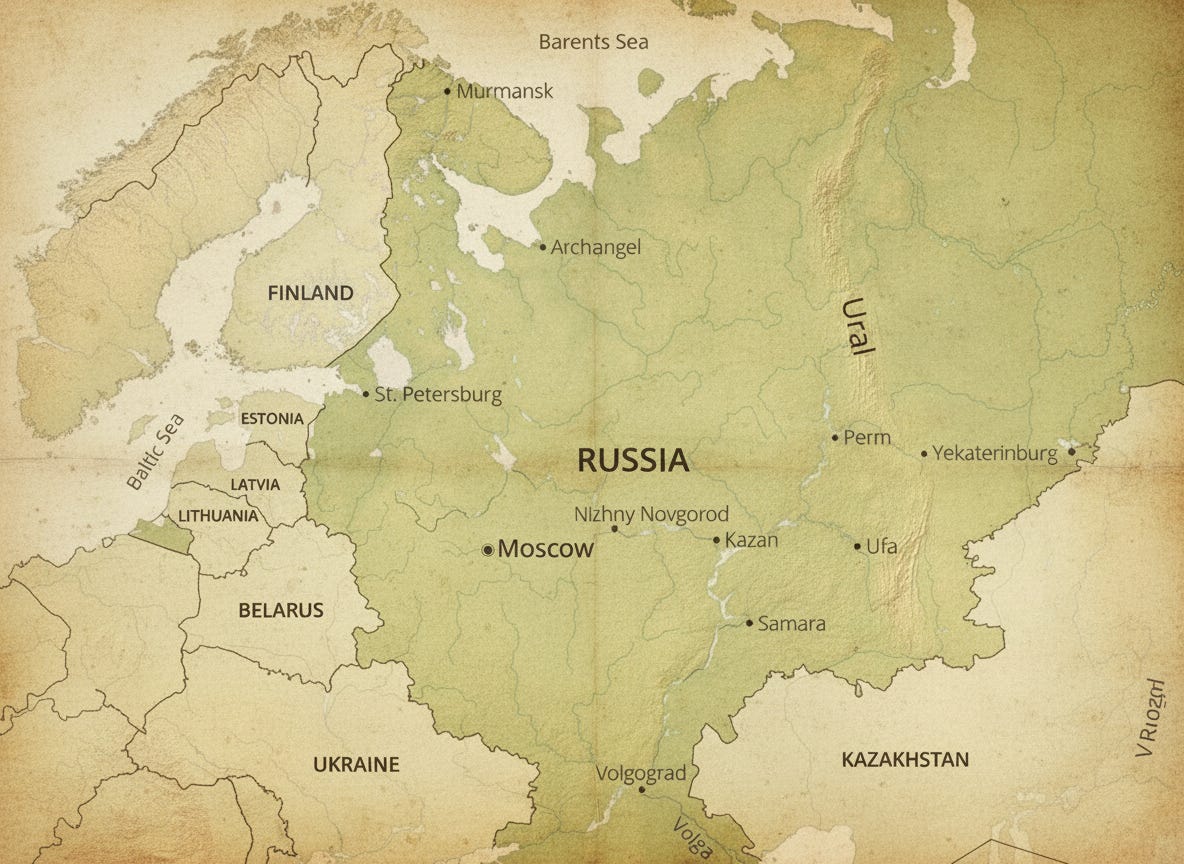
It’s not a secret that Russia wants its empire back.
Russia is the largest nation on Earth by land area. But it wants more. Putin invaded Georgia, Crimea, and Ukraine. Putin is expanding. But EU and, formerly, US support for Ukraine halted Putin in his tracks. The EU is both an obstacle to Russian expansion and the territory Putin wants. It’s not nations that hold back Putin, it’s NATO. So, will Putin attack NATO?
The specific question we are asking is, “Will NATO and the Russian military clash by the end of the year?”
To answer it, we will look at three frameworks: Russia’s historical patterns, M.J. Hornby’s archetypes, and the cultural dimensions that steer Putin, Russia, and the EU.
What “Clash” Means
“Clash” means direct military engagement between NATO and Russian military forces. This includes missile strikes, artillery fire, exchange of gunfire, or the shooting down of surveillance drones. Airspace violations, warning shots, cyberattacks, physical collisions without weaponry, and intercepting missiles targeting a third party do not count. Military contractors count only if operating under direct state command.
The Historical Pattern
Russian history is remarkably consistent with a cycle of: autocracy, collapse, brief openness, chaos, a new autocrat who restores order, repeat.
The Tsars had absolute rule over property and people for centuries. The system collapsed twice, each time followed by a moment of openness until new Tsars were installed. The final collapse came in 1917 and an open provisional government lasted months. The chaos brought Lenin and then Stalin, who imposed order through terror and control of property and people. The Soviet Union collapsed in 1991. Yeltsin’s decade of liberal democracy produced chaos. On December 31, 1999, Putin arrived as the next autocrat in the cycle.
Putin is in the consolidation phase, in which external aggression peaks and public support weakens. The consolidation began with Georgia in 2008, Crimea in 2014, and the full invasion of Ukraine in 2022.
Peter Hopkirk, in his book The Great Game, documents another driver. Russia’s geography. With no natural barriers to the west, Russia has been invaded from that direction repeatedly. The response, for centuries, has been expansion and the creation of buffer states. Hopkirk also documents Moscow’s fear of encirclement. From Russia’s perspective, NATO’s eastward is the encirclement Russia has feared for 300 years.
The historical cycle says Putin is in the expansionist phase, and NATO’s growth is the trigger that justifies it. Putin invaded Georgia, Crimea, and Ukraine, non-NATO states. Russia has never directly engaged a NATO member.
If you are enjoying this article, help support my work by becoming a paid subscriber or “buy me a coffee.”
The Archetypes
Putin aligns with what Hornby terms a North + Blue blend. The North component is the power-seeker: ambitious, dominant, controlling, he surrounds himself with people and ideas that serve his agenda. He dismisses those who disagree. But Putin is not Trump’s version of North. Trump is impulsive, shallow, and needs immediate visible wins. Putin is strategic.
The Blue Guardian component gives him an inner certainty that he is doing what is right, along with a suspicion of new ideas. Putin frames his authority through tradition and historical continuity. The “Russian civilization” narrative is his moral reasoning. The annexation of Crimea to “protect Russian speakers,” and the claim that Ukraine is historically part of Russia are expressions of the Blue archetype.
The Blue component is what makes Putin more dangerous than Trump, but more predictable. The North-Blue will not be humiliated, and the response will be calculated. Putin escalates when the escalation serves the larger strategic narrative, not when his ego is bruised.
This has a direct bearing on the question of the clash. The North-Blue archetype will push as far as the cost-benefit calculation allows. A direct clash with NATO is not a calculated move. It is a risky gamble. NATO’s combined military spending is roughly 10 to 12 times Russia’s. A direct engagement risks nuclear escalation. The North-Blue archetype does not take foolish risks. Putin’s pattern is to escalate against targets that cannot trigger a full NATO response: Georgia, Crimea, eastern Ukraine. He probes and tests, but does not cross the line where the cost becomes existential.
The exception is miscalculation. The North-Blue archetype’s weakness is overconfidence in its own strategic judgment. If Putin’s intelligence is wrong, if he misjudges NATO’s response, or if a tactical engagement escalates beyond what either side intended, the archetype’s strength becomes a liability. The 2022 invasion of Ukraine was itself a miscalculation. Putin expected Kyiv to fall in days. The North-Blue is capable of strategic error because the Blue Guardian is certain of their course of action.
The EU operates as a Blue + West institution. The EU’s institutional purpose is to do what is right as defined by rules, procedures, and treaty obligations, a true Blue. The West component demands data, evidence, impact assessments, and clear logical pathways before action. Brussels produces sequential, incremental analysis. It cannot think outside its own framework.
The institutional legal requirements, consensus across 27 member states, and exhaustive procedural steps make the EU incapable of starting a clash. It is also why the EU will not back down. Once the institution commits to a position, the Blue component follows through.
The Cultural Programming
Russia sits at the extreme end of what Schwartz calls Hierarchy: unequal power distribution is the organizing principle. One man decides whether Russia goes to war. The EU sits at the opposite end, Egalitarianism: power is distributed, every voice must be heard, and consensus is required before the institution moves. This single dimension explains more about whether a clash happens than any military assessment. Russia can escalate immediately because one person makes the decision. The EU must get 27 governments to align.
Schwartz’s second dimension reinforces this. Russia scores high on Mastery: the culture seeks to control and reshape its environment. This is the cultural root of the expansionist pattern Hopkirk documented: expansion, buffer states, and forward positioning. The EU scores toward Harmony: the culture seeks to fit within its environment, it responds to conditions. Mastery cultures start conflicts. Harmony cultures defend themselves.
Russia operates from what Trompenaars calls a particularist cultural persepctive. Rules apply differently depending on relationships and power. Putin makes agreements and breaks them when the strategic calculation changes. Under the Budapest Memorandum, Ukraine agreed to transfer all its nuclear weapons to Russia. In exchange, Russia pledged not to use military force against Ukraine. When the strategic calculation changed, Russia changed the rules.
The EU is universalist. Rules apply equally to everyone, and they cannot be easily changed. The EU follows the rules even when it harms the EU.
The Other Issues
NATO’s intelligence assessment is that Russia cannot attack NATO this year. Russia does not have the capacity to open a second front against NATO while sustaining operations in Ukraine.
The U.S. is the wild card. It is both deploying longer-range weapons in Germany and threatening to leave the alliance. If the U.S. pulls out of NATO, Putin’s cost-benefit analysis changes.
The Call And The Probability
The historical cycle puts Putin in the external aggression phase. But every act of aggression was against non-NATO states. Putin’s North-Blue archetype is strategic and calculated. A direct clash with NATO is a gamble. Russia’s military is committed to Ukraine and lacks the capacity for a second front. The U.S. is still deploying weapons on NATO’s eastern flank but publicly stating it may withdraw from the alliance.
The North-Blue archetype’s weakness is overconfidence. This makes miscalculation the most plausible path to a clash.
