

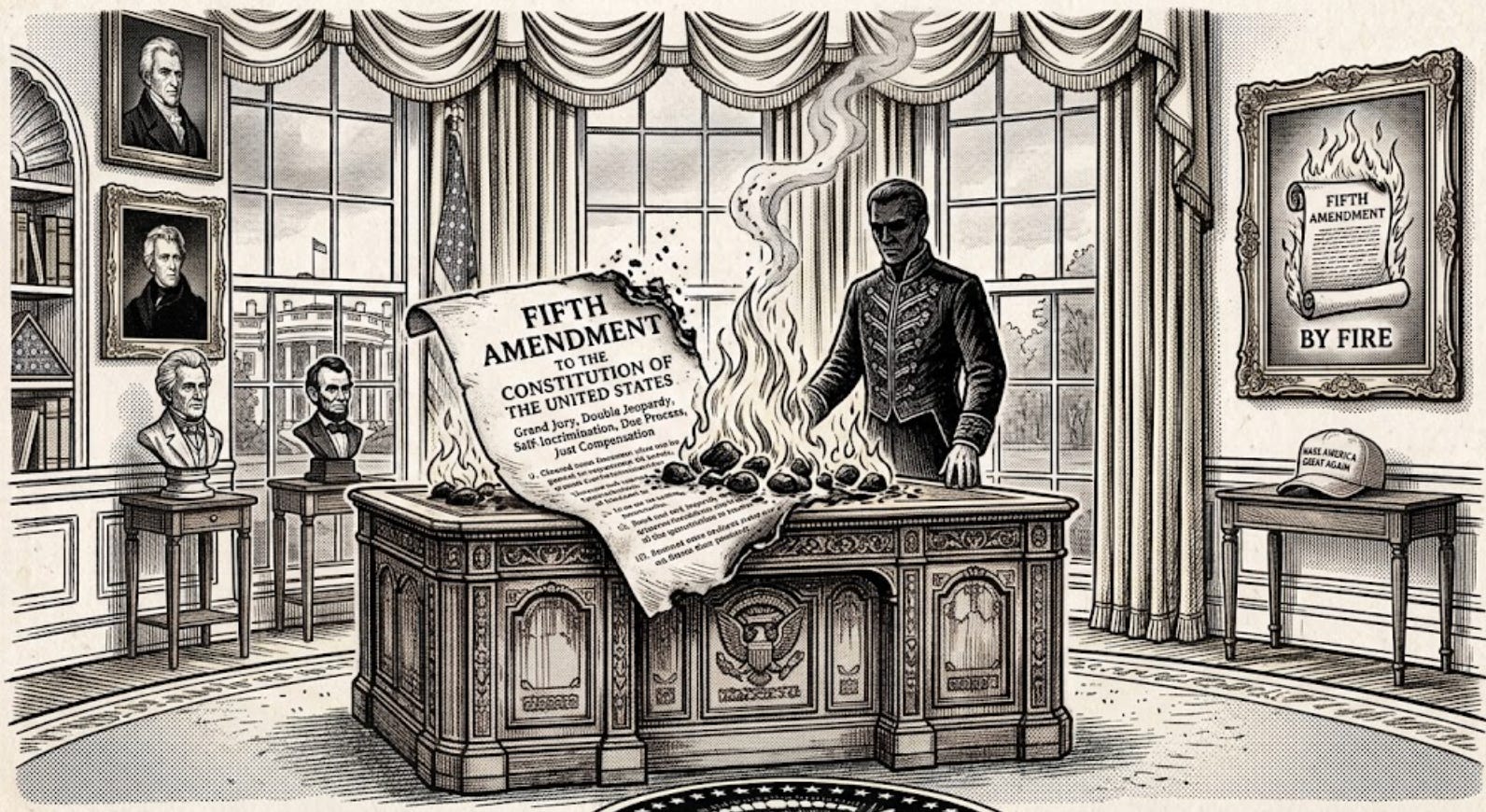
Do the Americans want a repressive, authoritarian-style government such as Russia, North Korea, or Turkey, or a free America?
The 5th and 14th Amendments of the U.S. Constitution, along with court interpretations, are key components of maintaining a free America. Trump and the Republicans would like them to go away. The latest iteration was Trump attempt to ban CNN, MS NOW, and Politico from the White House.
Authoritarian control depends on punishing people arbitrarily, without explanation, and with no recourse for those targeted. That’s exactly what the amendments and court cases protect against in the U.S. Currently, before the government takes away a benefit, the Due Process Clause in the 5th Amendment requires it to give the reason, follow published rules, and allow those targeted to respond. If Trump and the Republicans can get the appeals courts or the Supreme Court to uphold Trump’s press ban (a lower court blocked it with a temporary restraining order on September 24), it weakens the law that protects all Americans.
Here is a small sample of what Trump could do with that power:
End the payments of a retired worker who spoke at an anti-Trump rally.
Revoke a journalist’s passport while she is reporting abroad, which leaves her unable to travel.
Fire a career scientist the day after her research contradicts a White House statement.
Revoke the license of a local television station owned by a network that criticizes Trump.
Cancel a university’s research grants the day after its students protest the administration.
Revoke the status of a voter-registration group before an election. Donors lose their tax deduction, and the group loses its funding.
Without the protections currently in place, Trump and the Republicans can effectively put down most political opponents. And that’s exactly what they are testing with the latest press ban. The administration has lost most of these fights. That is not a reason to relax. That's why the protections matter. In each loss below, a judge stopped the government because it skipped the reasons, rules, or hearing that due process requires. In the two cases it won, the targets lost their access or were deported. The administration keeps testing because it needs only one Supreme Court win to set a rule that applies to every American. Here is the pattern:
November 2018: The White House revoked CNN’s Jim Acosta’s pass after he argued with Trump at a press conference. Judge Timothy Kelly ordered the pass returned because the White House violated Acosta’s due process rights. Trump lost.
August 2019: Press Secretary Stephanie Grisham suspended Playboy reporter Brian Karem’s pass for 30 days. A federal appeals court ruled the White House violated Karem’s due process rights. Trump lost.
February 2025: The White House barred the Associated Press from the Oval Office and Air Force One after the AP used “Gulf of Mexico.” An appeals court let the ban stand. Trump won.
April 2025: A lower court ruled the administration’s deportation of Abrego Garcia to El Salvador violated due process. The Supreme Court ordered the government to facilitate his return. Trump lost.
March 2025: Trump signed an executive order against the law firm Perkins Coie. Judge Beryl Howell struck it down because, among other items, it violated due process. Three other targeted firms also won. Trump lost.
16 May 2025: The Supreme Court ruled that deporting Venezuelans under the Alien Enemies Act with about 24 hours’ notice violated due process. Trump lost.
May 2025: DHS revoked Harvard’s certification to enroll international students. Judge Allison Burroughs blocked it the next day because it violated due process. Trump lost.
June 2025: The Supreme Court let the administration deport migrants to third countries without the notice and review a lower court had required. Trump won.
12 January 2026: Judge Amit Mehta ruled the Energy Department violated the equal protection guarantee of the Fifth Amendment when it canceled clean energy grants based on how states voted in 2024. Trump lost.
27 August 2026: Judge Rita Lin ruled the Pentagon’s designation of the AI company Anthropic as a supply chain risk violated due process. Trump lost.
This is not a comprehensive list.
Due process is a cultural choice written into law. It is Trompenaars’ Universalism in practice, where the government follows the law. The other choice is Particularism, where the government decides the law based on who the target is. Universalism and Particularism are reinforced by GLOBE’s Power Distance: whether a society expects power to be shared and leaders to answer to the public, or accepts that those at the top rule without explanation. Low Power Distance societies expect equal treatment and a say in government. A government that punishes people without giving reasons or a hearing is acting on High Power Distance.
This is the choice America must make: a free, Universalist, Low Power Distance government and society or a Republican, Particularist, High Power Distance dystopia.
The upside is that when culture drives the outcome, we have a good idea of what will come next.
Friday’s Edition: America’s choice: Trump - anger, threats, and revenge or America - institutions, law, and dignity.
If you enjoyed this article, help support my work by becoming a paid subscriber or “Buy me a coffee.”
Get a solid understanding of Trompenaars’ cultural dimensions by purchasing the guide or subscribing to Cultural Perspective (free or paid) and receiving the guide for free.
