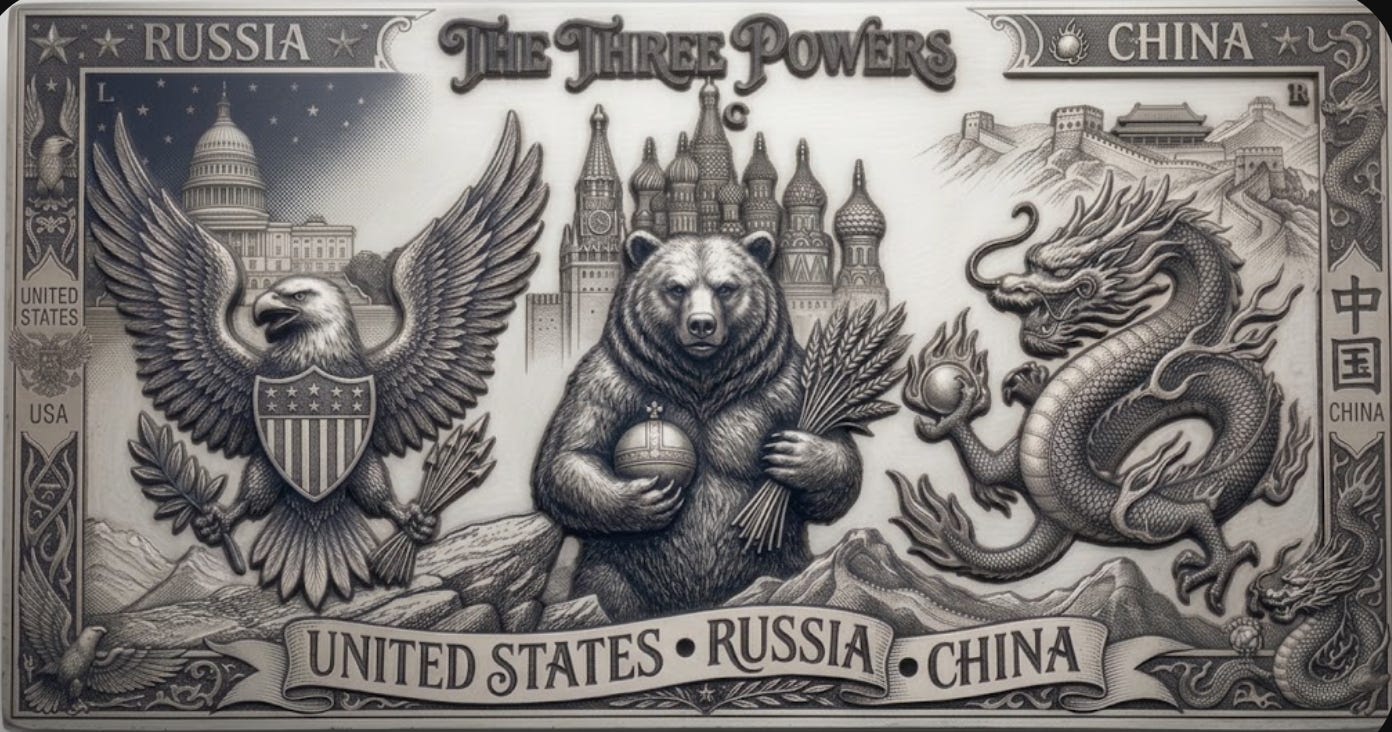
Why The U.S. Rules And Russia And China Do Not. Russia's System. Wednesday's Edition.
The Long Chain: Three Powers, Three Systems. Series 38 #2
Russia is a Particularist, Ascription-based, and Traditional (personal) authority culture. That means:
it applies the rules and laws based on who is involved, not equally to everyone - Particularist (Trompenaars)
it treats one’s position as inherited through family, age, and connections, not by accomplishments - Ascription (Trompenaars)
it places authority in leaders, not in the institution they run - Traditional (personal) authority (Weber)
Monday’s Edition, on how the US built a system nations join by choice, showed that the United States is the opposite of Russia’s three traits:
it applies its rules equally
it lets status be earned
it places authority in its institutions.
Those three opposite traits let other countries join the American system by choice.
Russia’s three traits come from a different cultural perspective, and they build the opposite kind of system, one that countries join only under force and leave the moment they can. Together they describe one cultural perspective: in Russia, the ruler is the rule. The ruler decides what happens regardless of what any written agreement states
What those three cultural perspectives built
After World War Two, the Soviet Union installed communist governments across Eastern Europe and tied them to Moscow through Comecon, an economic bloc it created in 1949, and the Warsaw Pact, a military alliance it created in 1955.
In the American system, the rules bound Washington as much as everyone else (Universalism), so a small country could trust them. In the Soviet system, the rules bound the members but not Moscow. (Particularism). Membership was not a contract a country could hold Moscow to. It was obedience to whatever Moscow decided, and Moscow could change the rules at any time.
Ascription fixed each member’s place. In the American system, a country’s influence grew as its economy grew, which gave members a reason to stay and build. In the Soviet system, Moscow’s position at the top was fixed, and no member could earn a greater say by performing well. Loyalty and effort changed nothing, so no member had a reason to stay once they could leave.
The rules were whatever the Soviet Union’s leader at the moment said they were (Traditional (personal) authority). When a member tried to loosen Moscow's control or leave, Moscow answered with force, then wrote the rule afterward. Warsaw Pact troops invaded Czechoslovakia on the night of 20 August 1968. Five weeks later, the Soviet newspaper Pravda published an article claiming Moscow could send troops into any communist country whose government moved away from communism. Leonid Brezhnev repeated the claim in a speech in Warsaw on 13 November 1968. Western governments named it the Brezhnev Doctrine.
Together, these three traits built a system in which a member nation could not leave and could not change the system from the inside. The only way to push back was open revolt, and Moscow met revolt with troops. East German workers rose against their government in 1953, and Soviet tanks crushed them. Hungary tried to leave the Warsaw Pact in 1956, and the Soviet army invaded and killed thousands. Czechoslovakia’s government tried to loosen the system in 1968, and Warsaw Pact tanks ended the attempt. Each invasion proved the same fact: the system held because Moscow would use force, not because members wanted to belong.
When Moscow stopped using force, the system collapsed. Mikhail Gorbachev canceled the Brezhnev Doctrine, and in 1989 his government announced that Moscow would no longer send troops to keep the Eastern European governments in power. His spokesman called this the Sinatra Doctrine, after the song “My Way”: each country could go its own way. Removing the threat of troops removed the system’s only support, and the members left within months. Poland held a partly free election in June 1989, and its communists lost every contested seat. East Germans tore down the Berlin Wall in November 1989. Czechoslovakia and Romania removed their communist governments by the end of the year. With the members gone, the shared institutions collapsed: Comecon, the Soviet bloc’s trade organization, dissolved in June 1991; the Warsaw Pact in July 1991; and the Soviet Union itself in December 1991.
A culture that gives all authority to the ruler, applies the rules by relationship instead of equally, and fixes each nation’s position instead of letting it be earned built a system that no member had chosen and none could improve. Force was the only thing keeping members in. The moment Moscow stopped using force, every member left, and the system Moscow had built by force was gone in less than three years.
Friday’s Edition covers China, which is building a different type of system with a cultural perspective closer to Russia’s.
If you enjoyed this article, help support my work by becoming a paid subscriber or “Buy me a coffee.”
Get a solid understanding of Trompenaars’ cultural dimensions by purchasing the guide or subscribing to Cultural Perspective (free or paid) and receiving the guide for free.


