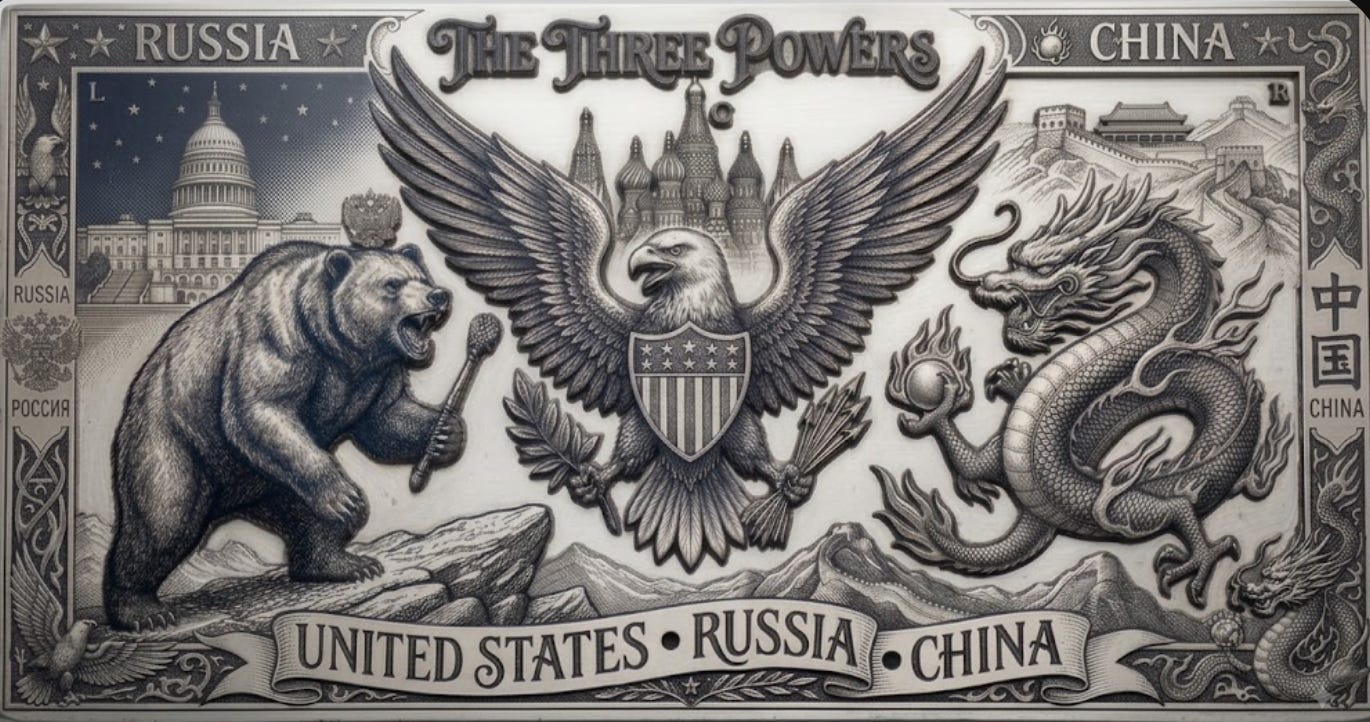
Why The U.S. Rules And Russia And China Do Not. The System. Monday’s Edition.
The Long Chain: Global Power And Culture. Series 38 #1
The United States is a Universalist, Achievement-based, Rational-legal authority, Specific, Low Context culture. In plain terms:
it applies rules and laws equally to everyone - Universalist (Trompenaars)
it requires status to be earned instead of inherited - Achievement (Trompenaars)
it puts authority in institutions rather than the people who run the institutions - Rational-legal authority (Weber)
it lets strangers do business without building a relationship first - Specific (Trompenaars)
it writes its rules down plainly enough that a foreigner understands them without a cultural insider to translate - Low Context (Hall)
Those five traits are the requirements for building a modern system other countries will join without being conquered. Russia wants this but has resorted to conquering by force. China wants something similar but lacks some of the key components.
Fons Trompenaars, a Dutch cultural theorist, found the strongest Universalism in the United States, Canada, Britain, Sweden, and Switzerland. He tested it in part by asking whether a person would lie under oath to protect a friend who hit a pedestrian while speeding, or follow the law and tell the truth. Respondents in Universalist countries said they would follow the law and tell the truth. Respondents in Russia and China, among others (Particularism) were far more likely to lie to protect their friend even though it violated the law.
Trompenaars measured the second trait by asking where respect comes from. In an Achievement culture, a person earns respect by what they accomplish. In an Ascription culture, respect comes from family, age, gender, and connections, and a person born into the wrong family cannot earn their way out of it. The United States is an achievement culture. China is an ascription culture, and Russia sits closer to the ascription side.
Max Weber's Rational-legal Authority describes a system where obedience is owed to the office and the written law, not to the person holding the office. The United States runs mostly on rational-legal authority. China and Russia run mostly on Personal Authority, in which the person in charge decides what the rules are, and the rules change when he does.
Trompenaars measured the fourth trait asking: If your boss asks you to spend Saturday helping paint his house, do you have to go? In a Specific culture, the answer is no, because the boss’s authority is only at work. In a Diffuse culture, the answer is closer to yes, because a boss is a boss in all aspects of life. Americans mostly refuse. Chinese and Russian respondents are far more likely to help paint the house.
The anthropologist Edward Hall named the fifth trait. In a Low Context culture, meaning is explicit in the words. In a High Context culture, meaning is derived significantly from the context of the situation, shared history, and unspoken understanding, and less so from the words alone. The United States is Low Context; Russia and China are High Context.
M. J. Hornby’s archetypes describe the behavior those five traits produce. The United States acts as a North Power-seeker, making decisions based on the West Sage’s information and is disturbed by the East’s communication and drive to connect people. Russia acts as a North Power-seeker, but makes decisions based on the Blue Guardian's established order and is disturbed by the Blue Guardian's directives and drive to punish anyone who deviates. China also acts as a North Power-seeker, making decisions based on the West Sage's accumulated knowledge and is disturbed by the Blue Guardian's insistence and intolerance for deviation
What those five traits built
The United States brought delegates from 44 nations to a hotel in Bretton Woods, New Hampshire, in July 1944 to set the rules for a new global economy. American economic power is why the United States could write most of the rules. Universalism explains why it wrote rules that apply to everyone, including itself (usually). Because the rules bound the United States (Washington could block changes because of its large voting share), countries the United States did not control could accept them, which made joining the new American global system a choice instead of a surrender. Twenty-nine governments ratified the agreement.
Universalism made the rules the same for everyone, so a small poor country got the same exchange rate obligations as a large rich nation. A government signing in 1945 did not have to trust American goodwill, because the contract was clear, and the contract bound Washington too.
Achievement made a country’s influence something it could change. Each member received 250 basic votes plus one more vote for every 100,000 dollars of its quota, so a member that achieved a larger quota received more votes. Japan and the UK had been enemies seven years earlier. Japan joined the same institutions in August 1952 and gained voting power as its economy grew, until Japan held the second largest share (along with Germany) by 1992. A country’s history did not determine how much influence it had. Its achievement did.
Rational-legal Authority meant the rules did not change when the leader changed. Roosevelt died in April 1945, and Truman's government signed the agreements in December 1945. The commitment Roosevelt made outlived the president who made it
Specific culture made the deal narrow. Membership required a declared exchange rate, a quota payment, and regular economic data. It did not require an alliance, a political system, or a permanent friendship. This is why India joined in 1945 while opposing American foreign policy for the next forty years.
Low context made the terms clear. The Articles of Agreement stated the obligations in writing, so a finance ministry in Cairo or Santiago could calculate the cost of joining without an American in the room to explain what the words “really” meant.
Together, those five cultural perspectives removed many of the reasons a government had to refuse. Government officials could read the terms in writing, calculate what membership would cost, join without changing their country’s political system, count on the terms holding after the next American election, and gain more voting power later by achieving more. The United States did not need to force anyone. Countries that joined gained from the system.
Wednesday’s Edition covers the system Russia built and why its members left as soon as Moscow could no longer force them to stay.
If you enjoyed this article, help support my work by becoming a paid subscriber or “Buy me a coffee.”
Get a solid understanding of Trompenaars’ cultural dimensions by purchasing the guide or subscribing to Cultural Perspective (free or paid) and receiving the guide for free.


