

On Monday, 29 June 2026, the United States and Iran pulled back from a weekend of trading missile and drone strikes and agreed to stop shooting. American officials said ships could again sail freely through the Strait of Hormuz. Iran said the opposite: the strait was still closed by its order, and any ship that wanted to pass had to follow Iran’s instructions and pay Iran a fee. The two governments could not agree on the most basic fact about the strait: whether it was open or shut.
They cannot agree because they are not arguing about the same thing. For the United States, the strait is an international strait that must remain open to all nations under a single rule (universalism). To Iran, the strait is its territorial waters subject to its rules (particularism), and after two centuries of foreign control, it is a matter of honor (honor culture).
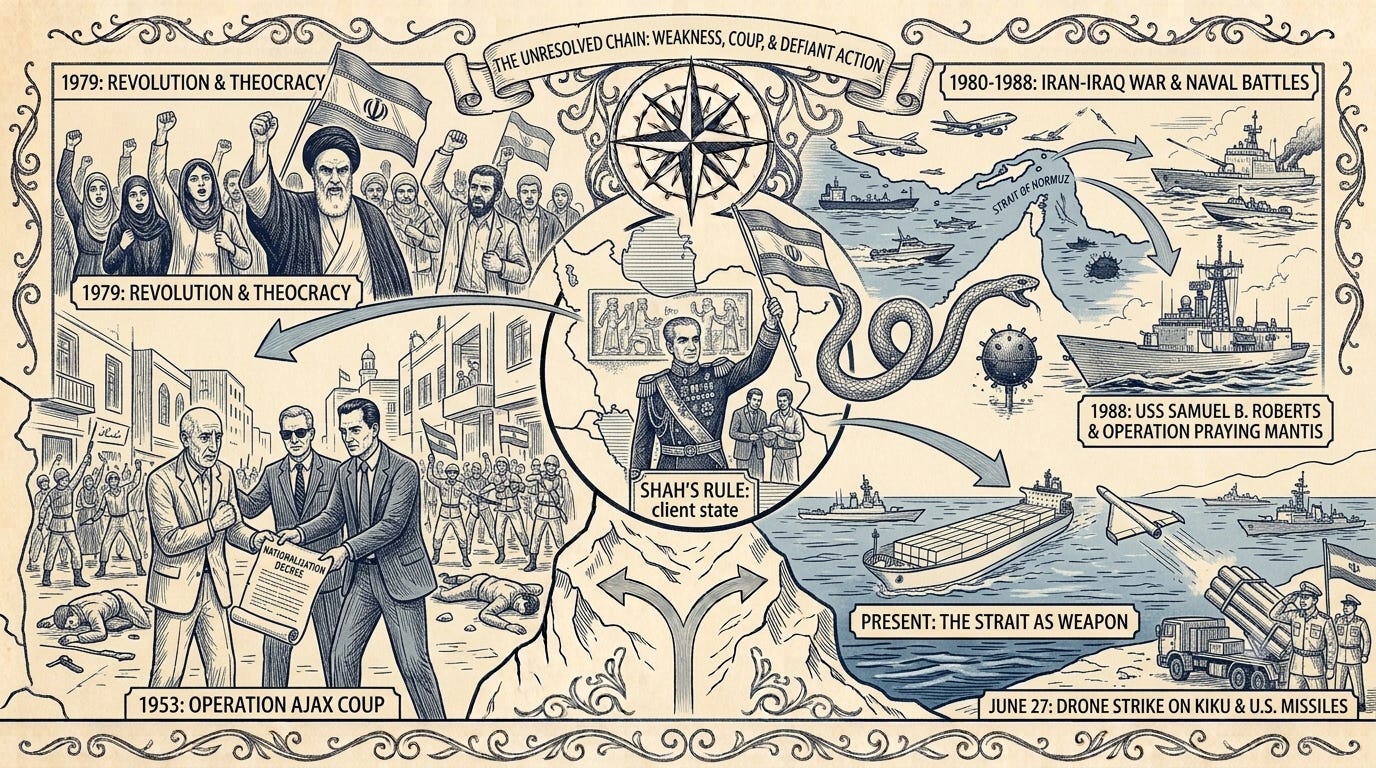
Because Persia was weak and Britain needed the Gulf to guard its route to India, Britain took control of the Gulf in 1820, and a broke Persia sold its oil to a British company, so by 1909 foreigners owned Iran’s oil and its only way to the sea. Because the postwar world ran on rules, Iran tried to regain control by law, nationalizing its oil industry in 1951 and winning a case at the World Court in 1952. Because Britain could not win by the rules, it and the United States overthrew Iran’s government in 1953. That betrayal taught Iran that the West’s rules don’t apply whenever the West wants something, so Iran turned to force: the 1979 revolution and, in the 1980s, the first use of the strait as a weapon.
This is why the 2026 crisis runs in a loop. The United States or Israel strikes Iran, Iran retaliates at the strait with drones, mines, and closure orders, the United States sends warships to reopen it, and both sides pause to talk, exactly as they did this week. Iran’s demand on June 29 that ships obey its orders and pay it a fee is the whole pattern in one move: Iran cannot yet control the strait outright, so it charges a toll to control who can and cannot pass through.
Here is what comes next.
