Why The Strait Of Hormuz Is So Important. Persia, Britain, And Oil. Monday’s Edition.
The Long Chain: The Strait of Hormuz. Series 32 #1
On Saturday, June 20, 2026, Iran’s Revolutionary Guard declared the Strait of Hormuz closed. It blamed Israel’s strikes in Lebanon and the United States for letting a ceasefire collapse. The United States Central Command said the strait was open and counted 55 merchant ships crossing that day. Independent ship trackers counted far fewer, 12 vessels. About one-fifth of the world’s oil is transported through this strait, 21 miles wide at its narrowest point, and the only sea route out of the Gulf. Iran declared the strait closed, the US declared it open, and the ship counts did not agree.
How did this channel gain the power to change the price of oil in every country? Why does Iran proclaim the right to close it? Why does the United States proclaim the right to keep it open? The answer starts more than two hundred years ago, with two cultures that disagree about how the Persian Gulf and the Strait should be controlled and how to address issues dating back 200 years.
Persia, now called Iran, is one of the oldest nations on earth. For about 2,500 years, it has been an empire or nation, and it has claimed the Gulf along its southern coast as its territorial waters. The maps still carry the name: the Persian Gulf.
Cultural researchers Kwok Leung and Dov Cohen identified three types of cultures: honor, dignity, and face. In honor cultures, a person's or a nation’s dignity, honor, and worth come from recognition by others. When there is a dispute, that dispute is settled by direct action to ‘win’ back one’s honor. Horon cultures take issues ‘personally’. For Persia, now Iran, losing control of its historic and legal territorial waters is more than a loss of control; it’s a loss of honor. That control, that honor, was taken from Persia by a stronger empire.
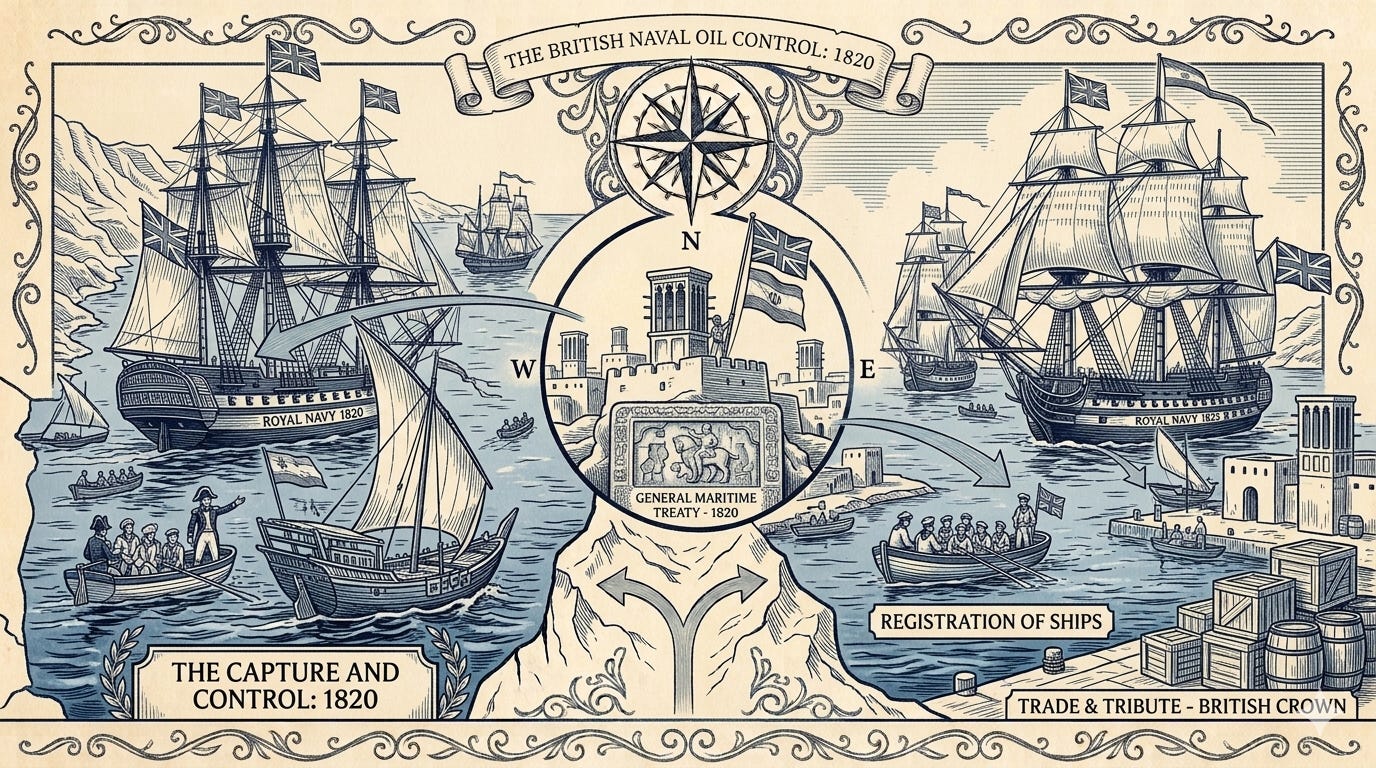
British corporations controlled India in the early 1800s and needed the sea route between Britain and India open and safe. To do that, Britain sent a fleet from Bombay in 1819 against the Arab rulers on the southern side of the Gulf, and in January 1820, it forced them to sign the General Maritime Treaty. That treaty gave Britain control of all shipping in the Gulf. Every ship had to register with British forces and fly a flag approved by Britain.
Britain felt it could take control of the Gulf in part because of its Universalist cultural perspective. Universalism is the belief that there are universal rules that apply to everyone and every nation equally. Britain’s Universalist perspective views the sea as a shared waterway, open to all ships that obey the laws of the sea equally. Britain, the strongest navy at the time, kept it open. Persia came from the opposite cultural perspective, Particularism. Particularism considers each case individually based on relationships, circumstances, and status. For Persia, the Gulf was theirs to control because of its history and status, and they, not a law, decided who could and could not pass through. This resulted in the British navy controlling the Persian Gulf, and for an honor culture, that control was a humiliation.
The British navy was able to control the Gulf because Persia was weak at that time. The weakness was not only military, Persia was also short of money, and it raised cash by selling mineral rights to Europeans. This was the time when oil was becoming a serious candidate to replace coal. In 1901, the Shah sold the sole right to drill for oil across three quarters of the country to a British investor named William Knox D’Arcy. For seven years, the drillers found nothing until 26 May 1908, when D’Arcy’s company struck oil that shot more than 80 feet into the air. It was the first oil field in the Middle East. Under the terms, Persia kept only 16 percent.
That discovery proved Persia held vast amounts of oil, and the right to pump and sell it belonged to D’Arcy and his London investors. They formed the Anglo-Persian Oil Company in 1909, registered in London. Persia’s oil was now controlled by Britain, as was Persia’s gulf.
One of the oldest states on earth had effectively lost its mineral resources and its historic control of the Persian Gulf. These humiliations still drive Iran’s actions because Persia had lost its honor, and honor demands that what was taken be returned. This is why Iran and the West cannot agree on who controls the Strait.
Most Western nations operate from a Dignity culture, where each nation’s worth is held within itself. Recognition from others is not necessary. When there is a dispute, that dispute is settled by courts, treaties, and written rules. It’s not ‘personal’. From a Dignity and Universalism view, British control of the strait was just a change in power, the law supported it, and everyone was treated the same. From an Honor and Particularism cultural perspective, Britain took the Gulf and Persia must act directly and regain control. Every time Iran closes the Strait, it is taking back the control that London took in 1820 and 1909.
Two hundred years ago, Persia was weak and in need of money. This enabled the British navy to take control of the Persian Gulf, which it needed to secure the sea route to India for British companies. The Anglo-Persian Oil Company was able to purchase mineral rights and control Persia’s oil at a time when oil was becoming a global commodity. These losses were seen as a humiliation by the Persians, and this legacy still affects Iran’s actions today. And all of this was driven by different cultural perspectives and historical twists.
Wednesday’s Edition covers how Persia/Iran tried to regain control of its oil and honor through the law, through Universalism in 1951, how Britain and the United States removed the leader who tried, how that produced the revolution of 1979, and how warring states first attacked the oil tankers passing through the strait in the 1980s.
If you enjoyed this article, help support my work by becoming a paid subscriber or “Buy me a coffee.”
Get a solid understanding of Trompenaars’ cultural dimensions by purchasing the guide or subscribing to Cultural Perspective (free or paid) and receiving the guide for free.


