Why Putin Wants Ukraine. The Cradle And The Buffer. Monday’s Edition.
The Long Chain: Russia and Ukraine. Series 29 #1
On June 4, 2026, Ukraine’s president, Volodymyr Zelensky, sent Vladimir Putin an open letter offering an immediate ceasefire along the current front line and a face-to-face meeting to end the war. Three days later, the leaders of Britain, France, Germany, and Ukraine made the same offer together, calling for the fighting to stop and a starting point for negotiations. Russia rejected both. By then, the full-scale war Russia launched in 2022 had cost it over a million soldiers killed and wounded. In the previous year, its army had gained about 12% of Ukraine’s territory. Russia is paying that price and refusing offers just to talk.
What is Putin’s obsession with Ukraine? The answer is far older than this war, older than the Soviet Union; it started before Moscow was a city. It runs through how Russia sees two things: its religion and its safety.
It starts with Vladimir the Great, ruler of the lands then called Rus, who converted to Orthodox Christianity in 988, before Moscow was founded. He held a mass baptism of his people in Kyiv. That conversion created Orthodox Christianity among the East Slavs, the peoples who became today’s Russians, Ukrainians, and Belarusians. Because Russia claims that heritage as its own, it sees Kyiv as the cradle of its faith and the nation.
By becoming Orthodox, Russia joined the eastern branch of Christianity, based in Constantinople. That made Constantinople the center of Russia’s religious world. The Ottoman Turks were close to conquering Constantinople in 1439, which drove the church leaders, desperate for Western soldiers to save the city, to agree at the Council of Florence to accept the Pope in Rome as their leader. Moscow saw this as a betrayal of the true faith. The Roman Pope was not the head of Orthodox Christianity; the head of the Orthodox Church was the Ecumenical Patriarch of Constantinople. Isidore, the senior church leader of the Rus’ lands, had signed the agreement, so Moscow arrested him when he returned.
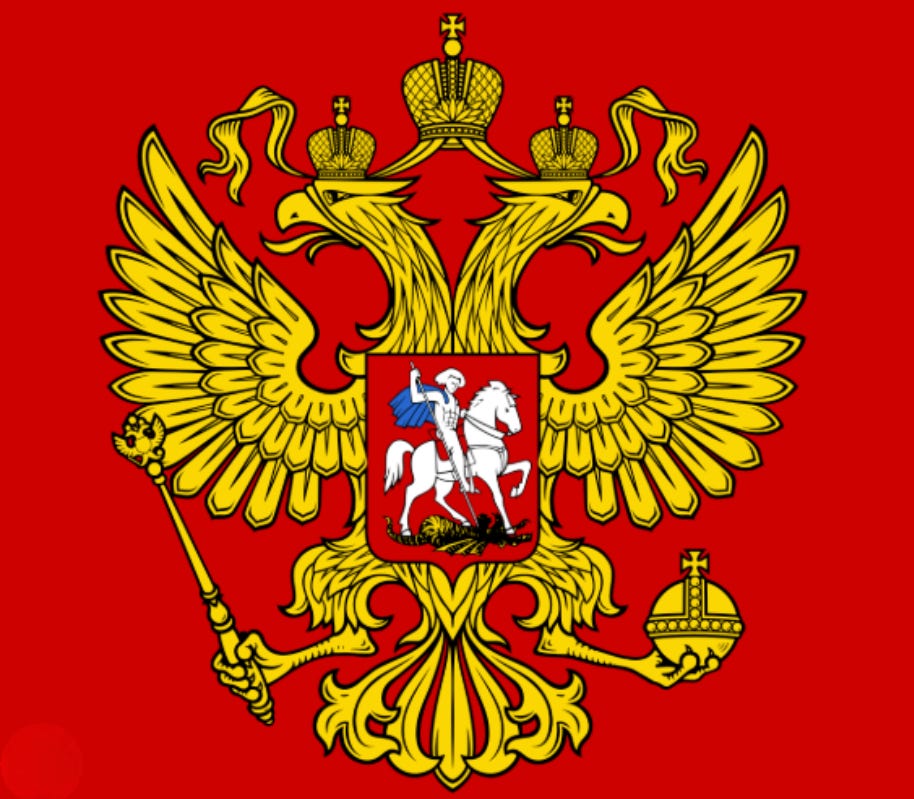
The Council of Florence agreement convinced Moscow that it alone stood for true Christianity. The belief hardened when the Ottomans captured Constantinople in 1453, ending the thousand-year-old Byzantine Empire and displacing the Orthodox Christian leadership. That void led Moscow to claim the leadership of the faith for itself. That claim was cemented in 1472, when Ivan the Third, ruler of Moscow, married Sophia, niece of the last Byzantine emperor, and took the Byzantine double-headed eagle as his own emblem. The marriage created a direct line from Moscow to Byzantium and the Orthodox church. In the early 1500s, a monk named Filofei wrote to the ruler of Moscow that two Romes had fallen, first Rome itself and then Constantinople, which named Moscow the Third Rome.
The Third Rome doctrine made Russia, in its own eyes, the last protector of true Christianity and the rightful leader of all Orthodox civilization. That self-image leads Russia to treat Ukraine as Russian rather than as a separate country. This is what the cultural theorist Shalom Schwartz labeled Embeddedness: the value a society places on preserving its inherited faith, customs, and sacred place in the world. Russia is a strongly embedded culture. From that cultural perspective, letting Kyiv go means letting go of who Russia believes itself fundamentally to be.
Russia sits at the eastern end of a vast flat plain that runs across Europe with few natural barriers. That open ground exposed the Russian heartland to invader after invader. The Mongols destroyed Kyiv in 1240, Polish armies held Moscow from 1610 to 1612, Napoleon reached Moscow in 1812, and Germany invaded across the same plain in 1914 and again in 1941. Those repeated invasions taught Russia to keep a wide buffer between the heart of the country and the enemy to the west.
The lesson hardened into a permanent fear of encirclement, the belief that hostile powers are always closing in from every direction. The cultural theorist Geert Hofstede measured this trait as Uncertainty Avoidance, how strongly a society fears unpredictable danger and builds walls against it. Where others see an open border as a chance for trade or a risk to manage, Russia sees a threat it must defend against.
That need for a buffer drove Russia to expand outward for centuries and to create dependent buffer states from the Baltic to Central Asia. The same need led Russia to control Ukraine in various forms since 1654. Holding Ukraine gave Russia a large buffer and the farmland that fed the empire. That made Ukraine the single most valuable piece of that buffer.
These two forces, set in motion centuries ago, created Russia’s cultural perspective: Kyiv is its sacred birthplace, bound to be protected, and the territory of Ukraine is a buffer it cannot live without. The conversion of 988 made Kyiv the birthplace of the Russian faith. The betrayal at Florence and the fall of Constantinople pushed Moscow to claim leadership of the Orthodox world, and the Third Rome doctrine cemented that claim, making Kyiv non-negotiable. The open plain and four centuries of invasion made Ukraine the buffer Russia could not give up. By the time Ukraine became independent, Russia was already set to take it back.
Wednesday’s Edition covers what happened when that programming met the modern world: how Russia held onto Ukraine, lost it when the Soviet Union collapsed in 1991, and could not accept watching it turn toward the West.
If you enjoyed this article, help support my work by becoming a paid subscriber or “Buy me a coffee.”
Get a solid understanding of Trompenaars’ and Hofstede’s cultural dimensions by purchasing the guide or subscribing to Cultural Perspective (free or paid) and receiving the guide for free.


