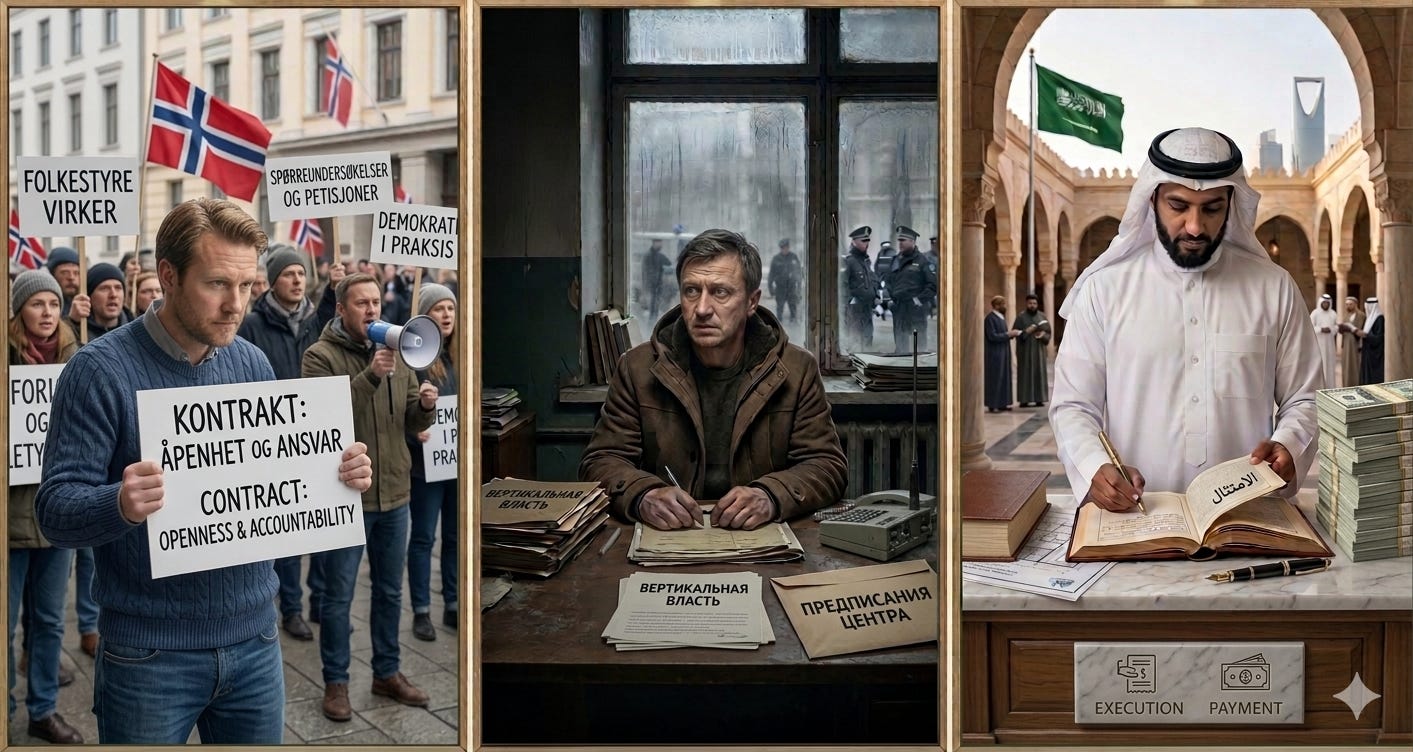
Why Countries Stay Free: The Map That Separates Democracies from Autocracies. Friday's Edition.
Why some countries become democracies and others do not. Series 26 #3
The Inglehart-Welzel cultural map is the most-cited image in cross-cultural research. It plots every country on two axes built from the World Values Survey, the longest-running measurement of national cultural perspectives in social science. Democracies cluster in one part of the map. Authoritarian states cluster elsewhere. The line between them is one of the cleanest in social science.
Before the map, Fons Trompenaars built a parallel framework in the 1980s and 1990s. He measured cultural perspectives through how groups solve common dilemmas. Three of his dimensions apply here.
Universalism measures whether a culture treats rules as applying equally to everyone, or whether rules bend for relationships. Universalist cultures expect a contract to mean the same thing for a friend, a stranger, and a relative. Particularist cultures adjust the contract depending on who is signing it. Democracies depend on universalism. If the same law does not apply to a king’s cousin and a farmer’s son, the rule of law collapses. The United States, Germany, and the Netherlands are the most universalist. China, Russia, and Venezuela are the most particularist.
Achievement measures whether status is earned through what a person does or assigned based on who a person is. In achievement cultures, anyone can rise based on competence. In ascription cultures, status comes from age, family, or social position. Democracies depend on achievement. Voters reward results. Ascription cultures produce stable elites who inherit power. Scandinavia, Britain, and the United States are high achievement cultures. China, France, and Indonesia are high ascription cultures.
Internal Control measures whether a culture believes people can shape their environment or must accept it. Internal-control cultures push back against rules that produce bad outcomes. External-control cultures adapt. A citizen who believes they can change the law votes, runs for office, and protests. A citizen who believes the situation cannot be changed has no reason to act. The United States, the United Kingdom, and Australia are strong internal control. China, Russia, and Saudi Arabia are strong external control.
Ronald Inglehart and Christian Welzel built their map from the World Values Survey, which has run every five years since 1981 and now covers nearly 100 countries. The map has two axes. The first measures traditional values against secular-rational values. Traditional cultures emphasize religion, family ties, and obedience to authority. Secular-rational cultures relax those rules and constraints. The second measures survival values against self-expression values. Survival cultures prioritize economic security, distrust of outsiders, and limited tolerance. Self-expression cultures prioritize tolerance, gender equality, environmental protection, and participation in decision-making.
Democracies cluster high on both axes. Norway, Sweden, the Netherlands, and Germany are in the top-right corner. Japan, Taiwan, and South Korea are high on secular-rational values and rising on self-expression. Authoritarian states are concentrated in the bottom half: Russia and the Orthodox world on the secular-rational side, the Islamic world and most of sub-Saharan Africa on the traditional side. No country in the high secular-rational, high self-expression quadrant is authoritarian. No authoritarian state has reached that quadrant.
This is the cultural perspective that Hofstede and Schwartz pointed to and that Trompenaars and Inglehart-Welzel confirm from different angles. Each framework measures something slightly different. Each produces the same outcome: Democracies on one side, authoritarian states on the other
The Norwegian’s culture is in the top-right of the map. He believes he can change the law because his culture believes the law can be changed. He follows rules because the rules apply equally. He treats officials as equals because his culture treats status as something a person earns. Writing his representative, voting, and joining a protest are normal acts. They are the cultural defaults that he does not even think about.
Saturday’s Core Brief, for paid subscribers, names the single cultural pattern that runs through all four frameworks and applies it to three 2026 geopolitical flashpoints.
If you enjoyed this article, help support my work by becoming a paid subscriber or “buy me a coffee.”


I'm a new fan of cross-cultural analysis. My present interest is envy and culture. It's easy to see how royalty and other form of inheritance overwhelms envy. Just as they expect to leave their right to rent land from the squire to their son, they are just fine with the present squire inheriting ownership of half the county from his father. In contrast, even though billionaires fund all the things we enjoy, Walmart, PayPal etc. and the fact that no matter how rich Jeff Besos gets, he can't make you buy his stuff or work for him. . . yet the mere fact that he has so much money for some people is reason enough to be envious which for them is why it is necessary to use force to take some of his wealth.