Why Countries Stay Free: 4 Cultural Dimensions - Hofstede and Schwartz. Wednesday’s Edition.
Why some countries become democracies and others do not. Series 26 #2
In 1965, Geert Hofstede was hired by IBM to study employee morale. The company had offices in more than 50 countries, the same company, the same job titles, and the same training. Hofstede expected the same answers. He found the opposite.
The same survey question, asked of the same kind of worker, yielded different answers depending on which nation the worker was from. The nation was the variable. That finding became the foundation for cross-cultural research. Hofstede spent 20 years building a framework from the IBM data.
Shalom Schwartz, working in Israel in the 1990s, built a parallel framework using teachers in 70 countries. They used different methods and vocabulary, and reached the same conclusion. The cultural perspectives a population holds about hierarchy and about the individual are not opinions. They are taken-for-granted assumptions that determine which forms of government a population will support.
The Key Cultural Dimensions
Power Distance (Hofstede). How much inequality a population accepts between those who hold power and those who do not. In high power distance countries, children do not question parents, students do not question teachers, employees do not question managers, and citizens do not question leaders. In low power distance countries, hierarchy is used to organize systems. Subordinates expect to be consulted. Authority is questioned, and questioning is accepted.
Individualism (Hofstede). Whether identity is built around the self or the group. In individualist countries, people are taught to look after themselves and their immediate family, to speak their minds, and to make their own choices. In collectivist countries, people are taught that the group protects them and that they owe loyalty in return. Speaking against the group brings shame on the family.
Autonomy (Schwartz). Whether a culture treats the individual as a separate moral unit with the right to form independent opinions, or as a part of a group that gets its meaning from belonging. Schwartz splits autonomy into two parts. Intellectual autonomy is the right to your own ideas. Affective autonomy is the right to your own feelings and pleasures.
Egalitarianism (Schwartz). Whether a society treats people as moral equals who care for one another voluntarily, or sorts people into categories who owe specific duties to others. Egalitarian cultures expect power to be shared and used for the common good. Hierarchical cultures expect power to be obeyed.
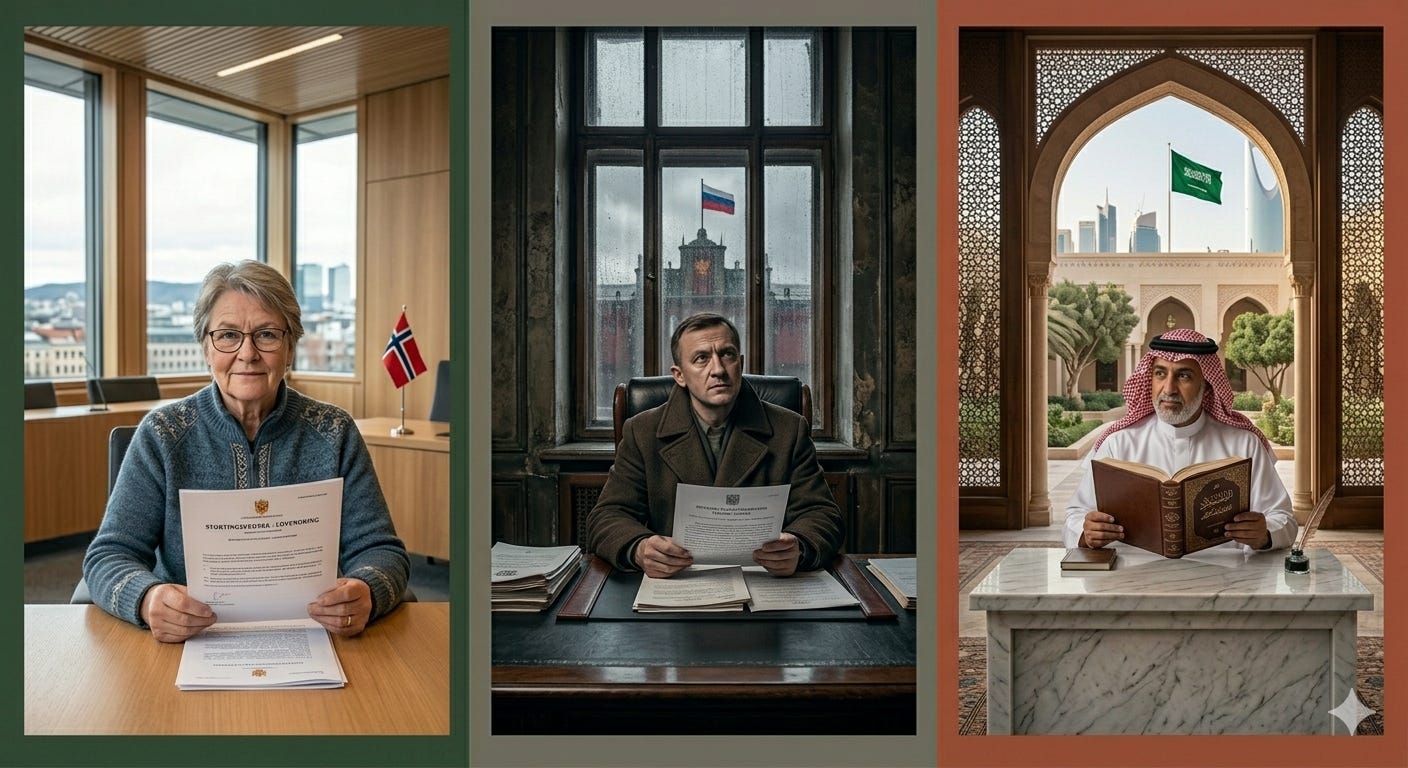
The Norwegian, the Russian, and the Saudi from Monday's opening are three positions on these four dimensions. The Norwegian is in a low power distance, high individualism, high autonomy, and high egalitarianism culture. Writing to a representative in protest is the norm. The Russian is in a high power distance, low individualism, low autonomy, hierarchical culture. Public disagreement carries real risk. Doing nothing is the norm. The Saudi is in a culture with the highest power distance, low individualism, low autonomy, and the most hierarchical structure of the three. The question of disagreement does not arise.
These four cultural dimensions greatly influence the type of government that evolves and the forms of government that people expect and will tolerate.
Voting against a leader requires low power distance. Forming a strong, independent opinion requires autonomy. Treating a stranger as a political equal requires egalitarianism. Holding a view different from family or clan requires individualism. This leads to more democratic governments. Norwegian democracy works because the cultural perspectives that move people toward democracy are part of Norwegian culture.
Russian and Saudi cultures are different. High power distance means supporting leaders. Low individualism means siding with the family or clan. Low autonomy means going with the consensus. Low egalitarianism means accepting the hierarchy. This steers a population toward more authoritarian governments.
Of the nations surveyed by Hofstede and Schwartz, the most democratic ones on the Economist Intelligence Unit Democracy Index cluster around low power distance and high individualism (Hofstede) and high autonomy and high egalitarianism (Schwartz). These include:
Norway
New Zealand
Sweden
Switzerland
Finland
The least democratic nations show the opposite. All score high on power distance and low on individualism, and have high hierarchy and high embeddedness. These include:
Russia
Iran
Saudi Arabia
Yemen
The correlation is strong, not absolute. Taiwan and Japan are high power distance Confucian cultures that produce working democracies. They transitioned to democracy in the last 40 years, after long periods of authoritarian rule, rapid industrialization, and the rise of an educated urban middle class.
Friday’s edition examines Trompenaars and Inglehart-Welzel. Universalism, Achievement, Internal Control, secular-rational values, and self-expression values. Why the Inglehart-Welzel map separates democracies from authoritarian states more cleanly than any other tool in the social sciences.
Saturday’s Core Brief, for paid subscribers, shows the single cultural pattern they all describe, in two parts. It is the answer to the week’s question.
Get a head start on Friday's edition with the Trompenaars Cultural Dimensions Guide. All eight dimensions with concrete examples for each. Use it to read leaders, predict how nations will act, and make sense of the news.
If you enjoyed this article, help support my work by becoming a paid subscriber or “buy me a coffee.”


