Why China Wants Taiwan. Setting Up The Century Of Humiliation. Monday’s Edition.
The Long Chain: China and Taiwan. Series 28 #1
In the last days of 2025, China ran a military exercise around Taiwan called Justice Mission. It rehearsed sealing off the island, blockading its ports, and cutting it off from the rest of the world. On a single day, Taiwan tracked sixty Chinese military aircraft near the island, forty-four of them crossing the line down the middle of the strait. A Chinese rocket unit fired shells into the water twenty-four miles off Taiwan’s coast. This is now routine. Twice a year, China rehearses taking Taiwan, and on most days, its planes and ships press the line.
The reason China is unwavering in its pursuit of Taiwan dates back to 1793, to how China and the West each see the world, and to the wound that never healed.
Two worlds that could not fit
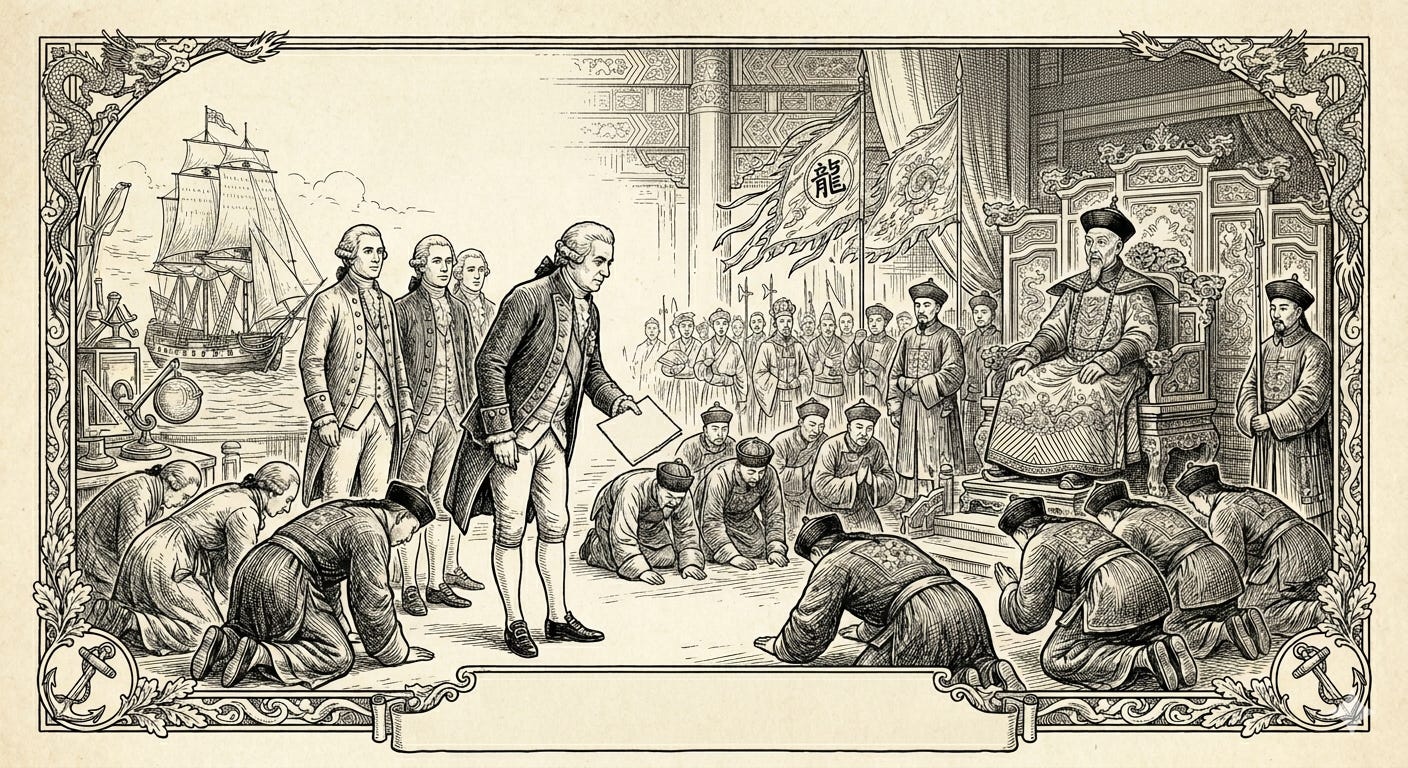
In 1793, Britain sent Lord Macartney to Beijing to open trade and place a permanent ambassador at the Qing court. China refused all of it. The standard story is that Macartney would not perform the kowtow, the full prostration before the emperor. The real problem was deeper. Britain came as one sovereign state seeking terms with another. China did not believe other sovereign states existed. In the Chinese order, the emperor sat at the center of the world, and everyone outside came as a lesser power bringing tribute. China was the Middle Kingdom. The Qianlong Emperor wrote to King George III that China possessed all things and had no need of British goods.
This is where it began, and it is a cultural clash, not a trade dispute. Britain operated from what Trompenaars calls universalism, the belief that the same rules apply to everyone equally, including kings. China operated from a worldview where status is fixed and inherited, what Trompenaars calls ascription, anchored by Schwartz’s Tradition value, where the existing hierarchy is the natural order. One side wanted a contract between equals. The other believed it had no equal. Two cultural perspectives that could not see the other’s perspective.
When the clash turned violent
The mismatch lasted for decades, with Britain restricted to trading in a single port and buying consumable goods such as tea with silver, a finite resource. This was unsustainable. Britain retaliated by selling opium grown in India, paid for in silver, and addicting millions of Chinese. In 1839, the emperor sent the official Lin Zexu to stop it. Lin seized over 1,400 tonnes of British opium and, on 3 June 1839, destroyed it at Humen, mixing it with lime and salt and flushing it into the sea. Britain treated the destruction of private property as an act demanding war. On 4 September 1839, the First Opium War began. China lost completely. British warships and modern artillery overwhelmed the Chinese military.
The wound
On 29 August 1842, China signed the Treaty of Nanking. It paid 21 million taels of silver, opened five ports to British merchants, granted British subjects immunity from Chinese law, and ceded Hong Kong Island to Britain in perpetuity. It was the first of the unequal treaties, and it marked the beginning of what China calls the Century of Humiliation.
In a dignity culture like Britain’s, which views self-worth as intrinsic, a lost war is a setback; one moves past it, and it eventually becomes a page in the history books. To a face culture, like China’s, which views self-worth as a disruption in the social order, the payment to Britain and the loss of control and territory were the moment the center of the world was forced to its knees by people it had considered barbarians. The loss was carved into the national memory as an open account that must one day be balanced. The same event is seen as history for one side and as an unhealed wound for the other. That difference between dignity and face cultures is the engine of this entire chain, and it is why China still operates as though 1842 happened recently.
This is where the chain begins. A clash of two worldviews, when universalism met ascription and tradition in 1793. This led Britian selling opium to China, which escalated to the Opium War. This brought about the unequal treaties, which would usher in the Century of Humiliation, dignity and face cultures unable to understand each other. This created a wound the modern Chinese state is still working to heal. Taiwan is how that wound gets healed.
Wednesday’s edition explains how the wound deepened when China lost Taiwan to Japan in 1895, and how that loss carried the humiliation straight into the founding of the modern Chinese state.
If you enjoyed this article, help support my work by becoming a paid subscriber or “buy me a coffee.”
Get a solid understanding of Trompenaars’ and Hofstede’s cultural dimensions by purchasing the guide or subscribing to Cultural Perspective (free or paid) and receiving the guide for free.


