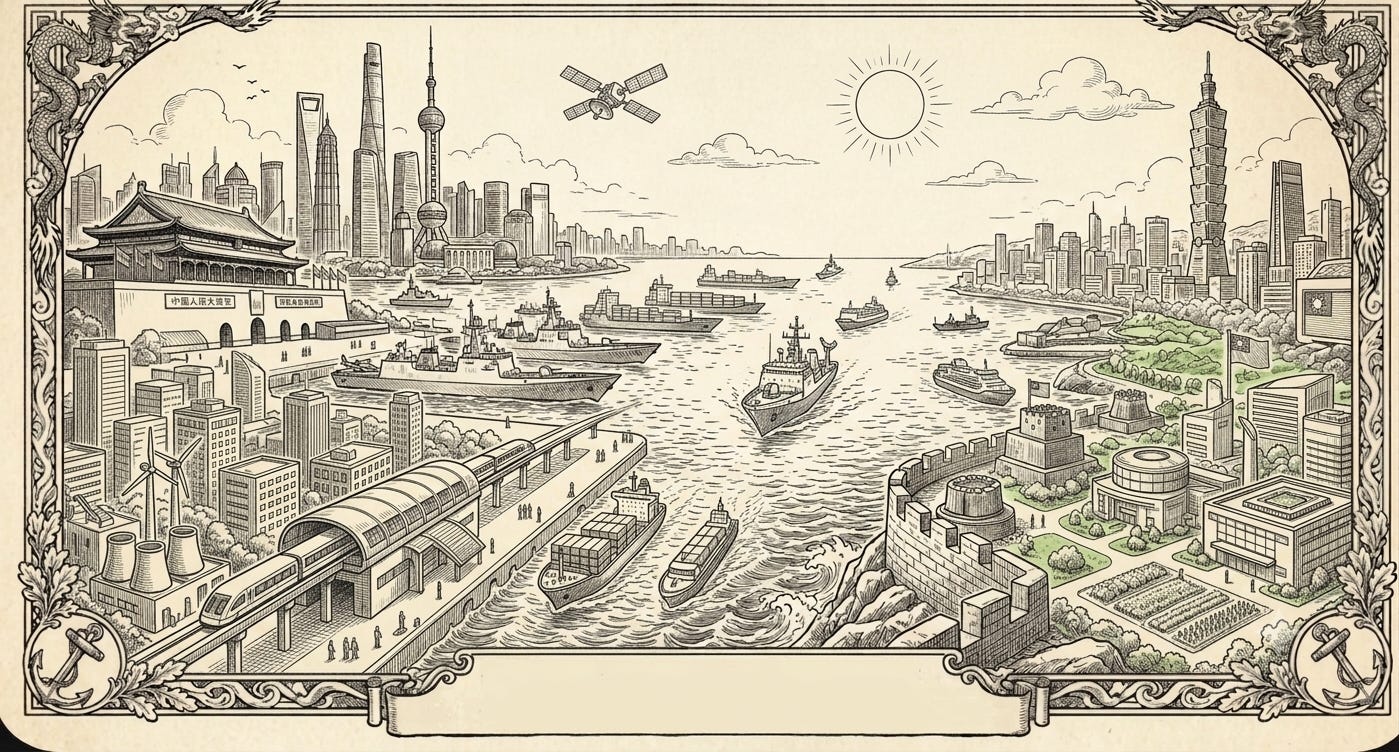
Why China Wants Taiwan. How China Takes Taiwan. Friday's Edition.
The Long Chain: China and Taiwan. Series 28 #3
On May 26, 2026, ships of China’s Fujian Coast Guard moved into the water around Kinmen, Taiwanese islands a few miles off the Chinese coast. China called it a routine law-enforcement patrol. Taiwan called it an intrusion into its waters and sent patrol boats to push the Chinese ships back. China has run these patrols for two years, since a Chinese speedboat collided with a Taiwanese coast guard boat during a chase in February 2024 and capsized, drowning two of the four men aboard. China used those deaths to begin regular patrols and call them normal policing of Chinese waters. Each patrol now treats water Taiwan has controlled for decades as China’s to police. The same pattern runs in the air. Taiwan began counting Chinese military aircraft entering its air defense zone in late 2020. The first full year, 2021, brought 972 crossings. The count for 2025 reached 3,764.
China is not preparing a surprise attack across the strait. It is doing something subtler and more difficult for Taiwan to respond to.
The story began in 1793, when two cultural perspectives met and did not fit. China saw itself as the center of the world with no equals, a rank fixed by who it was rather than what it did (ascription, Trompenaars). Britain saw a world of equal states under one set of rules (universalism). That mismatch, and the opium trade Britain used to break it, led to the Opium Wars, which led to the unequal treaties, which began the Century of Humiliation, the hundred years when foreign powers took China apart. That dismemberment cost China Taiwan, which Japan seized in 1895. Taiwan was returned to China after World War II. Then the Communists won China’s civil war in 1949, and the losing side fled to Taiwan, and a war in Korea in 1950 brought the American fleet into the strait and froze the island out of China’s reach. China lost Taiwan twice.
China has spent the decades since trying to close that wound because, in a Face Culture, a public defeat lowers a nation’s standing until that standing is restored. It took back Tibet, Hong Kong, and Macau. The land Russia took in the north is slowly being made Chinese again through names on maps, money, and migration. Taiwan is the last piece left.
Here, the Face Culture points away from the obvious move, not toward it. A Face Culture wants its standing restored in front of others. A long war that China might lose, fought against people who do not want to be ruled, would not restore standing. It would destroy it. So China is not trying to win a battle for Taiwan. It is trying to win Taiwan without a battle.
This is an old idea in Chinese strategy. Sun Tzu wrote in The Art of War that the highest skill in war is to break the enemy’s resistance without fighting. The coast guard ships off Kinmen, the planes in the air defense zone, and the twice-a-year blockade drills are that idea in practice. Each one is built to avoid a battle, not to start one. Together they wear down Taiwan’s will and its friends’ attention. The aim is to make Chinese control of Taiwan feel routine and Taiwan’s independence feel temporary, so that reunification, when it comes, looks less like a conquest and more like an inevitability.
China has already lost the one peaceful path it offered. It gave Hong Kong a deal called One Country, Two Systems: Hong Kong could keep its own way of life under Chinese rule. China ended that arrangement in 2020. Taiwan watched, and by December 2025, 82.6 percent of Taiwanese rejected the One Country, Two Systems. To China, that vote changes nothing because, from its cultural perspective, the relationship is more important than the rule, including a people’s right to choose (particularism, Trompenaars). Taiwan is Chinese in China’s eyes, and a vote cannot make it otherwise.
So the chain points to pressure, not invasion, as the most likely next phase. China will keep tightening the pressure. The patrols near Kinmen will reach more of Taiwan’s water. The flights into the air defense zone will continue to increase. The blockade drills will grow longer until a rehearsal and a real blockade look the same to Taiwan. Each step is built to draw no firm response, because each is too small to start a war over. China is betting that a wall built one brick at a time never gives the other side a clear moment to knock it down.
This runs on a clock most countries cannot hold. Xi Jinping has tied the recovery of Taiwan to 2049, the hundredth anniversary of the People's Republic of China. Holding one goal steady across a century takes a Tight Culture (Gelfand), a society with strong shared rules and the discipline to stay on course for generations, and a Long-Term Orientation (Hofstede) that counts progress in decades. The law is already written. China’s Anti-Secession Law of 2005 says that if peaceful reunification becomes impossible, China will use force. The pressure campaign is China’s way of making sure that line is never reached.
The danger in this plan is the risk of an accident. The chain that produced today is full of accidents, the Korean War being the largest of them. Chinese and Taiwanese ships near Kinmen will eventually collide. A plane will cross a line it should not, or a captain will fire when he should not, and a campaign built to avoid a war may start one by mistake.
From the West’s cultural perspective, the matter is closed. From China’s perspective, the matter is closed only when the humiliation is over and Taiwan is returned.
If you enjoyed this article, help support my work by becoming a paid subscriber or “buy me a coffee.”
Get a solid understanding of Trompenaars’ and Hofstede’s cultural dimensions by purchasing the guide or subscribing to Cultural Perspective (free or paid) and receiving the guides for free.


