Why China Wants Taiwan. Ending The Humiliation. Wednesday’s Edition.
The Long Chain: China and Taiwan. Series 28 #2
On April 17, 1895, in the Japanese port town of Shimonoseki, Li Hongzhang, China’s chief negotiator overseeing the Qing government’s foreign affairs, signed a treaty that handed Taiwan and the Penghu Islands to Japan. China also agreed to pay Japan 200 million taels of silver, recognize Korea as independent rather than a Chinese dependency, and open four more ports to Japanese trade. The treaty said Taiwan was Japan’s in perpetuity. Li had argued that Taiwan should not be surrendered because no fighting in the war had taken place there. Japan had won the war and had a stronger army, so Li gave up Taiwan.
Monday traced the chain leading to Taiwan's loss and the Century of Humiliation. China saw itself as the center of the world, the Middle Kingdom (ascription and tradition). Britain operated on the belief that the same rules apply equally to every country (universalism). Those two cultural perspectives collided, leading to the Opium War and the 1842 Treaty of Nanking, which forced China to open its ports and surrender Hong Kong. That defeat began the Century of Humiliation. China has not moved past that humiliation because it is a face-culture nation (public defeat lowers a nation’s standing) and insults such as lost territory must be rectified. Britain and the West are dignity cultures (self-worth is treated as intrinsic), so a lost war is a setback to learn from and move past.
Britain’s defeat of China lowered China’s standing, but Britain was a distant foreign power China had never claimed to rule over. Japan held a different place in China’s order. For more than a thousand years, Japan had adopted China’s writing system, Confucian philosophy, and model of government, and at times sent tribute to the Chinese emperor and accepted a lower rank in the Chinese order. In China’s cultural perspective, Japan was an inferior that had copied China. When that inferior defeated China and took Chinese territory, the defeat lowered China’s standing more than any Western defeat had, because in a face culture the rank of the side that beats you determines how much standing you lose.
The defeat by Japan caused the next action in the chain by convincing a generation of Chinese that reforming the Qing dynasty from within would not work and that the dynasty itself had to be removed. This led Sun Yat-sen to submit a reform proposal to Li Hongzhang in 1894. The proposal changed nothing. That, coupled with China's defeat in the war with Japan, prompted Sun to found the Revive China Society in Honolulu on November 24, 1894. This was the first organized group whose stated goal was to overthrow the Qing dynasty by force. Sixteen years of plotting and failed revolts followed. And then the October 1911 uprising in Wuchang occurred. The revolt spread, and the Qing dynasty collapsed. This put Sun Yat-sen as the first president of the Republic of China, the modern Chinese state. The six-year-old emperor abdicated on February 12, 1912, ending more than two thousand years of imperial rule.
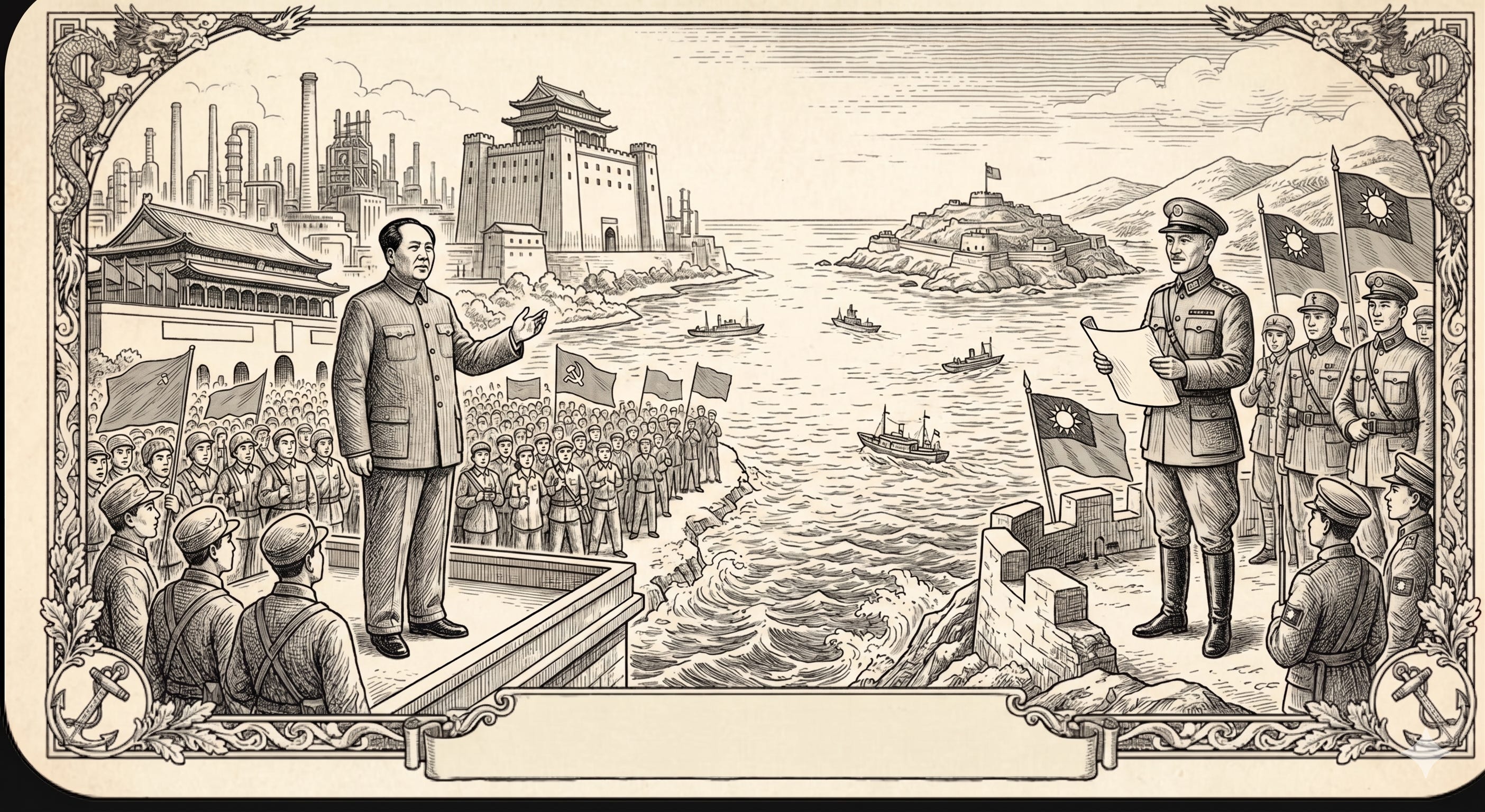
The new republic was weak, which resulted in warlord rule, and Sun’s party, the Nationalists, spent the next two decades fighting the warlords and the Chinese Communist Party for control of the country. Then Japan invaded Manchuria in 1931 and launched a full war on China in 1937. That united China’s warring parties into two factions: the Nationalists and the Communists. After Japan’s defeat in 1945, Taiwan was returned to China. But the Nationalists and the Communists immediately resumed their civil war, which the Communists won on October 1, 1949. This forced the defeated Nationalist government to flee to Taiwan.
Mao prepared to finish the civil war in 1950 by invading Taiwan. That invasion was stopped by a war in Korea. North Korea's attack on South Korea on June 25, 1950, caused the United States to reverse its policy of staying out of the Chinese civil war, and two days later, it ordered the Seventh Fleet into the Taiwan Strait to block any crossing. That forced Mao to cancel the invasion. The US has protected Taiwan since then. China lost Taiwan twice.
Taiwan has been independent for seventy years. From the West’s cultural perspective, the issue is settled. From China’s cultural perspective, this issue is as relevant as it was in 1895.
The territory lost in the Century of Humiliation has largely been restored, Tibet by force in 1950, Hong Kong and Macau by treaty and patience in the 1990s. Russian territory in northern China is being slowly and subtly absorbed by name changes on maps, financial dependence on China, and immigration of Chinese companies and workers. Taiwan is the only loss left.
Friday's edition covers how China’s view of Taiwan drives its choices in the strait and what comes next.
If you enjoyed this article, help support my work by becoming a paid subscriber or “buy me a coffee.”
Get a solid understanding of Trompenaars’ and Hofstede’s cultural dimensions by purchasing the guide or subscribing to Cultural Perspective (free or paid) and receiving the guide for free.


