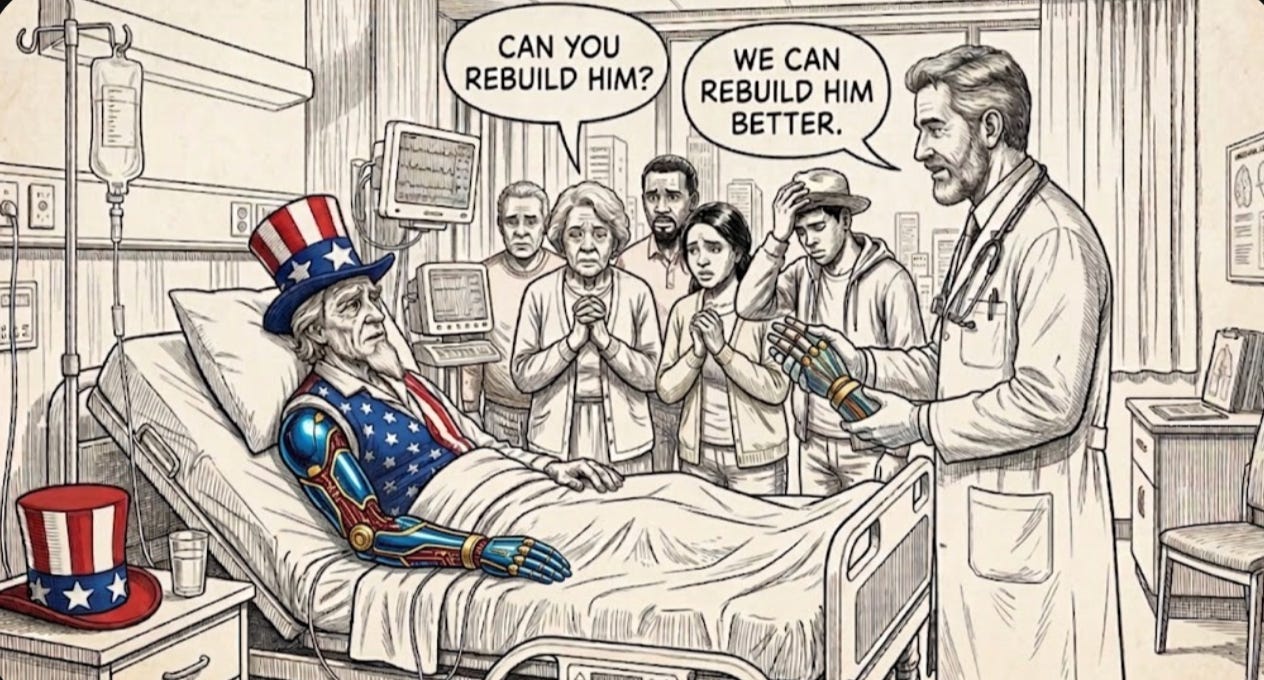
Will America return to normal? No, and that is good news.
Every crisis in American history produced a conservative, restorationist faction fighting to keep the status quo.
In the 1770s, it was the Loyalists.
In the 1860s, it was the Confederacy and, after the war, the Redeemers.
In the 1930s, it was the American Liberty League, funded by industrialists who wanted to dismantle the New Deal.
Every one of them lost. The Loyalists, the Confederacy, and the Liberty League all fought the transition head-on as it happened, but could not stop it. The Redeemers, who were successful, attacked Reconstruction's enforcement rather than the amendments themselves.
MAGA is this cycle’s restorationist faction. The name states the goal directly: Make America Great Again. Again is the operative word. It promises a return to a normal that no longer exists. The historical pattern is clear: MAGA will lose. It gets swept aside by the transition it is trying to stop.
A second pattern explains why nobody can predict what comes next with confidence.
In 1774, almost nobody in the colonies wanted an independent republic. They wanted the arrangement they had before 1763.
In 1859, nobody predicted the end of slavery along with the U.S. becoming the largest industrial economy.
In 1932, nobody proposed that the United States should run the world’s financial and security systems.
Each new normal was unexpected. Friday’s Edition will speculate about the next one, and speculate is the honest word.
Do not expect a switch to flip in 2030. The crisis ending and the new normal beginning are separate events. The Revolutionary War ended in 1783, the Constitution came in 1787, and the first peaceful transfer of power between parties was not until 1801. The Civil War ended in 1865, and the settlement was not fixed until 1877. The Second World War ended in 1945, and the American global order took decades to build. In each case, the architecture went up in about five years, then took a generation to settle.
When the new normal starts, it is built in a short burst. Each time, one coalition gets an unusual amount of freedom to act and uses it to construct the architecture of the next era.
1787 to 1791. The Constitution was written in 1787 and ratified in 1788. The Judiciary Act built the federal courts in 1789. Hamilton restructured the national finances and chartered the first Bank of the United States in 1791. The Bill of Rights was ratified that December. Four years.
1861 to 1868. The Southern delegations walked out, and the Republican majority passed almost everything it wanted. The Homestead Act, the Morrill Act, and the Pacific Railway Act in 1862 built the base of the industrial economy. The National Banking Acts created a national currency. Then the Thirteenth Amendment in 1865 and the Fourteenth in 1868. Seven years.
1933 to 1938. Banking reform and deposit insurance in 1933. The Securities and Exchange Commission in 1934. Social Security and the Wagner Act in 1935. The minimum wage and the forty-hour week in 1938. Five years.
1944 to 1949. Bretton Woods in 1944. The United Nations in 1945. The CIA and a unified military establishment in 1947, the Marshall Plan in 1948, and NATO in 1949. Five years.
Then comes the long stretch where the new architecture either gets enforced or gets hollowed out, and that is where the real fight happens.
The Fourteenth Amendment passed in 1868 and went unenforced for its purpose for ninety years.
Reconstruction collapsed in 1877 and delivered Jim Crow instead of equality.
The New Deal architecture was finished by 1938, then had to survive a court-packing failure and a hostile Congress.
Bretton Woods held until Nixon ended gold convertibility in 1971.
Construction is fast, but not immediate. Consolidation is slow, and not guaranteed to succeed.
If the crisis comes to a head around 2030, the construction window is roughly 2030–2035. The consolidation runs to mid-century.
Watch for three markers rather than a date:
A governing coalition that holds power across more than one election.
A burst of legislation instead of executive orders.
The losing faction losing its institutional footholds.
The end of the crisis will not restore the American global order; it always ends in something different. So the question is, what replaces it? That is Friday (speculative) Edition.
If you enjoyed this article, help support my work by becoming a paid subscriber or “Buy me a coffee.”
Get a solid understanding of Trompenaars’ cultural dimensions by purchasing the guide or subscribing to Cultural Perspective (free or paid) and receiving the guide for free.


I don't suppose you'd be willing to examine the power structures in place at those times and compare them to what's happening now.
In other words, "Who was (more) in charge and when throughout those periods?"
Another important point in that will be dispensing with the idea of "free and fair elections" and "equal power distribution" or at least consideration for the fact those are more theoretical than a reflection of reality
I think those are important factors here
Thanks