WHO GETS TO BE ONE OF US? GLOBAL SHIFTS. FRIDAY’S EDITION
Civic nationalism or ethnic nationalism - Series 13 #5
Tuesday examined civic nationalism. Wednesday examined ethnic nationalism. Thursday, we examined what causes societies to shift between them. Today, we look at countries where these shifts are happening now.
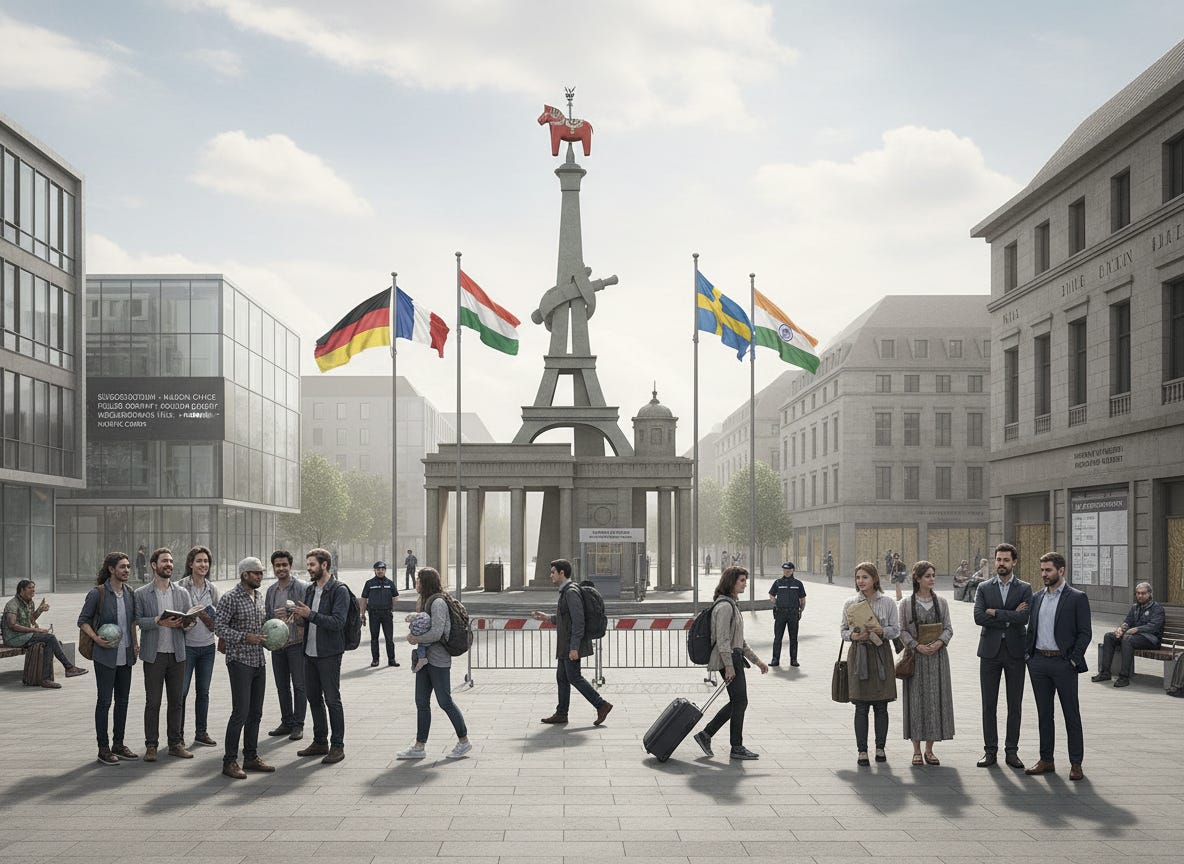
Germany built its postwar identity around civic and constitutional principles, explicitly rejecting racial nationalism after the Nazi era. Explicit ethnic nationalism became politically taboo, even as citizenship law remained relatively restrictive for decades and was only substantially liberalized in reforms around 1999–2000. In 2015, Germany received roughly 890,000 asylum seekers, with Syrians the largest single group among several nationalities. The speed and scale of arrivals placed visible pressure on housing, services, and local communities in some areas. Over the same period, the Alternative for Germany rose from 4.7 percent of the vote in the 2013 federal election to 12.6 percent in 2017, becoming the largest opposition party in the Bundestag. Germany’s civic legal framework remains in place, but public opinion on immigration and asylum has hardened. In recent years, the government has reintroduced and expanded border controls and tightened asylum measures, policies that would have been politically unlikely a decade earlier.
France faces a different version of the same problem. The French Revolution invented civic nationalism, declaring that anyone who embraced the French language, culture, and republican values could become French. North African and West African immigration tested that promise. Second-generation immigrants, born to French citizens, found that following the rules did not deliver jobs, housing, or social acceptance. Marine Le Pen’s National Rally has grown from a fringe movement to a serious contender for the presidency by promising to restore France for the “French.”
Hungary went further. Prime Minister Viktor Orbán explicitly rejected civic nationalism and declared Hungary a Christian nation defined by Magyar blood and culture. He built fences to block migrants, rewrote the constitution to enshrine ethnic identity, and won four consecutive elections. Hungary’s economy is weak, its institutions serve the ruling party, and its population is shrinking, but Orbán delivers what his voters want: certainty about who belongs.
Sweden shows how fast the shift can happen. For decades, Sweden welcomed refugees, provided generous benefits, and expected integration. The foreign-born population rose from 11% in 2000 to over 20% by 2020. Crime increased in immigrant neighborhoods, parallel societies formed, and gang violence spread to cities that had never experienced it. The Sweden Democrats, founded by extremists and shunned by all other parties, became the second-largest party in parliament by 2022. The center-right government now depends on their support.
India presents a different pattern. Its constitution defines citizenship in civic terms, but the ruling Bharatiya Janata Party has pushed Hindu nationalism. Prime Minister Narendra Modi’s government passed citizenship laws that favor non-Muslim immigrants, revoked the special status of Muslim-majority Kashmir, and built a Hindu temple on the site of a demolished mosque. India’s civic framework remains on paper while ethnic nationalism operates in reality.
From a cultural perspective, these countries follow the same pattern. Economic stress, migration, institutional decay, and external threats push populations toward ethnic-based belonging. The civic promise breaks when following rules stops delivering results. People fall back on the one thing that cannot be taken away: who their parents were.
Hornby’s Blue Guardian archetype appears across these examples. Orbán, Le Pen, the Sweden Democrats, and Hindu nationalists all appeal to the Guardian’s conviction that traditional ways must be preserved and that outsiders threaten traditional order. The Guardian does not argue; it asserts, and when conditions deteriorate, its certainty attracts people who feel society is changing too fast.
These shifts are not random or irrational; they follow predictable patterns based on material conditions and cultural perspectives. When civic nationalism stops working, ethnic nationalism fills the void. The question for any country is not whether this shift is good or bad, but whether the conditions that enable civic nationalism still exist.
Saturday: The United States as a case study in this shift.
If you enjoyed this article, buy me a coffee!


The cross-country comparison makes the pattern imposible to ignore, especially how Germany's civic framework coexists with hardening public opinion. What fascinates me is the tension between legal structures that remain liberalized and social dynamics that reject those liberalizations. The Guardian archtype framing helps explain why these shifts feel inevitable once material conditions change. I keep thinking about how quickly Sweden moved from consensus to contestation.