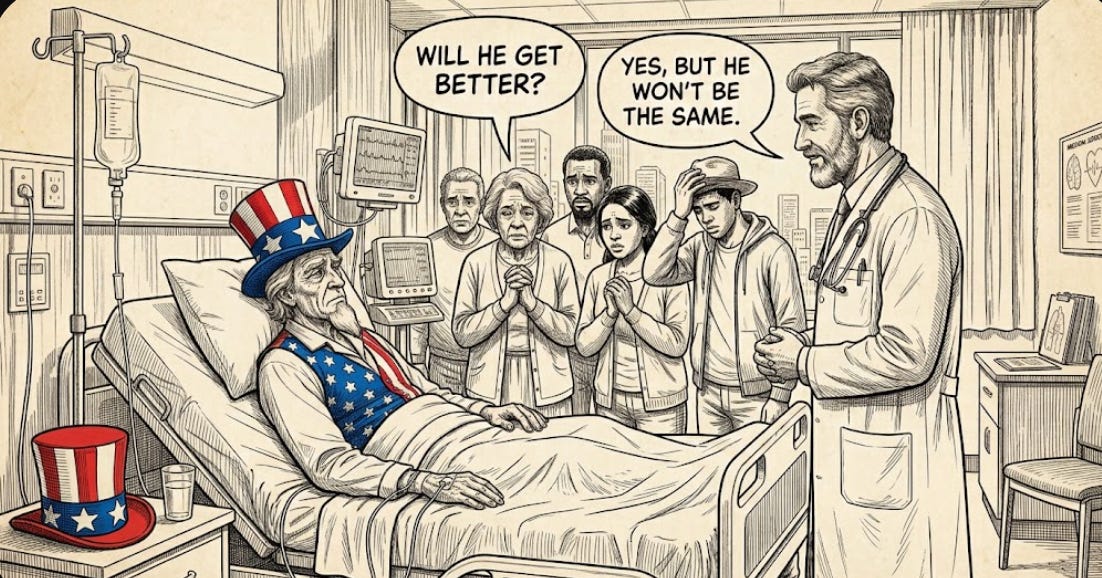
When will America return to normal? The short answer: never. But I mean that in a positive light. Here is my line of thinking:
1770s - 1790s. America (What would become the United States) in revolution. When the turmoil subsides, the 13 British colonies in North America are transformed into something completely different, and better: a representative democracy. A new normal.
1860s. America in civil war. When the devastation ends, America is transformed into something different and better: the end of slavery along with the U.S. as the largest industrial economy. A new normal.
1930s - 1945. America in the Great Depression and World War II. After the destruction, America is transformed into something different and better: the global leader and the American global order. A new normal.
2000s - 2030(?). America in fascism. When the turmoil subsides, America is transformed into something different and better: (We’ll speculate about what that may be in Friday’s Edition).
The U.S. does not want to return to what was the norm: the era of constitutional monarchy, the era of slavery and an agrarian economy, or the industrial era, because each evolution was a positive step forward for the nation, its people, and the world. What comes after the Trump-Republican fascism era will be better than the American global order, and America won’t want to go back. Whatever the new normal is, it will be a positive move forward.
One of the first things I hear when I present this is that every crisis ended in war. There was the Revolutionary War and the Civil War, but FDR turned the U.S. around and redefined how it operated through big, hands-on government. The U.S. built its new normal without a war. Every institution that defined it was law before Pearl Harbor: Glass-Steagall and the FDIC in 1933, the SEC in 1934, the Wagner Act and Social Security in 1935, the Fair Labor Standards Act in 1938. The war ended the Depression and made America the global leader, but it did not build the domestic order that emerged from the 1930s. Congress did that, in peacetime, in five years.
So the last transition gave us the new American normal through legislation, not fighting. The conditions that pushed the earlier two crises into war are weaker now. The Revolution and the Civil War both needed a geographic line: colonies against a crown across an ocean, states against states along a border. In today’s divide there is no line to draw and no territory to hold. And while 2025 had more state-involved conflicts than any year since records began in 1946 far fewer people die in war today than before 1939.7
So, when will this crisis end and a new American normal develop? Strauss and Howe suggest the Trump-Republican fascism crisis will end in the 2030s Ray Dalio puts the debt crisis around 2030. Peter Turchin places the peak of US political instability in the 2020s. George Modelski puts the next contest over world leadership opening around 2030. I’ve discussed each in previous articles, so I won’t go into them now; suffice it to say, they all point to a transition in the next few years.
The midterm elections in November will create upheaval. If the Democrats win, Trump and the Republicans will call the vote fraudulent, another steal, and create even greater chaos, which will likely involve violence but not a civil war. If the Republicans win, the nation will fall further into chaos, debt, higher prices, the Iran war will worsen, and the US will find itself adrift alone with few, if any, allies.
Then the 2028 presidential election will likely be the turning point. That’s when the U.S. military may get involved, but I don’t see a civil war. Either way, it will come to a head, and it will be clear that major changes are needed.
If you enjoyed this article, help support my work by becoming a paid subscriber or “Buy me a coffee.”
Get a solid understanding of Trompenaars’ cultural dimensions by purchasing the guide or subscribing to Cultural Perspective (free or paid) and receiving the guide for free.


