What’s Next In Trump’s War With Iran? From The Marine Barracks To The Abandoned Deal. Wednesday’s Edition.
The Long Chain: America and Iran. Series 35 #2
By July 20, 2026, the American-Iran war had nearly stopped traffic through the world’s most important oil route. About 130 ships crossed the Strait of Hormuz daily before the war. Lloyd's List Intelligence reported on July 10 that no ship over 10,000 deadweight tons had crossed the US-coordinated lane along Oman's coast with its tracking signal on since July 7, though at least two crossed with signals off. The next day Trump said the strait was still open and reinstated a naval blockade on ships sailing to or from Iranian ports. On July 19 Iran's Revolutionary Guard banned all shipping through the strait. Brent crude traded near $88 a barrel on July 20, about $10 higher than a week earlier.
Wednesday’s Edition covers how America and Iran fought for forty years without declaring war, and how it ended. Monday’s Edition started with the 1953 coup that humiliated Iran, an Honor Culture. How the American hostages taught presidents that helplessness against Iran can cost the presidency. Neither the U.S. or Iran could afford open war: America’s voters remembered Vietnam, and Iraq’s 1980 invasion left Iran too weak. So Iran retaliated through armed groups it organized in other countries. America answered with sanctions, arms for Iran’s enemies, and warships.
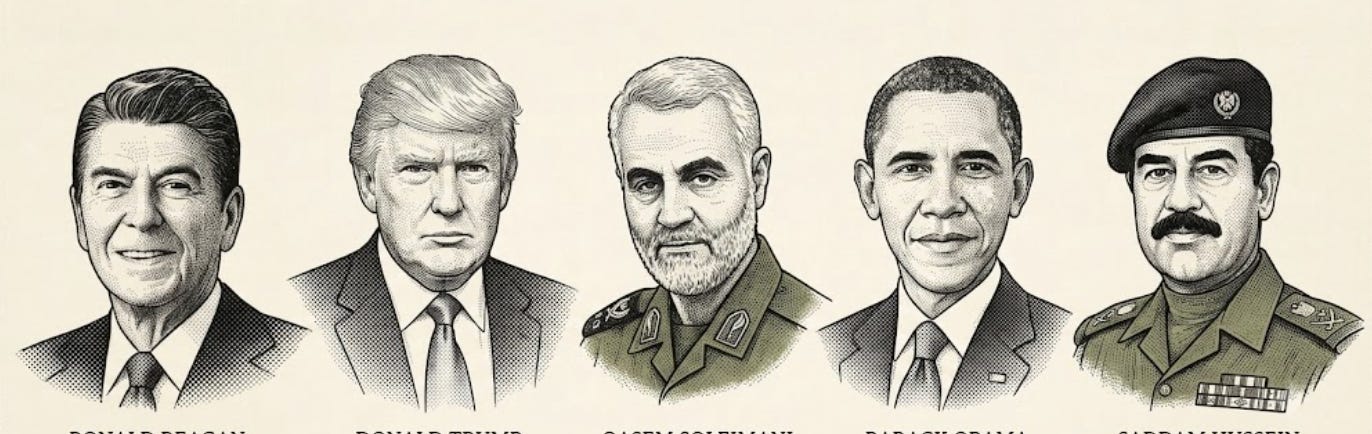
The most powerful of the groups that Iran armed developed when Israel invaded Lebanon in 1982. Iran sent Revolutionary Guards to help Lebanon’s Shia Muslims found Hezbollah. A truck bomb attributed to Hezbollah destroyed the barracks of the American peacekeepers in Beirut on October 23, 1983, killing 241 Americans, most of them Marines. The bombing forced Reagan to strike back or back down, and, unwilling to start another war so soon after Vietnam, he withdrew and never retaliated for the attack. That withdrawal showed Iran that armed groups in other countries force American troops out without bringing war to Iran.
Reagan's answer was a lie to the American people. In public, he declared Iran a sponsor of terrorism and backed Iraq's war against it. In secret, he sold Iran more than two thousand missiles in 1985 and 1986 to free American hostages in Lebanon. He spent the profit arming rebels fighting to overthrow Nicaragua's government, aid Congress had banned. The irony is almost unbelievable.
The secret came out in November 1986, the Iran-Contra affair. The lie proved the Particularism Monday's Edition described: America made the rules and expected every nation to follow them, but America followed the rules only when it was convenient for America.
The Iraq war spread to the Gulf. Both Iran and Iraq were attacking oil tankers. American warships escorted tankers through the Strait. The escorts led to battles with Iranian gunboats. On July 3, 1988, the cruiser Vincennes mistook an Iranian airliner for a warplane and shot it down over the strait, killing all 290 aboard, 66 of them children. America paid the families 61.8 million dollars eight years later but never apologized. In an Honor Culture, the money is meaningless; the offender must admit the wrong. Iran’s count of unanswered insults grew.
Iran and the U.S. were still deep enemies when al-Qaeda, an enemy of Iran as well as America, attacked the U.S. on September 11, 2001. After the attack, President Bush named Iran, Iraq and North Korea the “axis of evil.” America invaded Iraq in March 2003 and removed Saddam Hussein, who had invaded Iran in 1980. The invasion gave Iran allied militias inside Iraq and a supply route through Syria to Hezbollah.
The invasion also showed Iran what protects a nation: Iraq, with no nuclear bomb, was invaded; North Korea, believed to have one, was left alone. So Iran expanded uranium enrichment from 2006, making it possible to make a nuclear bomb. America and Europe answered with sanctions, and in 2012 cut Iran’s banks out of SWIFT, the network banks use to move money across borders. No country had been cut off before. Iran's oil income collapsed, and the loss forced Iran to negotiate. The talks produced the nuclear deal of July 14, 2015:
Iran:
Shipped out most of its enriched uranium
Let in inspectors to confirm it was not building a bomb
The United States, the EU, Britain, France, Germany, Russia, and China
lifted the sanctions on Iran
For once, the U.S. and Iran settled a fight by rules: Universalism.
Only 3 years later, the U.S. broke its word again. Donald Trump came to politics from New York real estate culture. A cultural perspective in which the basic unit is the deal, every deal has a winner and a loser, and a rival’s deal is by definition a loss. The theorist M.J. Hornby calls his type a pathological North: the power-seeker, a showman, willing to break rules other politicians obey. To that cultural perspective, the 2015 deal was Obama’s win, therefore Trump’s loss. Whatever other reasons he gave, Trump withdrew from the agreement on May 8, 2018, though inspectors had repeatedly certified Iran was keeping its part of the agreement. The U.S. restored sanctions.
Iran worked within the American system and lost anyway, a repeat of 1952, when it won in court, and the U.S. overthrew its government the next year. Iran has no reason to play by the rules. It enriched uranium past the deal’s limits from 2019, and Iran and its militias attacked Gulf tankers and American bases. The exchange peaked when Trump ordered a drone strike at Baghdad airport on January 3, 2020, killing Qasem Soleimani, the general who ran Iran’s militias abroad. Iran answered five days later with ballistic missiles at American bases in Iraq, then stopped. For the first time since their 1980s battles in the Gulf, each had struck the other openly.
The 1953 coup showed Iran that the U.S. does not obey its own rules and cannot be trusted. The Beirut bombing taught Iran that armed groups force American troops out. Iran-Contra and the airliner America shot down never apologized for reinforced that America's rules change to suit America: Particularism. America's invasion of Iraq made Iran stronger, and fear of being invaded like Iraq (and not North Korea, which has nuclear bombs) drove Iran to pursue a nuclear bomb. Sanctions forced Iran into the 2015 deal negotiated by Obama, which settled the fight by rules: Universalism. Trump, a pathological North Power-seeker, backed out of the deal, further reinforcing that the U.S. can not be trusted. Iran answered force with force until the Soleimani killing set the two nations directly against each other. That fight has now nearly stopped shipping through the strait.
Friday’s Edition covers the war itself: the strikes of 2025, the war of 2026, and what happens next.
If you enjoyed this article, help support my work by becoming a paid subscriber or “Buy me a coffee.”
Get a solid understanding of Trompenaars’ cultural dimensions by purchasing the guide or subscribing to Cultural Perspective (free or paid) and receiving the guide for free.


