What’s Next In Trump’s War With Iran? The Coup And The Hostages. Monday’s Edition.
The Long Chain: The U.S. and Iran. Series 35 #1
On July 17 and 18, 2026, American aircraft bombed Iran for the ninth night in a row, hitting bridges and power stations in Hormozgan, the Iranian province on the Strait of Hormuz, the waterway that carries about a fifth of the world’s oil. President Trump said, “We'll see what happens, but we hit them very hard again tonight.” Iran fired missiles and drones at American bases in Kuwait, Bahrain, and Jordan; American deaths in the war reached seventeen. Oil passed 90 dollars a barrel, and peace talks had collapsed over control of the strait.
The United States has a history of losing wars against smaller nations: Vietnam in 1975, Afghanistan in 2021. Iran may be the next. As with all wars, there is a long history behind it. For the U.S. and Iran, it began in 1953. That was the year America overthrew the Iranian government, an Honor Culture that demands that insults be answered, and the 444 days when Iran held Americans hostage made the two nations enemies to this day.
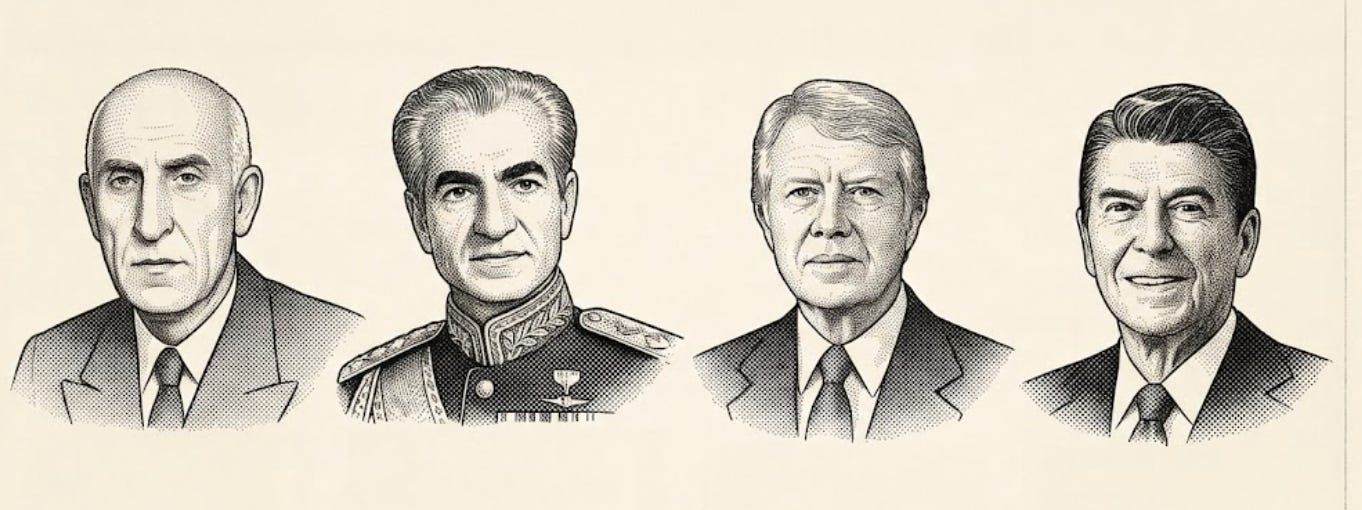
In 1951, Iran’s parliament took the country’s oil back from the British company that had controlled it since 1909. Britain challenged Iran's action in the World Court and effectively lost in 1952. The Court ruled the dispute was between Iran and a private company, not between two nations, so it had no power to hear the case. When Britain didn’t get its way legally, it pressured American leaders to help it overthrow the Iranian government and set up a puppet government. To regain control of Iran’s oil and from fear that Iran would fall to the communist Tudeh party and the Soviet Union, the CIA and Britain’s spy service, MI6, paid crowds and army officers to overthrow Iran’s elected prime minister, Mohammad Mossadegh, on August 19, 1953, and put the Shah, Iran’s king, in control of the nation.
After a day of street fighting that killed about 300 people, the Shah was in power and gave the oil back to the British and a large share to the Americans. In 1972, President Nixon agreed to sell the Shah any conventional weapon he wanted, so the Shah’s army, not American soldiers, would defend the Persian Gulf’s oil.
The Shah held power with a secret police force, SAVAK, that jailed and tortured opponents. It was clear that the U.S. had put the Shah in power and controlled him. So anger at the Shah grew into anger at America, and when the revolution forced the Shah out in January 1979 and toppled his government in February, the revolution’s leaders named the United States along with the Shah as the enemy.
For an Honor Culture, a nation’s worth comes from the respect others give it; insults and humiliations reduce that respect; they are personal and must be directly answered. The 1953 coup was such an insult; it must be answered and done so directly.
President Carter allowed the dying Shah into the United States for cancer treatment in October 1979. To the revolutionaries in Tehran, it looked like 1953 again: the CIA about to restore the king. Fear of a second coup drove hundreds of students to seize the American embassy on November 4, 1979, where they took about 66 Americans and held 52 of them hostage for 444 days. Americans watched helplessly night after night on television as the situation progressed. ABC started a nightly program named “The Iran Crisis: America Held Hostage.” It counted the days on screen.
America a Dignity Culture, where one’s worth is intrinsic. Disputes are not personal and are resolved in courts and by rules. But Americans hold a contradiction: they follow the rules, Universalism, when the rules work for them, but Americans also have a Particularism streak; the rules change when they are not in their favor. Americans call this cultural perspective American exceptionalism: America’s case is special, so the rules that bind others do not bind it. A nation that believes it is the exception demanded action against Iran.
The government acted, and failed. Carter sent helicopters and transport planes into the Iranian desert to free the hostages on April 24, 1980. Three of the eight helicopters failed, the mission was called off, and as the aircraft withdrew, a helicopter hit a transport plane; eight American servicemen died in the fire. Iranian television showed the wreckage to the world.
The televised wreckage helped decide an election held one year to the day after the seizure: Carter lost 44 of 50 states to Ronald Reagan on November 4, 1980. Inflation and a weak economy did part of that damage, but the hostages had convinced millions of voters that Carter was helpless. Iran made the defeat personal: it held the hostages until minutes after Reagan’s swearing-in on January 20, 1981, so the release would not be Carter’s.
That defeat set a rule for American politicians: a president who looks helpless against Iran can lose the presidency.
Reagan’s administration answered Iran with force in public view. In July 1987, the Navy began escorting reflagged Kuwaiti tankers through the Gulf. On April 14, 1988, an Iranian mine blew a fifteen-foot hole in the frigate USS Samuel B. Roberts and nearly sank it. Four days later, the Navy:
sank the Iranian frigate Sahand and the missile boat Joshan
crippled the frigate Sabalan
destroyed two Iranian oil platforms
sank several armed speedboats
Iran lost roughly half its operating navy in a single day.
Later politicians stated the rule directly. Between 2011 and 2013, Donald Trump, then a private citizen, said repeatedly that President Obama would attack Iran to win reelection. On November 29, 2011, he wrote that Obama would start a war with Iran in order to get elected. On October 9, 2012, he wrote that a president with falling poll numbers would launch a strike on Iran because he was desperate. Obama never did it. That is the point. Trump was not describing a plan. He was describing what he believed American voters reward. On January 3, 2020, facing an impeachment trial and a reelection campaign, Trump ordered the drone strike that killed Qasem Soleimani, the commander of Iran’s Quds Force.
Carter looked helpless against Iran and lost. No president since has wanted to test whether the rule still holds.
America overthrew Iran’s government in 1953 and put the Shah in power to keep control of Iran’s oil, which gave Iran, an Honor Culture, an insult to answer. The Shah’s police state made Iranians blame America along with the king, so when the revolution came, it was anti-American, and fear of a second coup drove Iranian students to take the U.S. embassy and American hostages. The hostages and a failed rescue cost Carter the presidency. Every president since Carter has known what looking helpless against Iran costs. That is one reason American bombs are falling on Iran again
Wednesday’s Edition covers what that lesson produced: forty years of attacks traded through proxies and warships, the deal that tried to end the conflict by rules, and the man who ended the deal.
If you enjoyed this article, help support my work by becoming a paid subscriber or “Buy me a coffee.”
Get a solid understanding of Trompenaars’ cultural dimensions by purchasing the guide or subscribing to Cultural Perspective (free or paid) and receiving the guide for free.


