What’s Next For The EU? The Treaty That Changed Europe. Monday’s Edition.
The Long Chain: The European Union. Series 34 #1
On July 7 and 8, 2026, the leaders of NATO met in Ankara, Turkey. On paper, the alliance held. But the reality was different. In May, the Pentagon announced it would pull about 5,000 American troops out of Germany. It canceled a missile battalion it had promised to send. Defense Secretary Pete Hegseth prepared to announce deeper cuts at a NATO meeting in June but instead announced a six-month review of American forces in Europe. CNN reported that in a private White House meeting, President Trump asked what message it would send if he cut American forces in Europe by a third.
That is the situation Europe now faces, leaving the European Union with a choice it has avoided since its founding. Its twenty-seven countries can combine their armies, their money, and their governments into something close to a single state, or they can splinter into separate nations again. Europe is in this position because of a treaty written in 1648 that changed the way Europe fundamentally worked.
That treaty was written to end the worst war Europe had seen. From 1618 to 1648, what started as a conflict between Catholic and Protestant rulers became the Thirty Years’ War. The fight was about how Europe would be ruled: by a single authority, and which one. The war killed between four and eight million people. In some German lands, one in three died from the fighting, hunger, and disease.
Before the war, European nations were expected to answer to a single authority, which held power even over the kings. The Pope in Rome and the Holy Roman Emperor each claimed the right to rule over all of Christian Europe. The Thirty Years’ War was the worst of Europe’s wars over who would rule the continent, and it settled nothing.
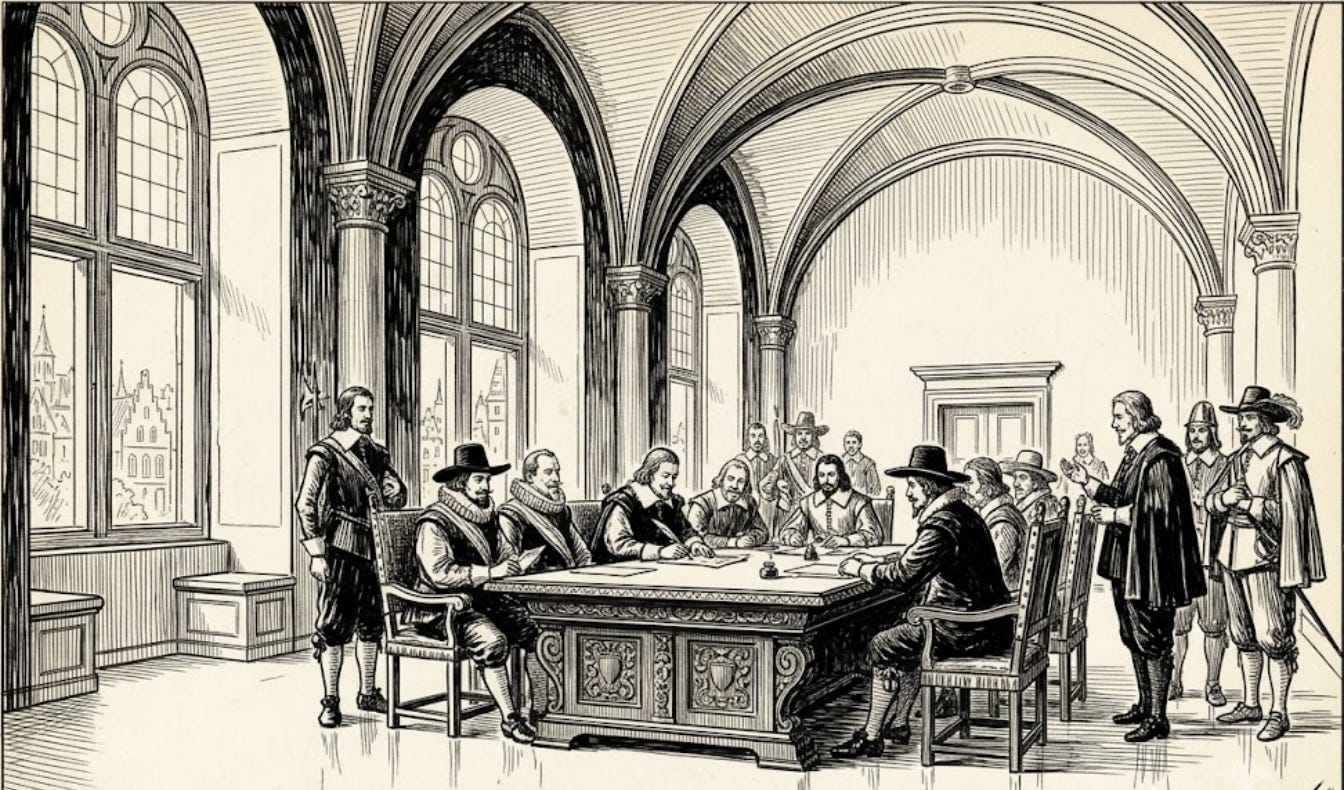
So in 1648, exhausted rulers signed a set of treaties known as the Peace of Westphalia. The Peace ended the war by ending the idea of a single authority. It replaced it with the idea of sovereign states, each ruled by its own leader, who did not answer to a higher power. Scholars mark this as the start of the modern state system, the world of separate, self-ruling countries that still exists today.
Over the next two centuries, people came to identify with their nation. They identified with the in-group to which they belonged, the nation. A German feels German first, and will fight and die for Germany.
The system of independent nations that Westphalia created, meant to keep the peace, ultimately produced two world wars. The survivors of those wars decided national self-rule was now the danger, not the solution. They began to build a union that would put a common set of rules and a common authority in control of the nations. That union became the European Union. But one persistent argument divides the European Union: how much power should the union wield and how much should stay with each nation?
The union asks twenty-seven nations to accept a body that can make rules all of them must obey. This is the exact thing their ancestors fought the Thirty Years’ War to abolish. It asks people loyal to the nation to feel European instead. Each time the union gains power, that power goes to Brussels. And each time, the people who want that power kept in their own capital resist. This disagreement is not one that the EU can easily overcome because it stems from the in-group-out-group divide: people do not give up a national identity for a larger, more mixed one.
For most of its history, the EU avoided that question because the United States took care of the hardest parts: defending Europe and directing (at least highly influencing) its foreign policy. After 1945, Europe lay in ruins. The United States rebuilt its economy and guarded it with American soldiers and nuclear weapons. That protection allowed European countries to integrate their economies. It began with the European Coal and Steel Community in 1952 and grew into what it is today: open borders, a common currency, and EU laws that override national ones. But the EU did not have to create a single army or common foreign policy.
The NATO meeting in Ankara put the American defense of Europe and its influence over foreign policy in question. With the United States now withdrawing its protection, Europe has to answer the question it set aside for seventy years: Will it become a federation able to defend itself and set policy, or dissolve into the separate nations that Westphalia created?
One authority once claimed to rule all of Europe. A war fought over that claim killed millions. The Peace of Westphalia replaced it with sovereign, self-ruled nations. Over two centuries, people identified with their nation. Those nations' endless wars culminated in two world wars. The destruction convinced the survivors that self-rule itself led to war, so they built a union that could make rules every nation had to obey. The United States protected and directed the union, so Europeans never had to unite into a federation. Now the United States is abandoning its obligation, and from a cultural perspective, four hundred years in the making, Europe must choose between a federation or independent nations
Wednesday’s edition traces the middle of this story: how the self-ruling nation that Westphalia created led to Napoleon, to two world wars, and to the men who decided that the only way to stop European nations from fighting was to bind them together.
If you enjoyed this article, help support my work by becoming a paid subscriber or “Buy me a coffee.”
Get a solid understanding of Trompenaars’ cultural dimensions by purchasing the guide or subscribing to Cultural Perspective (free or paid) and receiving the guide for free.


For a future possible European model visit Switzerland. Anything that can bring German, French, and Italian cultures together must be doing something right. A pure culture based model struggles.