Trump's Third Term. Why America Put A Limit On The President. Monday's Edition
The Long Chain: Trump's third term. Series 36 #1
On July 24, 2026, President Donald Trump spoke at the White House Correspondents’ Dinner in Washington. Trump said, “Just like my presidency, the second time is always better, always better, and the third time will be better yet.” At the end of his speech, he put on a red cap that read “Trump 2028,” and he said, “I'm pleased to announce my intention to, and this is somewhat of a scoop, my intention to run for a fourth term as president of the United States." Then he added, “I’m only kidding.” He was not kidding. In July 2024, speaking at Turning Point Action's Believers' Summit in West Palm Beach, he said: "In four years, you don't have to vote again." In March 2025, he told NBC News, "there are methods" for him to serve a third term. His online store had been selling the Trump 2028 hats since April 2025.
The 22nd Amendment to the U.S. Constitution states that no person shall be elected to the office of the President more than twice. That rule exists to keep one person from becoming too powerful and the U.S. falling into dictatorship and fascism. In the American politcial cultural perspective, people rule themselves as equals, and no one person or party rules for life, or even too long.
Twenty-Second Amendment
No person shall be elected to the office of the President more than twice, and no person who has held the office of President, or acted as President, for more than two years of a term to which some other person was elected President shall be elected to the office of the President more than once. But this Article shall not apply to any person holding the office of President when this Article was proposed by the Congress, and shall not prevent any person who may be holding the office of President, or acting as President, during the term within which this Article becomes operative from holding the office of President or acting as President during the remainder of such term.
Americans formed that persepctive to escape the one-man rule of England’s King George III. The American colonists spent eight years, from 1775 to 1783, fighting to be free from King George III, a ruler who held power for life. They were acting from the cultural persepctive of Egalitarianism: the value that people are equals, and no one is born to rule over them. The opposite cultural persepctive is Hierarchy, the value that some people are placed above others and are owed obedience. A king is the purest form of hierarchy. A democracy is the cleanest form of egalitarianism because it allows the people to choose the government. The U.S. Founding Fathers had already written the belief down in 1776, in the line that all men are created equal. In the 1700s, “equality” pertained only to white men who owned land; thankfully, that has changed, although the U.S. is far from real egalitarianism.
That founding idea that power must never be in the hands of a single person led George Washington to give up power. He was popular enough to be re-elected for as long as he lived. But holding power for life was exactly what Americans had fought to escape; it was essentially the reason for the American Revolution. So in 1797, Washington left office and went home to his farm in Virginia after two terms. His choice created an unwritten rule: a president serves only two terms and then leaves.
America’s second President, John Adams, served only one term and power passed peacefully to Thomas Jefferson. Washington’s example convinced Jefferson to serve only two terms. Jefferson was asked to run for a third term, but refused. He warned that a president who kept winning re-election would in time become president for life, and the office could become inherited, like a king’s. Jefferson’s was clear: even if the people want a president for life, it should not happen.
Washington and Jefferson set the precedent and tradition: no president serves more than twice. That tradition grew strong enough to stop the men who challenged it. Ulysses S. Grant, a war hero who had already served two terms, tried to run for a third term in 1880, and his own party refused him the nomination. Theodore Roosevelt, who had served nearly two terms, ran for another in 1912 and lost. The rule held without needing to be a law, because it was a basic part of the American system. This was the way it was for almost a hundred and fifty years through wars, recessions, and depressions.
Then came the Great Depression, in which at one point, a quarter of American workers were unemployed. That crisis created a new level of fear, and that fear convinced Americans they needed a single strong leader to save them. The war in Europe added to the fear, and the Americans elected Franklin Roosevelt to a third term in 1940 and a fourth term in 1944. Roosevelt became the only president to hold power beyond two terms, and the tradition George Washington started, which came to be a basis of the American system, came to an end.
After the depression, the war, and the fear had passed, America returned to its founding principle, and Congress passed the 22nd Amendment restricting presidents to two terms. The custom Washington began in 1796 was now Constitutional law.
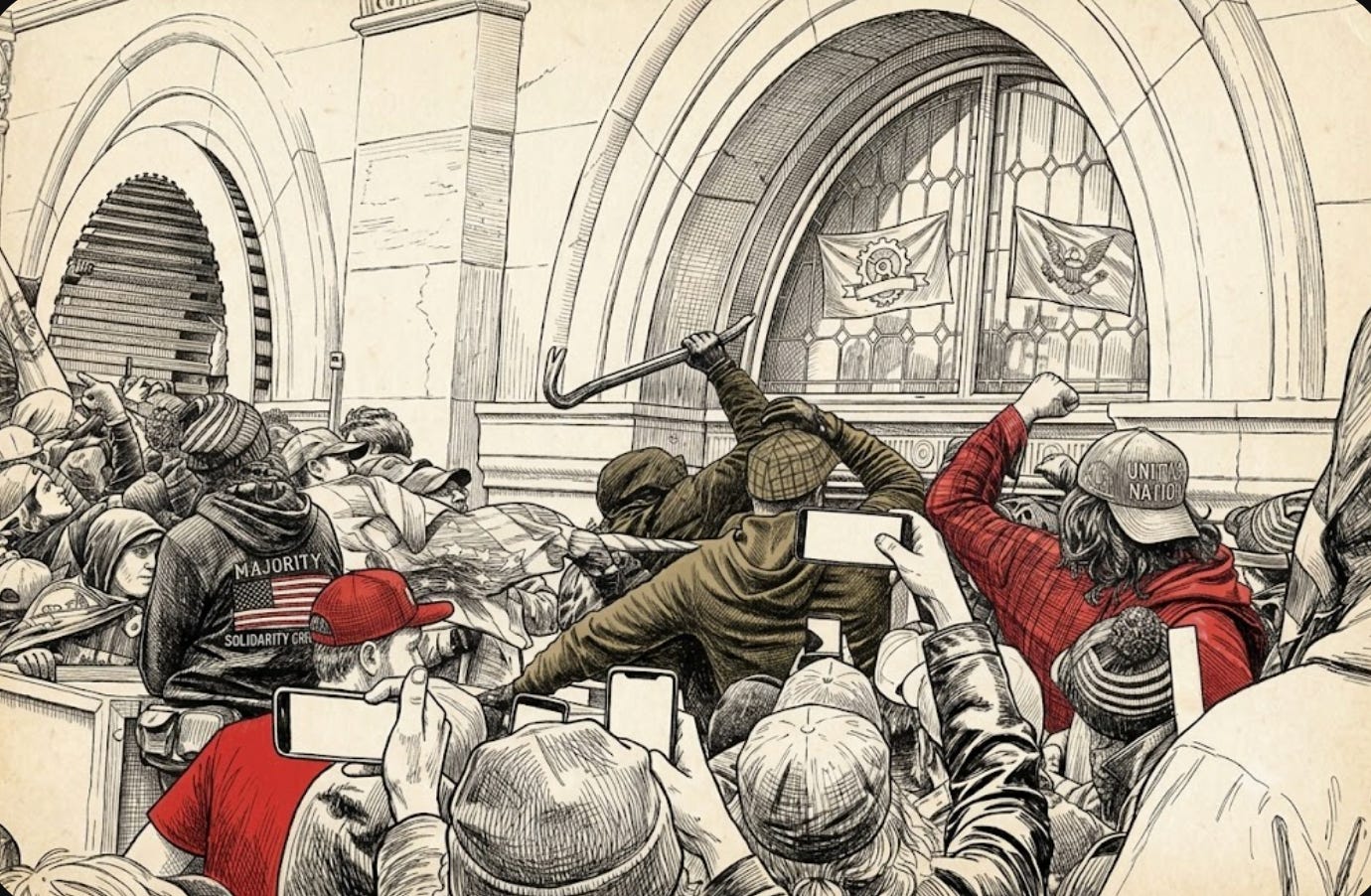
For the next 70 years, there has never been an issue with the transfer of power in America. That ended on January 6, 2021, when Donald Trump lost the election and incited the Capitol riot in a desperate hope to hold on to power. He failed. Now he appears to be trying a new tactic to hold on to power, running for a third term
The American colonists wanted freedom from one-man rule, King George III. That brought about the American Revolution, which created the American cultural perspective that no one man rules for long. That belief led Washington to give up power after two terms in 1796. His example led Jefferson to do the same, and created the tradition and basic American identity that a president can serve no more than two terms. Grant and Theodore Roosevelt tested it, but the Party and the people said 'No’. During the Depression and the Second World War, Americans gave in to the fear and elected Franklin Roosevelt for four terms. This caused Congress to pass the 22nd Amendment and legally restrict a President to two terms. The 22nd Amendment has been a key part of keeping any one person from taking power and making the U.S. into a dictatorship - until now.
Wednesday’s Edition covers what Trump has said and done to stay in power for life. How much control he now holds over the Republican Party, the courts, and those that could stop him.
If you enjoyed this article, help support my work by becoming a paid subscriber or “Buy me a coffee.”
Get a solid understanding of Trompenaars’ cultural dimensions by purchasing the guide or subscribing to Cultural Perspective (free or paid) and receiving the guide for free.


In following your essays on culture, I have become quite culturally centered in my own philosophical writings. Can you address how individuals, particularly those with political power take exception to culture norms. The phrase "yes but" comes to mind.
A similar discussion from you might be how culture informs politics. Politics, being the only way to curb those who control power of the institution which is tacitly accepted as OK to use threat-of-punishment. Compare that with how culture informs actions in the voluntary-sphere (marketplace). . . Where millions who, through mutual accommodations, simultaneously satisfy wants, meet needs and solve problems.