Trump’s Third Term. What He Has Said And Done To Keep Power. Wednesday’s Edition.
The Long Chain: Trump’s Third Term. Series 36 #2
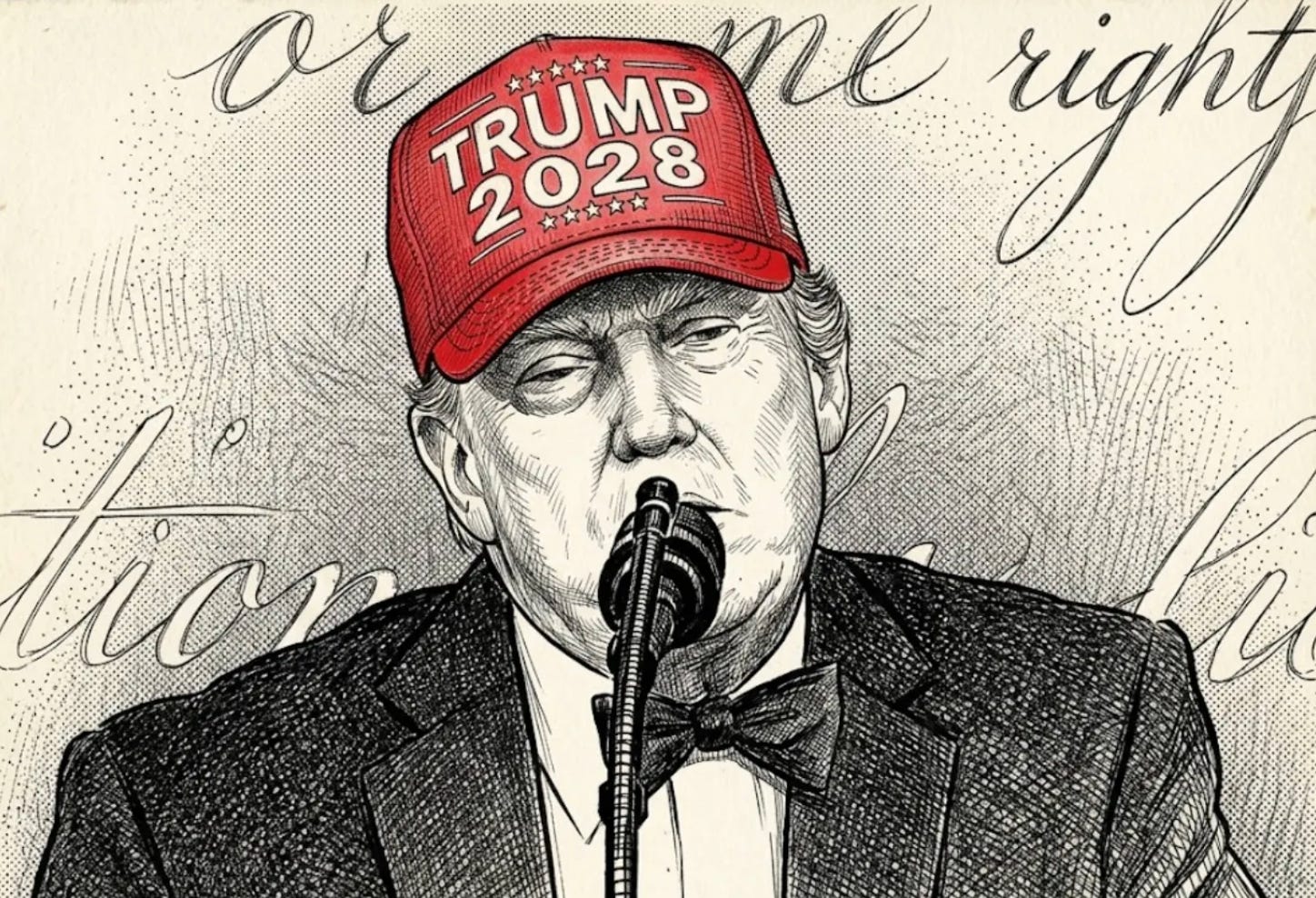
Trump’s online store sells a red hat that reads “Trump 2028.” Tennessee congressman Andy Ogles filed a resolution to change the Constitution so Trump can run a third time. A group called the Third Term Project started at a conservative conference in February 2025 to build public support for Trump’s third term. In October 2025, asked whether he would run again, Trump said, “I would love to do it.”
The question is not whether Trump wants to keep power, but how far he will go to hold it. Trump acts from what theorist M.J. Hornby calls the North drive, the Power-Seeker: a person whose main aim is to lead and to hold power, who rejects other people’s ideas unless they serve him, and who bends or breaks rules when they block him. A healthy North directs good government, builds companies, and coaches a successful football team. A pathological North, with nothing to check it, produces dictators and tyrants. It works against the cultural value of Egalitarianism, a belief at the center of the American political cultural perspective, that power is earned, held for a short time, and passed to the next person.
Trump’s pathological North drive showed after he lost the 2020 election and refused to accept the result. He told a crowd in Washington to march on the Capitol and “fight like hell,” and the crowd attacked the Capitol to stop Congress from counting the votes. It was violent; people died, 140 officers were injured, but the insurrection failed, and Trump left office. The House impeached him for inciting an insurrection, and the Senate acquitted him.
Unable to keep power by force, but also having it made clear that the Republican Party would support him, Trump took a less violent route. He returned to office in 2025 and began building a system that would keep him in power indefinitely. Ogles filed his resolution to let a president serve three terms. That resolution gave the Third Term Project something to organize behind, and by April 2025 Trump’s own store was selling the “Trump 2028” hat.
With momentum moving in favor of a permanently elected President, Trump said in October 2025 that he would “love” to run for a third term and would not rule it out. He wore the “Trump 2028” cap at the Correspondents’ Dinner in July 2026. He has also said “it’s pretty clear I’m not allowed to run,” and he rejected one legal trick, running as vice president and then taking over, as “too cute.” Saying this serves him. As long as a third term stays possible, Trump does not become a lame duck, the weak final-term president the two-term limit usually creates. The doubt keeps Republicans from proposing another presidential candidate in 2028.
Trump’s goal is to be America’s first President For Life. He already holds the power that would decide a third term. Trump controls the Republican Party. Of the roughly 270 Republican Congress and Senate members, fewer than half a dozen vote contrary to Trump’s demands. He controls the Republican primaries by endorsing candidates months before the vote, which clears the field before anyone can challenge them. Almost every Republican now in office depends on his support, so almost none will cross him. His grip is strong but not complete: several candidates he backed in 2026 still lost, in Iowa and in a Georgia runoff.
His power reaches the courts as well. The Supreme Court gave him broad protection from the law in July 2024, ruling that a president cannot be prosecuted for official acts. In June 2026, the Court gave Trump the power to fire the officials who run federal agencies, though it set some limits. Three of the nine justices were appointed by Trump, part of a six-to-three conservative majority. The Court has generally supported Trump's consolidation of power and move to dictatorship and seldom rules against him.
Real barriers still stand:
Changing the 22nd Amendment requires two-thirds of both houses of Congress and the approval of 38 states, and no party is close to that.
The states run the elections and print the ballots.
Voters in the November 2026 election will either elect a Republican-controlled Congress that supports Trump as a President for Life or a Democratic controlled Congress that supports the Constitution.
To overcome the voter problem, Trump and the Republicans, along with the support of the Supreme Court, are changing laws and rules to restrict voters not favorable to Trump.
In Shelby County v. Holder, the Court voted 5 to 4 to strike down the formula that decided which states had to get federal approval before changing their voting rules. States with a history of discrimination now change their voting rules without federal review.
In Rucho v. Common Cause, the Court voted 5 to 4 that federal courts cannot hear claims about districts drawn for partisan gain. Chief Justice John Roberts wrote that federal judges have no authority to redistribute political power between the two parties. The Court did not say those maps are legal. It said federal judges cannot stop them.
In Louisiana v. Callais, it made it far harder for Black and Latino voters to prove their votes had been diluted.
Trump told Texas in 2025 to redraw its districts to win five more House seats; the Supreme Court let it stand for the November 2026 elections.
On 11 February 2026, the House passed the SAVE America Act by 218 to 213. On 17 March, the Senate voted 51 to 48 to open debate. Debate collapsed weeks later without a vote on the bill itself, well short of the 60 needed to break a filibuster. It requires a passport or birth certificate to register and a photo ID to vote, and it ends most mail and online registration. The Brennan Center finds 21 million eligible citizens lack ready access to those documents. The Center for American Progress reports 69 million women hold birth certificates that no longer match their legal names. The bill stalled in the Senate in March 2026, short of the 60 votes it needed. Fourteen states have passed their own versions.
Republican legislatures also passed laws that cut mail voting, closed polling places, and purged voter rolls, steps that harm Democratic and Black voters the most.
The aim is clear: the fewer people who can vote against him, the longer Trump can hold power.
Trump’s pathological Power-seeker drive led him to call for an insurrection when he lost the election and a mob attacked the Capitol. When it failed, that failure led Trump to try a new strategy: a resolution in Congress for a third term, an organized campaign, and a packed Supreme Court. The pro-Trump Supreme Court has given Trump more power, and that has caused Republican members to submit to him, increasing his power. Now only voters keep Trump from being the first American President For Life. This has led Trump, the Republicans, and the Supreme Court to restrict who can vote, skewing the balance firmly in Trump’s favor.
Friday’s Edition runs this chain one step into the future:
what Trump is most likely to do to keep power
whether the Republican Party, the courts, and the November election stop him
what America looks like if they do not
If you enjoyed this article, help support my work by becoming a paid subscriber or “Buy me a coffee.”
Get a solid understanding of Trompenaars’ cultural dimensions by purchasing the guide or subscribing to Cultural Perspective (free or paid) and receiving the guide for free.


