

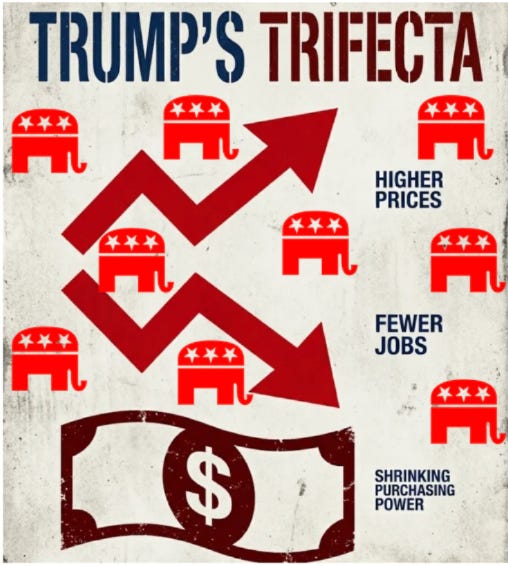
Trump promised Americans lower prices, more jobs, and greater prosperity. He delivered higher prices, fewer jobs, and greater poverty. Past American presidents have done the same. This happens as economic cycles turn and administrations come and go. The economy improves, falters, and gets better again. But this time may be different.
What Trump and the Republicans have done will be longer-lasting and, in some cases, permanent.
Since Trump and the Republicans have taken control:
Consumer prices are up 3.7% according to the Bureau of Labor Statistics.
Gasoline prices are up 34.2%
Electricity prices are up 4.4 percent,
Food prices are up 2.5 percent
Housing prices continued to climb.
At the same time, inflation-adjusted wages have fallen, and job growth has slowed.
Trump’s trifecta of economic disaster for Americans.
But it’s not just people. Businesses are struggling too.
The USDA forecasts that farmers’ inflation-adjusted profits will decline by $9.1 billion in 2026, a 5.5 percent reduction. Manufacturing growth slowed sharply in the third quarter, while motor vehicle production fell 3 percent in September.
Homebuilders face high material costs, expensive financing, and labor shortages. Agricultural producers face the same problems on top of crippling diesel prices.
These numbers describe an economy in trouble. The American economy has been in trouble before, but what’s different about this trouble is that Trump has created a situation that makes it difficult for the economy to recover. He’s worked to make it long-term at best and permanent if he succeeds.
Here’s how it works: For decades, American farmers built relationships with foreign customers, including China, one of the world’s largest agricultural markets. When tariffs made American soybeans more expensive, Chinese buyers bought more from Brazil. Brazilian growers compete directly with American growers for those customers.
Once a foreign buyer signs long-term contracts with a new supplier and invests in the ports and railways to move the grain, the buyer has little reason to go back. A future president can end the tariffs, but that does not undo contracts or change infrastructure.
Manufacturing follows the same pattern. Higher costs, unpredictable trade policy, and uncertain export markets force companies to cut production or move. When a factory closes, workers lose their jobs, suppliers lose their customers, and the town loses spending and tax revenue. Some factories reopen, some do not.
Construction and agriculture significantly depend on immigrant workers. Deportations and tighter enforcement remove those workers. Ending the enforcement does not bring back the production already lost.
This is Trump’s trifecta: higher prices, fewer jobs, paychecks buying less, and he’s done his best to make it permanent.
If you enjoyed this article, help support my work by becoming a paid subscriber or “Buy me a coffee.”
Get a solid understanding of Trompenaars’ cultural dimensions by purchasing the guide or subscribing to Cultural Perspective (free or paid) and receiving the guide for free.

What is the endgame here in your opinion, Way?