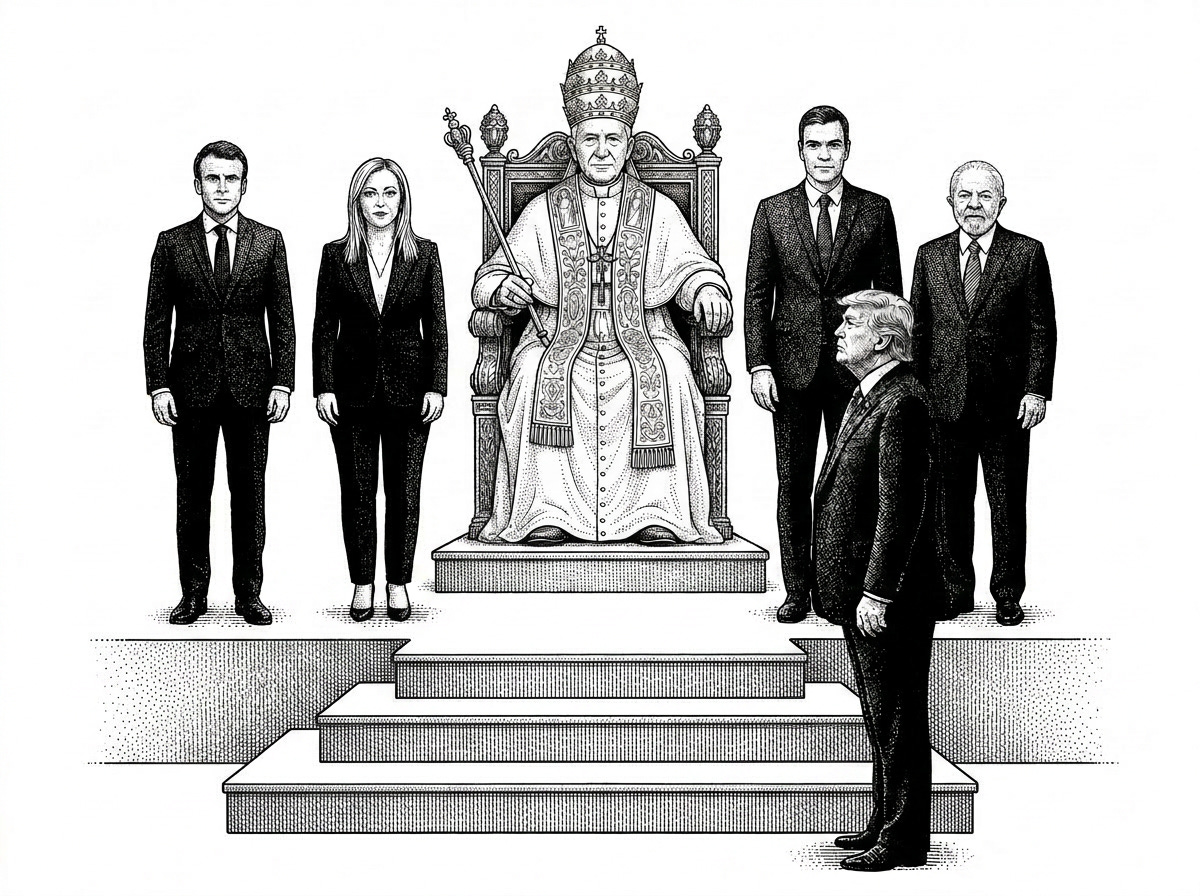
Trump vs. Pope Leo
Marco Rubio, the U.S. Secretary of State, met Pope Leo XIV at the Vatican this week. The audience was meant to repair a rift that began in October, was accelerated by Trump in early April, and that Trump has reopened almost weekly since. The rift has cost Trump his strongest ally on the European right.
Pope Leo first drew Trump’s anger over deportations in late 2025. Leo called U.S. deportation tactics 'extremely disrespectful.' He called migrants “messengers of hope”. He accepted Cardinal Timothy Dolan, a friend of Trump’s, mandatory retirement and chose Bishop Ronald Hicks, a public critic of the deportation campaign, as his successor. The Iran war made it worse. Leo called Trump’s threats against the Iranian people “truly unacceptable” and said a “delusion of omnipotence” was driving the U.S. and Israeli campaign.
On April 12, 2026, after a CBS “60 Minutes” segment in which three American cardinals called the Iran war “unjust,” Trump posted on Truth Social, his social media platform, that Leo was “WEAK on Crime, and terrible for Foreign Policy.” He added that Leo would not be pope if Trump were not president. The next day, Leo answered that he had “no fear” of the administration and would not stop speaking about the Gospel. Days later, Trump posted, then deleted, an image generated by artificial intelligence of himself as Jesus. On May 5, on The Hugh Hewitt Show, Trump claimed Leo was “endangering a lot of Catholics” and accused him of being soft on Iran’s nuclear program. Leo had said no such thing.
Criticizing Leo was a mistake. About fifty million Americans are Catholic. A pope born in Chicago who speaks American English is the worst possible critic for a president who won the Catholic vote in 2024 by fifteen points. Trump’s pattern with critics is to discredit them until they go silent. Leo did not go silent.
While in Cameroon in mid-April, Leo denounced the “handful of tyrants” spending billions on war. He held his line on migrants. The Vatican is preparing his first encyclical, an official letter from the pope to the worldwide Catholic Church, on artificial intelligence, international peace, and the crisis of international law. It is expected on May 15, the 135th anniversary of Rerum Novarum.
The reaction to Trump’s attack and Leo’s response has fallen into two groups, and one of them was a surprise.
The expected group spoke first. Spain’s prime minister, Pedro Sánchez, said: “While some sow the world with wars, Leo XIV sows peace, with bravery and courage.” French President Emmanuel Macron met Leo at the Vatican on April 10 and accused Trump of “fueling instability.” Brazil’s president, Luiz Inácio Lula da Silva, told Brazil’s bishops that “advocates for peace and for the oppressed have been attacked by powerful people who think they are deities to be adored.” Mexico’s Claudia Sheinbaum and Colombia’s Gustavo Petro joined Sánchez and Lula in Barcelona on April 18 at a summit framed openly against Trump.
The unexpected group is the headline. Italy’s prime minister, Giorgia Meloni, was Trump’s strongest ally in Europe and the bridge between MAGA and the European populist right. Italy had already refused to support the Iran war and denied U.S. bombers permission to land at Sigonella, an Italian air base that hosts a major US military presence in Sicily. On April 13, she called Trump’s attack on the pope “unacceptable” and said: “The pope is the head of the Catholic Church, and it is right and normal for him to call for peace and to condemn all forms of war.” Trump told Italian newspaper Corriere della Sera the next day: “I thought she had courage, but I was wrong.” He has not spoken with her since.
In Italy, Catholic identity is integrated with national identity. The two value systems Schwartz calls Conservation (tradition, conformity, security) and Embeddedness (loyalty to one’s group) cluster in Italy around the Church, not the political party. Italy is also a diffuse culture (Trompenaars): a politician’s faith and the office they hold are not as separated as in other Western nations. So when forced to choose between the American president and the bishop of Rome, Meloni’s choice was clear.
Trump’s attacks have produced the opposite of their goal (if they even had a goal). They have not silenced Leo; they have given him a stage and a reason for people to rally around him. They have turned his ally, Meloni, into a critic, hardened opposition from Sánchez, Macron, Lula, Sheinbaum, and many other leaders, and built a larger audience for the encyclical Leo will publish in the next few weeks.
Watch for more leaders to use this to distance themselves from Trump. This is an ideal opening for the right to push back against Trump with little political fallout.
If you enjoyed this article, help support my work by becoming a paid subscriber or “buy me a coffee.”


