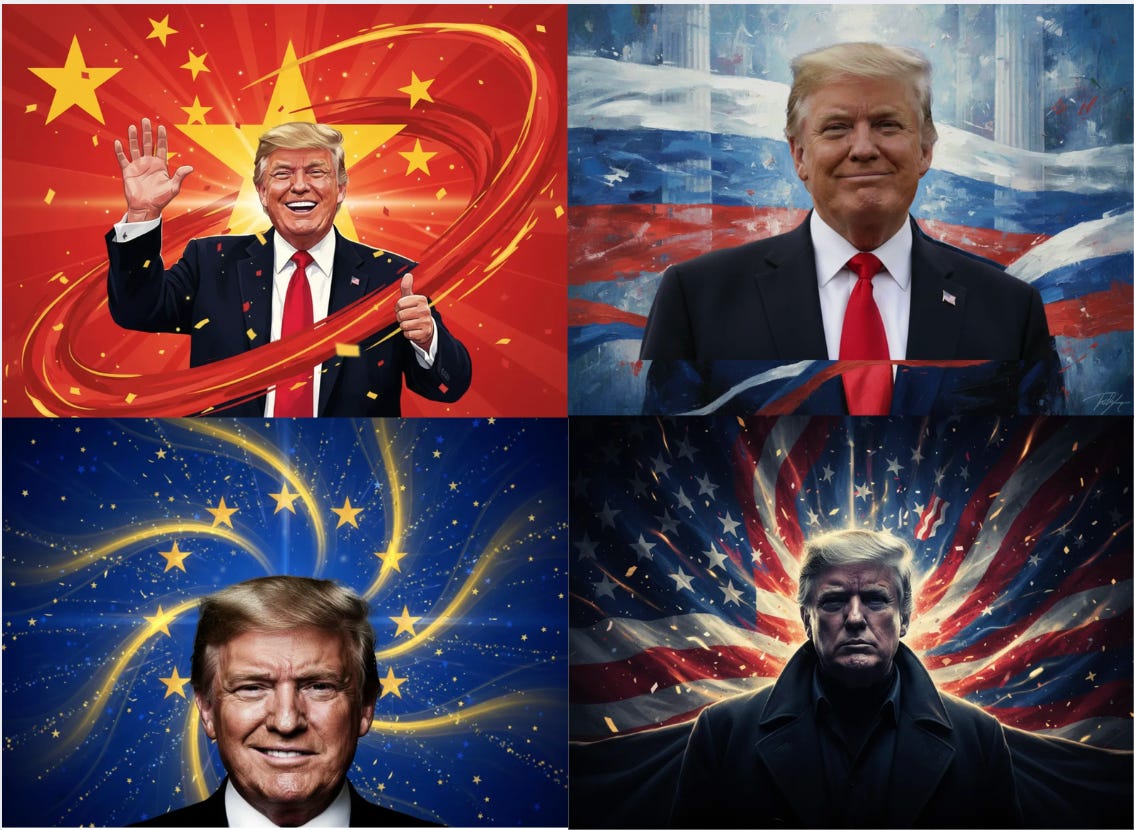
Trump: Good Or Bad For The World? Monday's Edition
Trump: good or bad for the world?
In the first eleven months of 2025, China recorded its largest trade surplus in history: $1.08 trillion. In the same period, Trump’s tariffs cost the average American household $2,400 to $3,800.
Same policy. Same president. Opposite outcomes.
This is not a contradiction. It is a pattern.
Donald Trump is the most consistent president in modern American history. That sounds like a good thing, it’s not. He does not adapt. He does not negotiate in good faith. He does not learn from failure. He rewards loyalty and punishes disloyalty. He sees every relationship as a transaction and every transaction as a zero-sum game. He trusts his instincts over expertise, his allies over institutions, his interests over obligations. Every time, no change, no learning, no evolution.
He has operated this way for decades. As a real estate developer. As a casino owner. As a reality television host. As a first-term president. As a candidate. As a second-term president. The settings change. The behavior does not.
This consistency is his greatest strength and his greatest weakness. It makes him predictable. And predictability, in international relations, is something other actors can exploit, accommodate, or resist depending on their own cultural orientation.
The outcomes of Trump’s presidency vary not because Trump changes, but because his stakeholders differ. Some cultures can read his patterns and adapt around them. Others benefit because his style serves their interests. Others are forced into changes they should have made years ago. And one is being torn apart from within.
This week examines four stakeholders through the lens of cultural frameworks developed by researchers who spent decades studying how societies differ in their fundamental assumptions about power, time, relationships, and rules.
Geert Hofstede identified dimensions like power distance (how much a society accepts inequality), uncertainty avoidance (how much it fears the unknown), and individualism versus collectivism (whether people see themselves as “me” or “we”). Fons Trompenaars mapped dimensions like universalism versus particularism (do the same rules apply to everyone, or do relationships determine exceptions?) and internal versus external direction (do you control your environment, or adapt to it?). M.J. Hornby described psychological archetypes that drive individual and collective behavior: the power-seeker, the guardian, the sage, and the caregiver.
These are not abstractions. They are tools that explain why the same American president produces a trade surplus in China, a red carpet in Russia, a defense transformation in the EU, and economic disaster in the U.S.
“Is Trump good or bad for the world?” is too simple a binary question. The reality is
Trump is great for China, Tuesday’s Edition.
He’s good for Russia, Wednesday’s Edition.
He’s neutral for the EU, Thursday’s Edition
He’s bad for the US, Friday’s Edition
The good or bad framing misses the point that Trump is consistent. The better question is: for whom does that consistency work?
China can read him and adapt. Russia can flatter him and benefit. Europe can resist him and reform. Americans must live under him, inside a system he is systematically dismantling.
Saturday will reveal the deeper pattern beneath these outcomes: what connects China’s surplus to Russia’s red carpet to Europe’s rearmament to America’s decline. And what that pattern means for the future.


He is a despicable human being. He’s more barbaric than humane, always transactional and therefore predictable. The man and his regime are a modern day scourge. The complicity of Fox and others is also a lesson in the dynamics of manipulation. This is how the N*zi party slowly turned “the people against the people”. All of in the name of righteousness nationalism. Once the national psyche was corrupted, it compelled itself to follow the preset course. The “kill or be killed” mind control was complete but eventually devoured itself. This is the America of today headed towards the lethality of tomorrow.
Wow that was a Jack Handy moment wrapped up into a meandering comment.