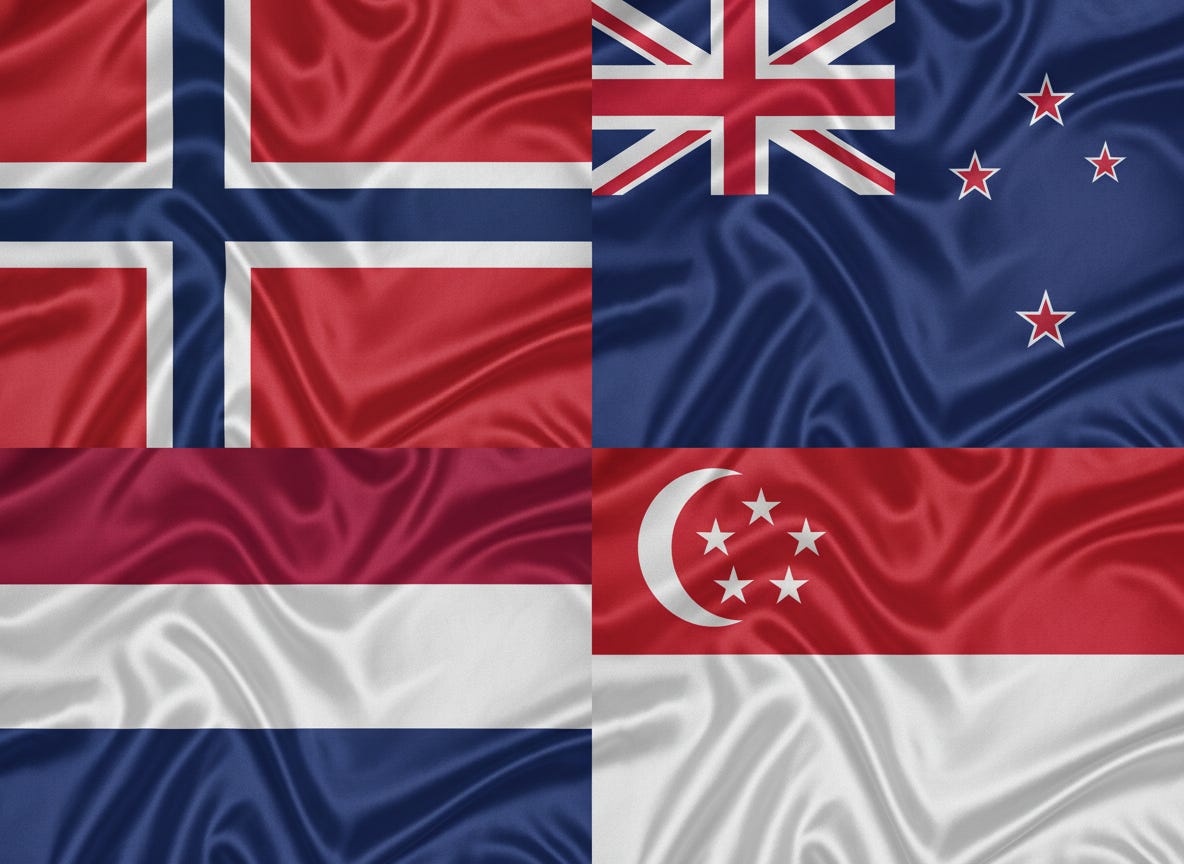
There Is No Best System: Monday Edition
Four government systems the deliver results
There is no best system of government.
A belief that there is a best system is a reaction to the propaganda and ideology we’ve been fed, and a good dose of ignorance.
The idea that one political model represents the endpoint of human progress is comforting. It flatters those who benefit from it. It builds national cohesion and helps keep the elite in power. But it collapses the moment results are examined, and rhetoric is abandoned.
Across the world, wildly different systems deliver what we all want: a life that works. A society in which people are healthy, children are educated, streets are safe, bureaucracies function, corruption is minimal, we have opportunity, the machinery hums, imperfectly but reliably.
That machinery looks nothing alike from place to place.
This is where most political debate goes wrong. It starts with values, progresses to ideologies, and ends with accusations or self-congratulations. It asks what a system believes before asking what it produces. It treats government as identity, but government exists for what it produces for the people, not what it self-identifies as.
Government is closer to plumbing than philosophy. When it works, no one notices. When it fails, everything smells.
This week’s series begins with a simple premise: Some types of governments produce positive outcomes for citizens. They optimize different priorities and have different trade-offs. None of them is universally superior, they succeed only if society matchs their cultural perspective.
The outcomes show up in ordinary life: health, education, safety, opportunity, corruption levels, and how well public institutions function. Can we live our best lives?
Some systems prioritize equality and security, reducing extremes, fewer poor, but fewer super-rich. Others prioritize rules and rights, building strong legal guardrails that slow decision-making but reduce abuse. Some systems take longer because everyone gets a seat at the table and therefore decisions are meant to be long-lasting. Others restrict choice in the short term to accelerate economic growth and build national capacity.
Each choice extracts a price. There is no free lunch, only different bills sent to different addresses. What determines the bill and who gets billed is the culture.
Not culture as food or flags or folklore, but culture as expectation. How people relate to authority. Whether rules are seen as binding or negotiable. Whether time is measured in election cycles or generations. Whether conflict is resolved by confrontation, compromise, or delegation.
Where government aligns with these expectations, it feels boring. Where it does not, even well-designed systems feel frustrating, oppressive, or chaotic.
This is why systems that look ideal on paper can fail in practice when used in a mismatched culture. A high-trust welfare state transplanted into a low-trust society becomes a corruption machine. A technocratic growth model dropped into a low-power distance culture gets a hard pushback. A consensus system imposed in a hierarchy goes nowhere.
This is also where Hornby’s archetypes matter. Some societies are comfortable being guided by a Visionary or a Guardian, someone who sets direction and enforces boundaries. Others expect a Communicator or a Negotiator, someone who mediates, explains, and smooths conflict. Some value the Craftsman, obsessed with systems that work. Others rely on the Caregiver, protecting cohesion above all else. When leadership archetypes align with institutional design, systems hold. When they clash, it ends quickly.
Scholars have tried to formalize these patterns. Hofstede, Trompenaars, Schwartz, GLOBE, Hall. Different maps of the same terrain. None perfect, all useful. They converge on one point: governance succeeds when it reinforces what people already believe is correct in their culture.
This week examines four governance models that do exactly that. It does not rank them, nor praise or condemn them. The goal is to understand why they work where they do.
The question is not which system is best, it’s which system allows ordinary people, in a specific place, with specific expectations, to live a life that works for them.
Tomorrow begins with the model most often idealized, and most often misunderstood. The Nordic model - Social Democracy


