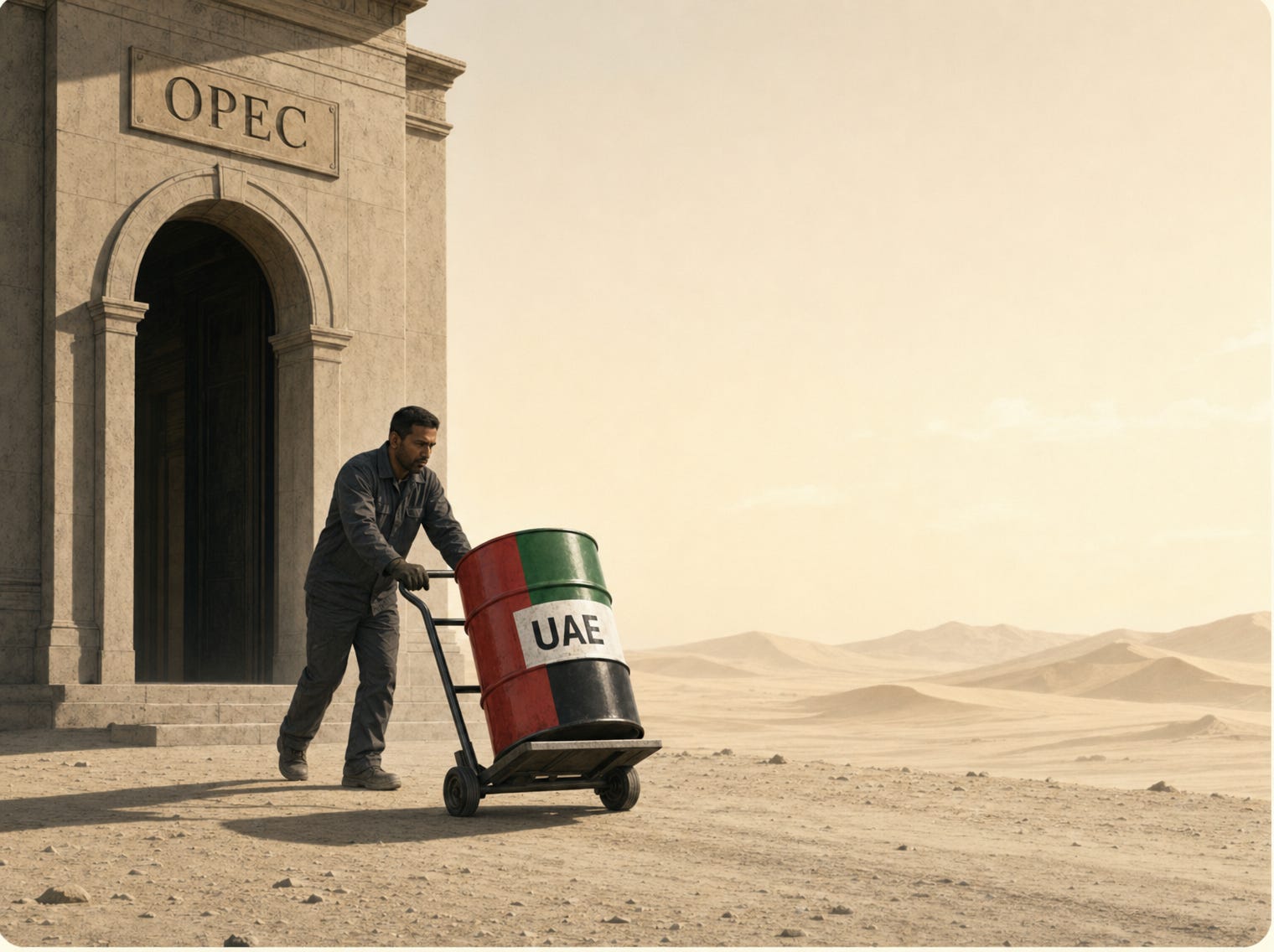
The UAE Was Always Going to Leave OPEC
The United Arab Emirates leaves OPEC on 1 May. The international press has framed this as a sudden break, a reaction to the Iran war, or a present to Donald Trump. But the exit is the predictable end of a decade of pressure that was in place long before the Iran war.
UAE energy minister Suhail Mohamed al-Mazrouei told Reuters the decision was strategic. The country wants to sell 5 million barrels per day by 2027, but OPEC’s quotas cap restricts it from selling that much.
Iran’s attacks on Gulf shipping have nearly closed the Strait of Hormuz, which normally carries one-fifth of the world’s crude. Thus, announcing the exit now won’t have an immediate impact on the market, which is why Mazrouei picked this moment. This was not a reaction; it was a plan.
The Cultural Dimensions
The UAE and Saudi Arabia, OPEC's leader, are divided across several cultural dimensions. The disagreement is not recent; it’s coming to light now because what held them together has failed.
Saudi Arabia leads OPEC because of who it is (Tromenaars’ ascription): the founding member, custodian of the holy sites, and has the largest reserves. The UAE is built on what it has achieved (Tromenaars’ achievement): a financial hub, an AI ministry, foreign capital, and the 2020 Abraham Accords with Israel. The UAE is rejecting the Saudi leadership that rests on the fact that Saudi Arabia is the leader.
Saudi Arabia works with circumstances as they arise (Tromenaars’ external direction). The UAE tries to create circumstances for its benefit (Tromenaars’ internal direction). OPEC's production caps constrain the UAE's efforts, and it’s no longer willing to be held back.
The UAE also tolerates ambiguity (Hofstede’s low uncertainty avoidance). Only a country that handles uncertainty well leaves OPEC during a war.
The Historical Patterns
Mancur Olson, in The Logic of Collective Action (1965), argued that cartels break apart when members gain more from leaving than from staying. The UAE can sell more oil if it leaves OPEC. OPEC has already lost Ecuador, Indonesia, Qatar, and Angola.
Stephen Walt, in The Origins of Alliances (1990), argued that states align against the most threatening neighbour, not the most powerful one. Iran’s attacks since February have made Iran that threat. The 2020 Abraham Accords brought the UAE into a security bloc with the United States and Israel. The UAE is choosing that bloc for protection over OPEC.
Robert Gilpin, in War and Change in World Politics (2008), argued that regional blocs break apart when smaller nations find that staying subordinate costs more than breaking away. The UAE’s strategic value to Washington and its move away from oil dependence raise the price of deferring to Riyadh, so the UAE is breaking away.
The Archetypes
The UAE acts as M.J. Hornby’s North Power-Seeker North: ambition-driven, change-oriented, willing to bend rules to expand. Mazrouei’s calm framing of the exit as the product of careful policy review is characteristic of the West Sage, providing analytical cover for North’s ambition. Saudi Arabia plays the Blue Guardian: preserving the established order. North wants to grow. Blue wants to keep things the same. So North leaves, and the UAE leaves OPEC.
No single factor would have produced the exit, but combined, they made staying in OPEC the harder choice. Once Hormuz reopens, the UAE raises output, and the Gulf has two oil powers, not one.
If you enjoyed this article, help support my work by becoming a paid subscriber or “buy me a coffee.”


