The Rice Hypothesis: How Crops Create Culture - Tuesday's Edition
How culture originated
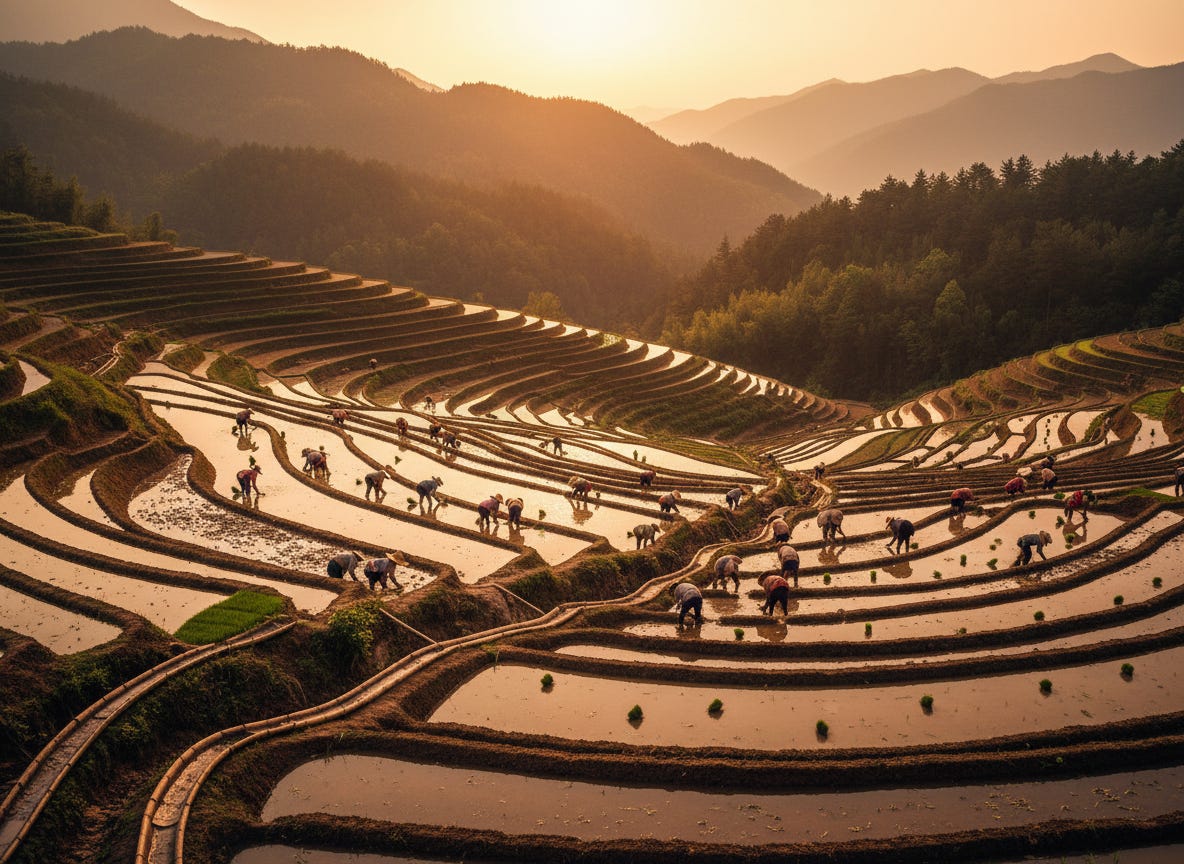
Walk the raised paths between rice paddies in Guangdong, Bangladesh, or Mali. Water sits in every field. Channels cut between them, linking each farm. One farmer’s drain water is another farmer’s supply. You help the family to your left plant this week, and next week they help you. The next week, you will help the family to your right because no household has enough hands alone and the water has to be drained on schedule, which will supply the next field.
This is how rice gets grown. The crop requires flooding, flooding requires shared water systems, and shared water systems require people who depend on each other to behave as if they depend on each other. Those who do not cooperate do not eat. Worse, they endanger everyone who did cooperate.
Wheat farmers live in a different world. Rain falls on their fields. They plant when ready, harvest when ready, succeed or fail by their own effort. If a neighbor did not see his or her field, it does not affect you.
Thomas Talhelm, a psychologist studying cultural variation, suspected these differences might explain patterns that persist long after most people stop farming.
In 2014, Talhelm recruited over 1,000 Chinese university students from northern wheat-growing provinces and southern rice-growing provinces. None had farmed. All lived in cities. He gave them psychological tests measuring thinking patterns, loyalty tendencies, and social orientation, then mapped results against one variable: whether their ancestral province had grown rice or wheat.
The split was clean. Students from rice regions showed collectivist thinking patterns, stronger friend-over-stranger loyalty, and holistic reasoning. Students from wheat regions showed individualist patterns, abstract reasoning, and weaker in-group bonds. The difference held after controlling for wealth, urbanization, and disease history. Ancestral crops predicted cultural perspectives better than any other variable tested.
Rice cultivation shapes specific cultural perspectives:
Collectivism vs. Individualism
Collectivism is the most direct. When your livelihood depends on coordinated labor and shared infrastructure, people think in terms of “we.” There is no “rugged individualist”; there is only group survival.
Wheat creates different cultural perspectives. A family can clear land, plant, wait for rain, and harvest on their own. Success depends on your effort. Failure is yours alone. This is the material basis of individualism: production that one household controls from start to finish. Self-reliance is how the work gets done.
High-context vs. Low-context
High-context, implied and indirect, communication follows. Families who coordinate across generations develop shared references, unspoken expectations, and the ability to communicate through implication. Spelling things out becomes unnecessary and even insulting. It says you do not know your friends and neighbors well enough to understand them without explicit words.
Wheat farmers deal with merchants, seasonal laborers, and strangers more often. Explicit communication prevents misunderstanding when a shared history doesn’t exist.
Rice societies select for certain psychological types. Hornby’s South archetype, the practical worker who learns through doing and reads non-verbal cues in coordinated labor, matches rice cultivation directly. The work itself produces this orientation. The Blue archetype, the guardian who enforces schedules and maintains customary practice, is essential. Someone must ensure the irrigation schedule holds, everyone participates, and free riders face consequences. These are not optional roles. The system requires them.
The Rice Hypothesis explains cultural perspectives rooted in coordination: collectivism, implicit communication, and relationship-based obligation. It does not explain everything. Tomorrow’s article examines a different force, market integration, that shapes the dimensions rice cannot explain.
If you enjoyed this article, please buy me a coffee!


Great article. So interesting to learn how food has shaped culture.
i love this