The Post-American Order: Modi and Lula Build the Trade and Money System. Wednesday’s Edition.
Building the system that comes next. Series 27 #2
Monday’s edition proposed that the United States is no longer the center of the global system, and five leaders are building its replacement. The new system is multi-actor; no a single country sets the rules, and most of what these leaders build cannot be undone by a future U.S. administration because it is written into signed treaties, trade routes, and payment systems.
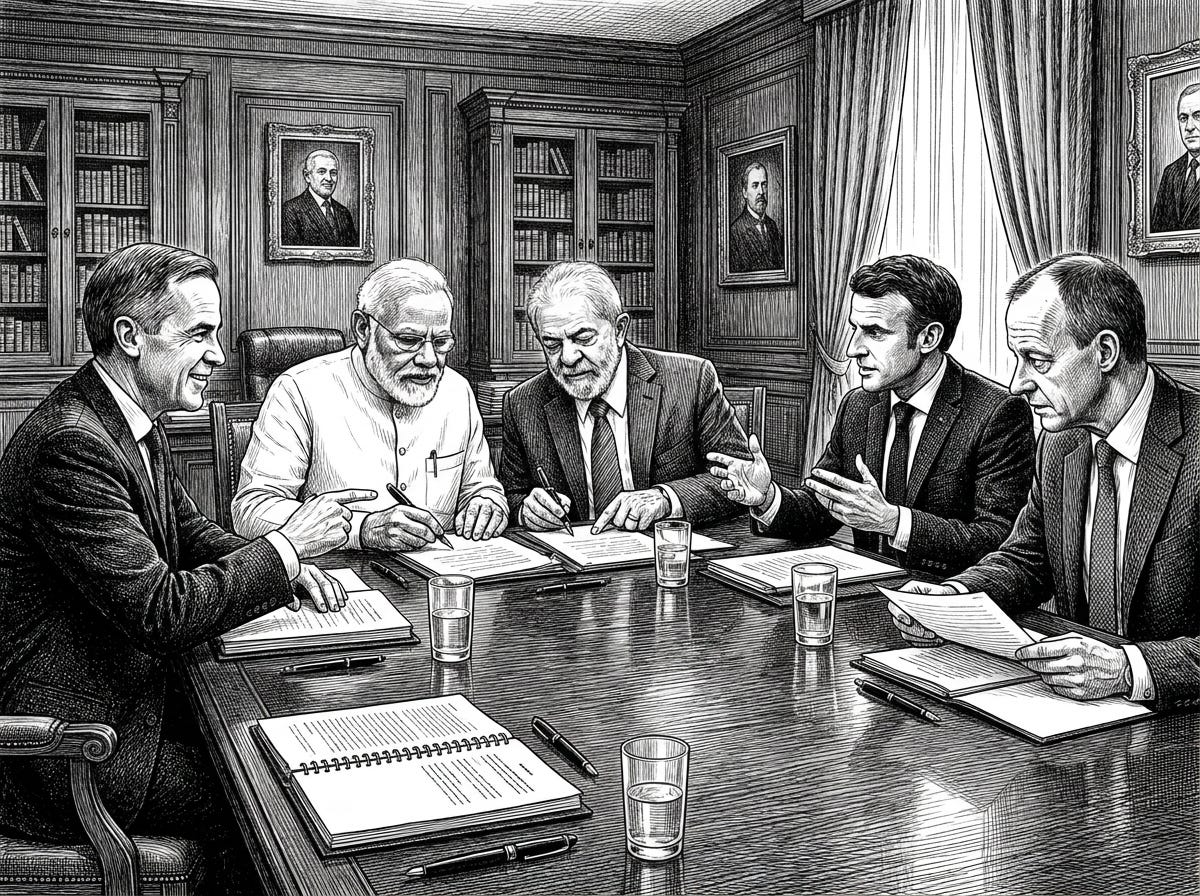
Carney is building the defense and alliance piece. Narendra Modi and Luiz Inácio Lula da Silva are building a different piece: the system for who trades with whom, and in which currency. Each works from a different cultural perspective, and that perspective explains how it is built.
India does not pick a side. In one year, Narendra Modi, India’s Prime Minister, signed a free trade deal with the United Kingdom in July 2025, concluded a free trade deal with the European Union in January 2026 that drops tariffs on almost all Indian exports, kept buying discounted Russian oil through a year of U.S. tariffs, and took over as chair of BRICS for 2026. He works with rivals at the same time and treats each relationship as its own arrangement.
Western analysts call this fence-sitting. They are using the wrong cultural perspective. The cultural theorist Fons Trompenaars separates universalist cultures, which apply one rule to everyone, from particularist cultures, which judge each relationship on its own terms. The United States and most of Western Europe are universalist: establish alliances, support only them, and follow the same rules. India is particularist. Modi sees no contradiction in arming the Quadrilateral Security Dialogue, a partnership among the United States, India, Japan, and Australia, while buying Russian oil and leading BRICS. Each agreement is a separate deal, judged on its value to India.
India absorbed Trump’s 50 percent tariffs through the second half of 2025, tied with Brazil for the highest rate on any major economy, without folding. India had many other ties that did not run through Washington. When Washington added a 25 percent penalty in August 2025 for buying Russian oil, Modi condemned it publicly and kept buying. This caused Trump to back down. In February 2026, he cut the tariff from 50 percent to 18 percent, below even the 25 percent India faced before the oil penalty. Trump announced India had committed to stop buying Russian oil. Modi responded that he did not need anyone’s permission to buy Russian oil and kept buying. India did agree to cut its own tariffs on the US and pledge about $500 billion in US purchases over five years.
This is how particularism works. India refused to turn one demand into a permanent rule. Washington wanted a rule. India gave a reversible concession guided by its own interest and kept the relationship. Each deal stands on its own, and none is allowed to set the rules for the rest.
For Modi, there is no contradiction between working with the United States, which controls the world's reserve currency, and taking the 2026 BRICS chair, a seat he is using to push a plan to link the digital currencies of BRICS central banks and bypass the U.S. dollar. Modi keeps each relationship in its own box
Lula da Silva, President of Brazil, builds through relationships and does so openly. In July 2025, he hosted the BRICS summit in Rio and pushed for trade in local currencies instead of the dollar. Brazil and China already run a local-currency trade system worth about $60 billion a year. In December 2025, he pressed the European Union to finally sign the Mercosur trade deal, an agreement between Europe and South America negotiated for more than 26 years, and told Europe it was now or never.
Brazil’s cultural perspective is particularist like India’s, but warmer and more personal. What Trompenaars calls an affective culture. Affective cultures work through open emotion and personal trust rather than formal procedure. Lula works the phones, builds coalitions face-to-face, and says in public what Modi, a neutral culture, says in private. When Trump put a 50 percent tariff on all Brazilian goods in 2025, in part to protect a former Brazilian president on trial, Lula answered with a dramatic line aimed at the world: “We don't want an emperor, we are sovereign countries.” He then invoked Brazil’s reciprocity law, which allows the Brazilian government to retaliate when another country imposes unfair trade barriers on Brazilian goods. But rather than let the law determine the outcome, he opted for personal negotiation.
Two leaders, two cultural perspectives, one result. Modi, particularist and neutral, works matter-of-factly with rival parties. Lula, particularist and affective, builds the open, relationship-based coalitions of the global south. Together, they are writing the trade and payment rules of a system that does not use the American dollar.
Friday’s Edition covers Macron and Merz and the European core of the new order.
If you enjoyed this article, help support my work by becoming a paid subscriber or “buy me a coffee.”


