The New Trade Map - RCEP: The Trade Bloc America Cannot Join. Tuesday’s Edition
The trade map America isn’t on - Series 14 #2
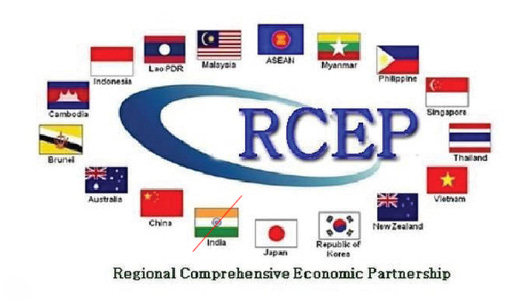
On January 1, 2022, fifteen nations began trading under a new trade bloc, RECP. Under RECP, China shipped goods to Australia with reduced tariffs. Japan sold electronics to Indonesia under streamlined customs procedures. South Korea moved auto parts to Vietnam with a single certificate of origin valid across the entire bloc. American companies watched with envy, unable to participate.
RCEP, the Regional Comprehensive Economic Partnership, covers 2.2 billion people and $29.7 trillion in combined GDP. That is 30% of global economic activity operating under one trade agreement. The members include China, Japan, South Korea, Australia, New Zealand, and all ten ASEAN nations: Brunei, Cambodia, Indonesia, Laos, Malaysia, Myanmar, the Philippines, Singapore, Thailand, and Vietnam.
As much as American companies would like to be in this trade bloc, the United States is not a member, and the United States cannot become a member. This was Trump’s decision on trade policy.
ASEAN proposed RCEP, with strong support from China, in 2011 as a direct response to the American-led Trans-Pacific Partnership (TPP). The TPP was designed to contain Chinese economic expansion in the region, but Trump pulled the U.S. out of the agreement in 2017. With the U.S. out, China took the lead and significantly expanded it econiomic influence in the region. Trump not only failed to contain China, he aided in China’s rapid expansion.
RCEP members negotiated terms that fit their own economies: Cambodia has fifteen years to eliminate tariffs on cars while Singapore eliminated them immediately; Indonesia keeps protections on rice to shield its farmers while Australia dropped barriers on manufactured goods it doesn't make anyway. Fons Trompenaars calls this particularism: rules bend to fit relationships and circumstances rather than applying the same formula to everyone.
Trump's trade policy works the opposite way: he applied the same tariff formula to every country regardless of relationship or history. He gave no exceptions to allies like Japan or Germany, and ignored whether a country was a security partner or a rival. Trompenaars calls this universalism. It sounds tough, exactly what Trump and the Republican Party want, but in practice, nations abandon the U.S., and trade with those that want to work together. Japan joined RCEP and CPTPP, Germany pushed EU-Mercosur forward, and potential partners chose cooperation with China over bullying from Trump.
RCEP’s membership includes historic enemies. Japan colonized Korea and invaded China. China and Vietnam fought a border war in 1979. Japan and South Korea still dispute islands and historical grievances. Yet all trade under the same agreement. This reflects the “ASEAN Way,” a diplomatic approach that compartmentalizes conflict. Political disputes stay in one box, economic cooperation stays in another. The nations did not resolve their grievances; they agreed that trade mattered more than settling old scores. This is long-term orientation in action: future prosperity outweighs past problems.
Hofstede’s research shows these cultures prioritize group harmony over confrontation. Collectivist societies find ways to coexist because the alternative, open conflict, hurts everyone. Trump and the Republicans cannot understand this cultural perspective. For Trump, unresolved grievances demand domination, compartmentalization looks like weakness, and cooperation looks like losing.
In M.J. Hornby’s archetypal framework, Trump embodies the North archetype, the Power-seeker at its worst: driven to dominate, rejecting others’ positions unless they serve his agenda, and forcing outcomes through coercion. North types see relationships as hierarchies to be won, not partnerships to be developed.
RCEP nations operate from different archetypes. The Green archetype, the Caregiver, prioritizes harmony and long-term relationships. Green types set aside ego for the group benefit. The ASEAN Way is Green in diplomatic form: preserve the relationship, compartmentalize the conflict, and keep trading. The East archetype, the Communicator, adapts to circumstances and navigates ambiguity. East types network across hierarchies to find consensus. RCEP’s flexible rules, different schedules for different members, unanimous consent, and patient negotiation reflect East’s ability to hold diverse parties together.
The practical consequences are significant. American manufacturers selling into RCEP markets pay tariffs that their Japanese, Korean, and Chinese competitors do not. A Ford truck shipped to Thailand faces barriers and costs more than a Toyota does. An American semiconductor company selling to Vietnam competes against Samsung and Chinese firms operating under preferential terms.
RCEP rewards companies that source parts from member countries. A Japanese company building cars in Thailand can import engines from China and electronics from South Korea tariff-free. American and other nations have to pay the tariffs. The math is simple: use RECP suppliers, save money. This also incentivizes factories to locate in RECP countries. The cycle pulls manufacturing deeper into Asia and further from the U.S.
China pushed RCEP specifically to reduce American influence in Asia. Trump made this possible by pulling the U.S. out of the TPP, and now the region’s economies are integrating around a trade bloc that excludes the United States and that it cannot join.
Tomorrow: CPTPP, the trade agreement America designed and Trump abandoned.
If you enjoyed this article, buy me a coffee!


