The New Trade Map - CPTPP: The Deal America Wrote, Then Walked Away From. Wednesday’s Edition
The trade map America isn’t on - Series 14 #3
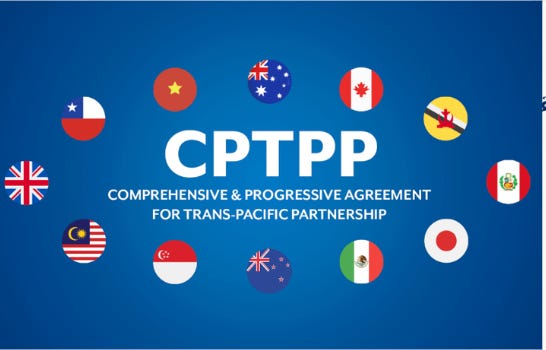
Three major trade blocs now operate without the United States: RCEP in Asia, the CPTPP spanning the Pacific, and EU-Mercosur linking Europe and South America. Yesterday, we examined RCEP, the world’s largest trade agreement. Today, we look at the CPTPP, the deal America designed, abandoned, and now cannot rejoin.
The Trans-Pacific Partnership began in 2005 as a modest agreement among four small economies: Brunei, Chile, New Zealand, and Singapore. The United States joined in 2008 under George W. Bush, drove the expansion under Barack Obama, and by 2016 had assembled twelve nations into the most ambitious trade agreement ever negotiated, covering 40% of global GDP.
Then Donald Trump killed it just three days into his presidency. He withdrew the United States, and the remaining eleven countries faced a choice: let the deal collapse or move forward without the U.S. They moved forward, but first they made changes. The original TPP contained 22 provisions that other countries had accepted only because the United States demanded them. Australia, New Zealand, Canada, Japan, and others had objected throughout negotiations but agreed because American market access was worth the concessions. When Trump pulled the U.S. out, the remaining countries rewrote the agreement for their benefit, not America’s.
They changed copyright terms that would have locked up books, music, and films for 70 years after the creator’s death, meaning Australians and Canadians would have paid higher prices for older works longer. Automatic patent extensions that would have kept drug prices high for years beyond the original patent, meaning a cancer drug that should have gone generic in 2025 might stay expensive until 2030. Rules requiring countries to give pharmaceutical companies 5 to 8 years of exclusive market access for biologic medicines, blocking cheaper biosimilars that could save patients thousands of dollars per treatment. Provisions allowing corporations to sue governments when regulations hurt their investments, meaning a country that banned a toxic chemical could face millions in legal claims.
Every suspended provision protected American corporate profits at the direct expense of citizens in partner countries. The United States had the leverage to demand these terms; its partners swallowed them to get the deal done. The moment that leverage disappeared, so did the concessions. The rewritten agreement entered into force in December 2018 with two-thirds of the original text intact. Today, it has twelve members covering $15.8 trillion in combined GDP, and the bloc keeps growing. The United Kingdom joined in December 2024 after spending two years opening its agricultural markets, accepting stricter labor standards, and aligning its intellectual property rules with CPTPP requirements. Costa Rica is in final negotiations. Uruguay has begun the process. Indonesia, the Philippines, and the United Arab Emirates will start talks in 2026.
Several cultural patterns shape how the CPTPP operates. Trompenaars identifies achievement cultures, where status comes from what you accomplish rather than your title or credentials. The UK earned entry by proving it could meet the standards, not by invoking its history or economic size. Trompenaars also identifies universalism, where the same rules apply to everyone regardless of relationships. Costa Rica follows the same accession process the UK followed; no country gets special treatment. Hofstede’s long-term orientation explains why the eleven remaining members continued building after the US left rather than scrambling for quick bilateral deals. They invested in a structure that would pay off over decades.
In Hornby’s framework, the CPTPP operates as a blend of West and Blue archetypes. West is the Sage: knowledge-driven, verifying competence through evidence, accepting only what can be proven. Blue is the Guardian: maintaining standards, enforcing rules, insisting on doing things the right way. The U.S. fits the North archetype, demanding compliance rather than earning cooperation. The CPTPP requires countries to earn their place.
The CPTPP now represents something America helped create but cannot join without accepting terms it once rejected. American farmers pay tariffs that member states don’t pay. The architecture America designed operates for everyone except America.
Tomorrow: EU-Mercosur, and why Europe signed a deal twenty-five years in the making after Trump returned to office.
If you enjoyed this article, buy me a coffee!


You mean the world is a better place without the U.S?