

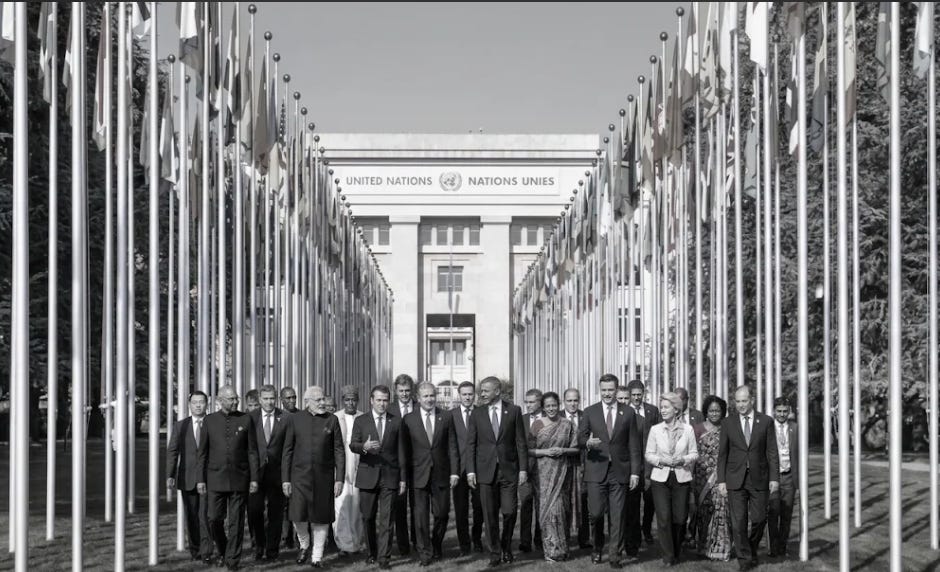
The next global order is here, and it will fundamentally change the power dynamics between nations.
The arc of history continues to move nations toward greater political autonomy and cooperation.
For centuries, powerful nations organized the world for their own interests. They conquered territories, controlled colonies, and established alliances that gave them influence over other nations.
Today, nations are moving from dependence on powerful nations to interdependence among sovereign nations. They are building relationships that don't require a dominant nation.

Wednesday’s Edition showed how, as alternative networks develop, the dominant power risks losing the influence that made its dominance possible.
Now we can see the consequences: nations creating their own networks, establishing new economic relationships, and reducing their dependence on dominant powers.
Each benefits from making their nation more useful to everyone. Ironically, the more useful a nation becomes, the more power it holds, which can lead it to dominate the relationship. The distinction is that each nation is more useful, so no one nation dominates.
This is how middle powers are gaining influence and great powers are losing their dominant position.
A 2024 International Monetary Fund study found that countries outside the major geopolitical blocs are increasingly acting as economic connectors between them.
Canada is a clear example.
Prime Minister Mark Carney has called on middle powers to cooperate rather than depend on dominant nations.
Canada is working to connect the Trans-Pacific Partnership with the European Union, creating a trading bloc of 1.5 billion people.
Carney is developing new trade relationships across Southeast Asia and expanding cooperation with China.
Canada is moving away from American dominance.
Carney argues that middle powers gain greater independence and influence by working together rather than negotiating individually with dominant powers. They do better when no one nation dominates. (Carney, World Economic Forum; Government of Canada)
BRICS is another example. It has expanded from five to eleven members, bringing nations from Africa, Asia, and the Middle East into a forum focused on economic cooperation and reforming global governance.
They cooperate without surrendering their independence or agreeing on every issue. (BRICS, 2025)
Major powers still exercise enormous economic, military, and institutional influence. Nations can still align and cooperate with them, but smaller nations no longer have to depend exclusively on those powers to participate in the global economy.
The new global order gives nations choices.
Friday’s Edition will examine what the future looks like in the Post-Hegemonic Order.
If you enjoyed this article, help support my work by becoming a paid subscriber or “Buy me a coffee.”
Get a solid understanding of Trompenaars’ cultural dimensions by purchasing the guide or subscribing to Cultural Perspective (free or paid) and receiving the guide for free.

Three powerful leaders meet.
The Upcoming, the Dying and the Suicidal.
Your choice who you place the labels on.