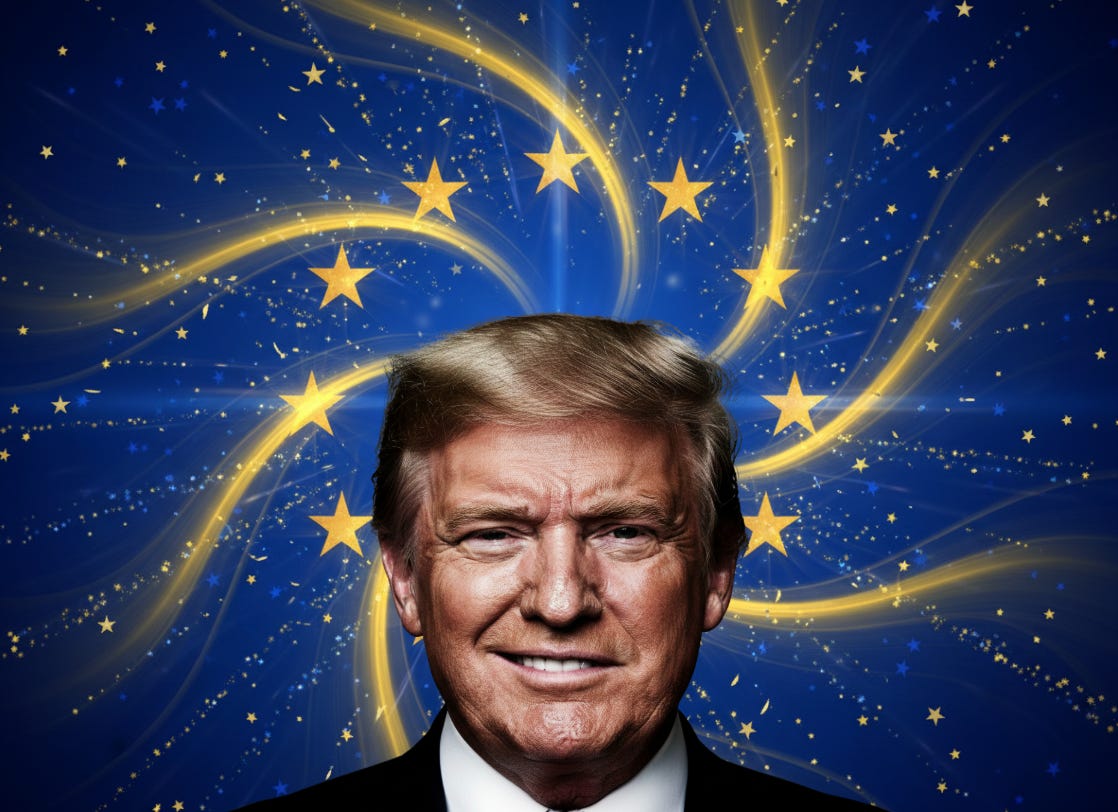
The EU: Trump The Empowerer - Thursday’s Edition
Trump: good or bad for the world?
This is the paradox in the EU: Trump is actively trying to break the European Union, but he’s making it stronger.
The Justus Lipsius building in Brussels has a kitchen that serves 3,000 meals a day. I’ve never eaten there, but I’ve read the menus. They rotate by member state. Polish pierogi on Monday. Spanish tapas on Tuesday. Greek moussaka when Athens holds the presidency. Twenty-seven cuisines, one cafeteria, everyone pretending the food is equally good.
That’s the European Union. A diplomatic fiction held together by procedure and the mutual agreement not to mention that some countries cook better than others.
Trump wants to shut down the kitchen.
On March 4, 2025, Friedrich Merz stepped to a podium in Berlin. Gray suit, no tie, the studied casualness of a man about to burn down everything he’d built his career defending. Behind him, the German eagle. In front of him, a room full of reporters who didn’t yet understand what they were witnessing.
“Whatever it takes.”
Mario Draghi said those words back in 2012 to stop a sovereign debt crisis from killing the euro. They became sacred text in Brussels, three words that proved Europe could act when survival required it.
Merz was using them to kill something else. Germany’s debt brake, the constitutional spending limit his party had defended for over a decade. The fiscal religion he’d personally preached during his campaign. Gone. Half a trillion euros for infrastructure. Unlimited defense spending.
Six weeks after Trump’s inauguration, Germany abandoned the thing that made it German. Not because Merz wanted to. Because Trump left no choice.
The administration hasn’t been subtle. Vice President Vance met with Alternative for Deutschland at the Munich Security Conference, then endorsed them nine days before the federal election. Trump posted “FREE MARINE LE PEN” after her conviction. Elon Musk urged Germans to vote for AfD. Similar backing for pro-Russian candidates in Romania and Poland. The pattern is obvious: support parties that want to tear the EU apart from within.
When asked about NATO’s Article 5, whether America would defend its allies, Trump said it “depends on your definition.” During his campaign, he told a rally he’d encourage Russia to do “whatever the hell they want” to members not meeting spending targets.
The message to Europe was clear: you’re not just on your own, America is going to break you.
But this hasn’t weakened the EU, it spurred it into action. The EU is arming itself.
The EU runs on universalism, the belief that rules apply the same way to everyone. Same tariff schedules for Poland and Portugal. Same data privacy standards for Google and some startup in Estonia. This cultural perspective shapes how Brussels fights: not through strongman handshakes, but through legal frameworks applied uniformly, bureaucratically, maddeningly.
When Trump hit them with 25% tariffs, the Commission didn’t cut side deals. They prepared a unified retaliation. When “Liberation Day” tariffs landed, they activated the Anti-Coercion Instrument, a legal mechanism they’d spent years building for exactly this moment.
The vote was 26 to 1. Only Orbán opposed, and we all know what Orbán is.
I think about what it takes to get 26 countries to agree on anything. Nations that spent centuries slaughtering each other over borders and religion, and which king slept with whose wife, are now voting together on tariff retaliation. Not because they love each other. Because Trump reminded them what the alternative looks like.
Defense spending jumped almost €40 billion in one year. The ReArm Europe plan unlocks another €800 billion by 2030. Germany’s fiscal revolution alone could boost GDP by 2.5% over the next decade. At NATO’s June summit, allies agreed to spend 5% of GDP on defense by 2035. Cold War levels.
And trade deals collecting dust for decades suddenly got done. Mercosur signed after twenty-five years of negotiation. Malaysia, Thailand, and the Philippines are back at the table. Von der Leyen announced EU-India before the year’s end.
Trump took real bites. German automakers, French vintners, Spanish olive farmers all gutted by tariffs. The EU accepted 15% in July, that hurt.
But the same months saw the transformation Brussels had debated for decades and never executed. Defense capacity. Trade diversification. Strategic autonomy. All the things European leaders said they should do, then never did, because American protection made it unnecessary.
Trump made it necessary.
I don’t know which way this breaks. I don’t know if Trump succeeds in fracturing the union from within, peeling off Hungary, then Italy, Austria, Hungary, and the kitchen stops pretending everyone’s cuisine matters equally.
But twice now, when the union faced its crisis point it reacted with the same three words.
“Whatever it takes.”
Draghi meant saving what existed. Merz means building what can be.
The EU would have been a great power in 20 or 30 years. But with Trump in power, I’m betting on the EU in the next couple of years.


