Social Democracy - The Nordic Model: Tuesday's Edition
Four government systems the deliver results
Americans often confuse Social Democracy with Socialism. The words sound similar. Political rhetoric treats them as interchangeable. They are not.
Socialism is government ownership of production. The Soviet Union was socialist.
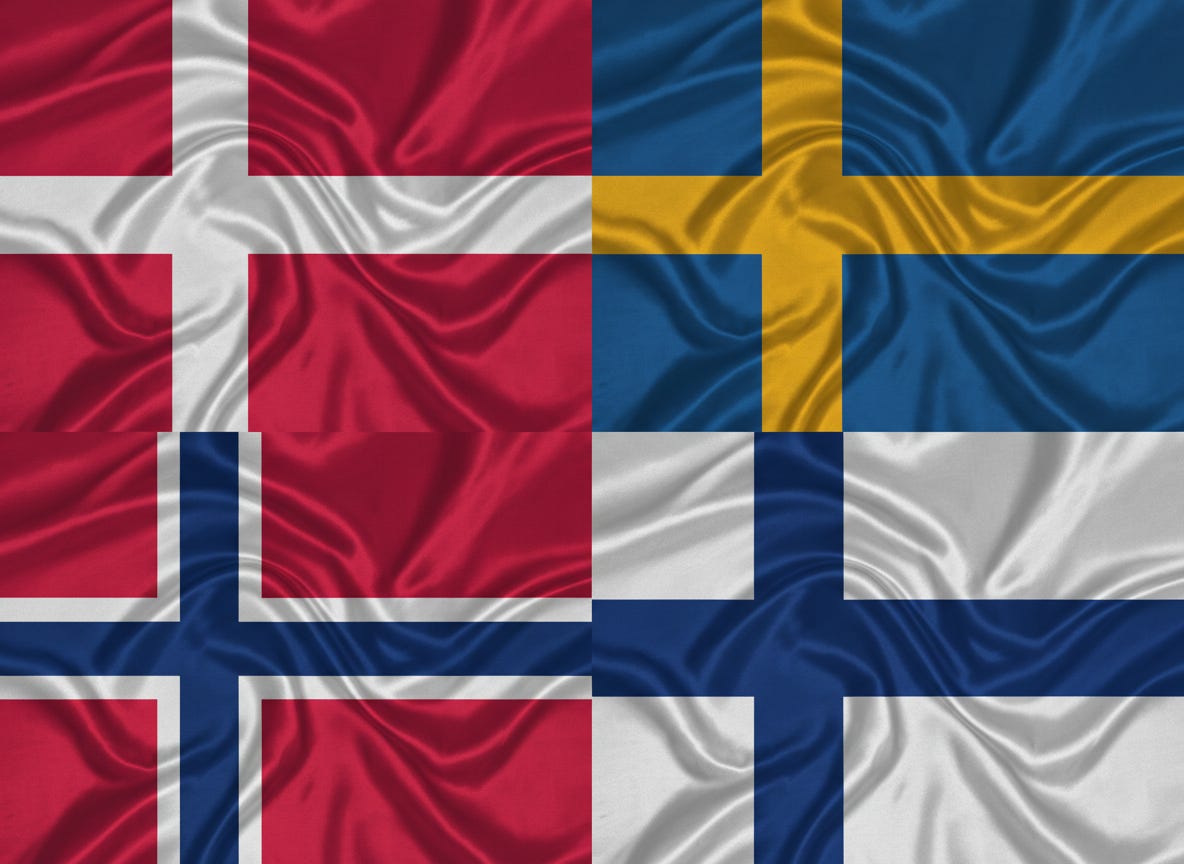
Social Democracy is capitalism with regulation. Denmark, Sweden, Norway, and Finland are Social Democracies. They are capitalist economies with robust private sectors, stock markets, billionaires, and multinational corporations. IKEA, Volvo, Nokia, Lego, Maersk, Spotify, these are private companies operating for profit. They function in a market economy, but one with a comprehensive welfare state. And it works.
What makes the Nordic model different is what happens after wealth is created. High taxes fund universal healthcare, free university education, generous parental leave, unemployment insurance, elder care, childcare, and much more. The state does not run the economy, it redistributes the economic output, as do all governments. However, in a Social Democracy, the economic output is used to ensure no one falls through the cracks, rather than redistributing it to the wealthiest citizens.
The defining factor in Social Democracies is equality, and that’s why they work.
The outcomes are measurable. Nordic countries consistently rank at the top of global indices for happiness, social mobility, education, healthcare, low corruption, and quality of life. Denmark and Finland trade places atop the World Happiness Report. Sweden and Norway score among the highest for social mobility, meaning a child born poor has a genuine chance of becoming wealthy.
These results did not emerge from policy genius. They emerged from cultural alignment.
Hofstede's research identifies Nordic societies as the world's most "quality-of-life-focused" in cultural orientation. Quality-of-life-focused cultures prioritize well-being, caring for the weak, and cooperation over competition. The opposite side of the spectrum are achievement-focused cultures that prioritize success, assertiveness, and material reward. In quality-of-life-focused cultures, the goal is that everyone is okay. In achievement-focused cultures, the goal is that winners are rewarded.
A welfare state makes sense when the underlying culture already believes that collective well-being matters more than individual accumulation. Swedes do not pay 50% taxes because the government forces them. They pay because the cultural perspective is one in which they want to help others, they genuinely care about their fellow citizens, and they believe a decent society takes care of everyone.
Nordic countries score low on Hofstede’s power distance scale. Citizens do not want leaders to behave as superiors. Hierarchy helps keep life in order, but it does not give people power. Prime ministers bike to work. Bosses sit in open offices. Employees call executives by first names. This orientation creates high trust in institutions because those institutions are accessible and open.
Trompenaars’ research shows Nordic cultures as both individualist and communitarian, an unusual combination. People value personal freedom but accept collective obligations. The welfare state keeps the balance: you are free to live as you choose, but you contribute to a system that provides that opportunity for everyone.
Hofstede's concept of long-term orientation also applies. Nordic societies invest in future generations, accepting short-term costs for long-term gains. Free education is expensive now, but creates a skilled workforce that produces more in the future. Parental leave reduces immediate productivity but produces healthier families, which are more productive in the long run.
These cultural traits map onto Hornby’s archetypes. The Green (Caregiver) archetype, driven by empathy and service to others, reflects the welfare state’s philosophy. Leaders in Nordic societies often embody the East (Communicator) archetype: facilitators who network across hierarchies rather than commanders who issue orders from above. Leadership is mediation, not domination.
The model has trade-offs. Taxes are high. The system produces fewer billionaires but also fewer homeless encampments. These countries are ethnically homogenous, but now immigration tests whether social trust extends beyond the original group. The system requires cultural buy-in that cannot be legislated.
This is the point. Social Democracy works in the Nordic countries because the culture already valued what the system delivers. The policies did not create the values. The values created the policies.
Transplant Nordic institutions to a society with different cultural expectations, and the machinery breaks. In the U.S., high taxes are viewed as theft rather than a contribution. Welfare is seen as dependency rather than security. The same system, different culture, opposite reaction.
Tomorrow: Liberal Constitutional Democracy, where rules and rights dominate.


Strong framing of cultural foundations beneath policy systems. The distinction between social democracy and socialism gets lost constantly, and pointing out that Nordic countries have thriving private sectors while funding comprehensive safety nets is critical context. What stood out to me is the point about cultural alignment preceding policy success, I've seen attempts to transplant institutional models fail when the underlying cultural values don't support them. The bit about quality-of-life vs achievement orientation explains alot about why unemployment insurance is seen as security in one place and dependency in another.
My values align with social democracy. Here in the US it’s automatically labeled socialism, BAD! High taxes, government handouts, strict regulations. Americans are supposed to pick themselves up by their bootstraps. It’s rugged individualism. MAGA ideology has made it worse.
Many can’t see how we already have democratic socialism in some aspects….unemployment, Medicare, Medicaid, social security, police, fire department, etc. They don’t want anyone stepping on their Freedoms, nor stop them from becoming rich. The reality is you’re 3 months closer to becoming homeless than ever becoming a millionaire.