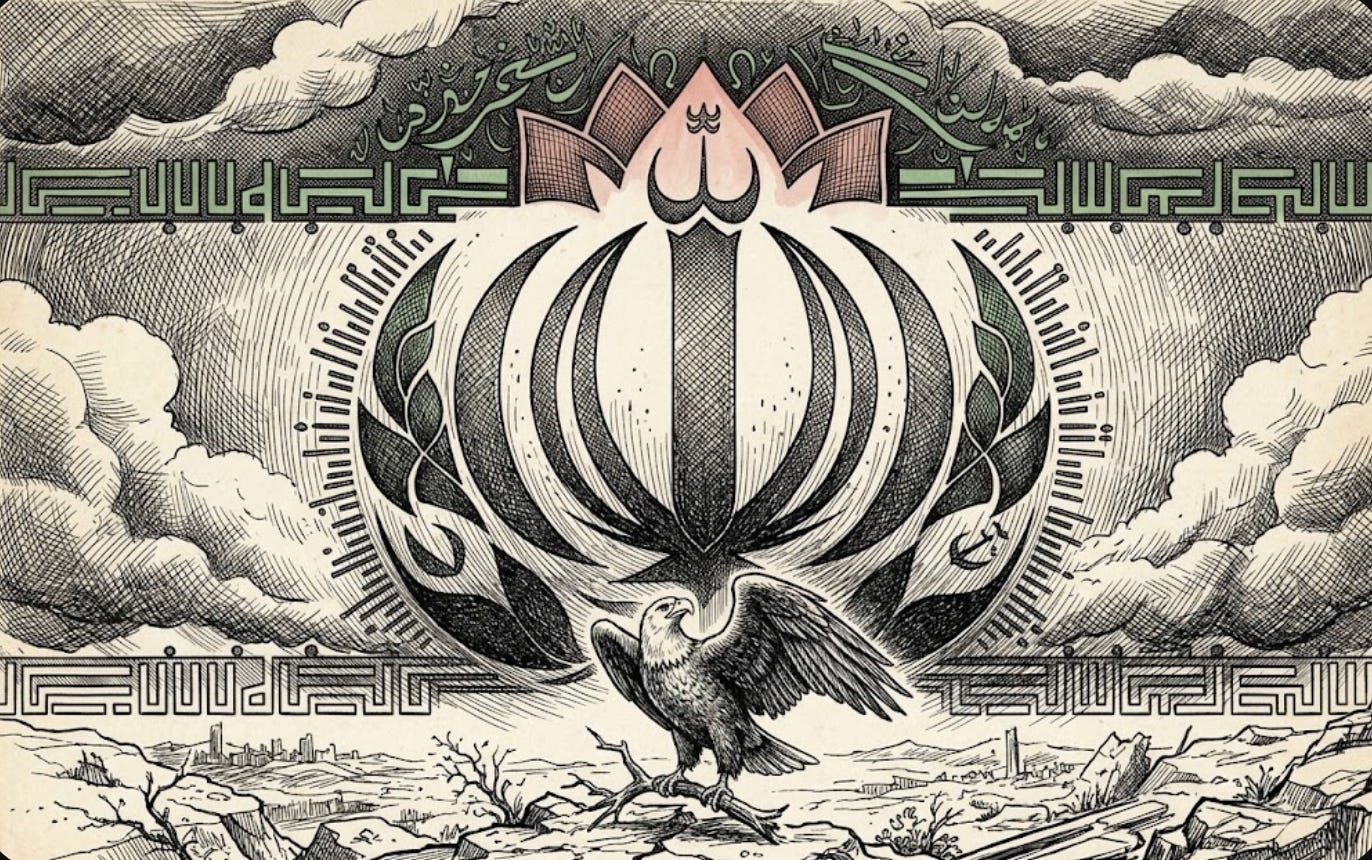
Trump is losing the Iran war. American forces are winning many engagements but losing the war.1 That should sound familiar to Americans. The United States won many battles in Vietnam and lost the war. Tactics decide engagements. Strategy decides winners. Iran is playing a long-term winning strategy and it is working.2 Trump’s options for a win are almost nonexistent.
Trump can:
Escalate the air war, but CENTCOM commander Adm. Brad Cooper told the White House in late July that designated targets were mostly exhausted.3
Keep the blockade, but despite its economic impact, Iranian oil revenue fell from about $5.13 billion in March to $837 million in May,4 and the Statistical Center of Iran measured year-on-year inflation at 88.6 percent,5 Iran still refuses direct talks and still demands the blockade be lifted.6
Add sanctions, but Iran is already under nearly 2,000 imposed sanctions,7 and Beijing issued its first blocking order on May 2, telling Chinese firms not to comply with new U.S. sanctions.8
Invade, but an occupation would need as many as 1.6 million troops,9 more than the entire U.S. active-duty military.10 Additionally, much of Iran is mountainous, and Saudi Arabia, Qatar, and Kuwait have refused to let the US use their territory for offensive operations.11
Seize Kharg Island, but something happened. The Pentagon prepared plans in March for weeks of ground operations,12 but Trump did not approve them, and the Marine unit moved into position and returned to Japan on July 22.13 Something is taking this option off the table.
Clear the mines, but the Navy decommissioned its four Bahrain minesweepers in September 2025.14 A classified briefing told the House Armed Services Committee that clearing could take six months.15
Escort tankers, but escorts protect ships from missiles and small boats. They do not remove mines.16
Let allies clear the mines, while the UK and France already lead a multinational mine-clearing mission,17 and European governments have resisted turning it into an American enforcement operation.18
Wait Iran out, but Trump needs a solution by November; maybe he can wait as long as the 2028 election. Iran can wait decades.
Ask China to pressure Iran, but Trump requested this publicly in March,19 and China made the ask.20 It resulted in no change.21 China understands how much Trump’s war is weakening America.
Accept a transit fee, but that is capitulating to Iran and a benefit only for Iran. Trump has refused to pay.22
Take the deal he already signed on June 17, but releasing frozen Iranian assets, committing to at least $300 billion in reconstruction, issuing waivers for Iranian petroleum products and the associated banking, insurance, and shipping services, and permanently ending military operations, including in Lebanon, benefits Iran. Terms for the U.S. are essentially what was in place before the war.23 This is not so far removed from a surrender.
The list splits in two. The military options need forces, allies, or time the United States does not have. The diplomatic options require Washington to accept Iranian authority over the strait or pay for passage. Trump has ruled out both.24. What options are left?
If you enjoyed this article, help support my work by becoming a paid subscriber or “Buy me a coffee.”
Get a solid understanding of Trompenaars’ cultural dimensions by purchasing the guide or subscribing to Cultural Perspective (free or paid) and receiving the guide for free.
Notes
Congressional Research Service, “U.S. Aircraft Combat Losses in Operation Epic Fury: Considerations for Congress,” IN12692. https://www.congress.gov/crs-product/IN12692 and https://www.dawn.com/news/2002532 ↩
Iran’s demands are documented in Al Jazeera, “US-Iran talks in deadlock: What’s the latest,” 13 August 2026, and in Reuters reporting on the Iran-Oman transit fee talks (Iran seeking 5 to 7 percent of declared cargo value), 6 August 2026. https://www.aljazeera.com/news/2026/8/13/us-iran-talks-in-deadlock-whats-the-latest and https://tass.com/world/2169555 ↩
Axios, “Top U.S. military commander in Middle East advised halting Hormuz bombing,” 26 July 2026. Two sources with knowledge of Cooper’s position said he told the Pentagon, the joint chiefs and the White House that “the designated bombing targets had been mostly exhausted.” https://www.axios.com/2026/07/26/hormuz-bombing-pause-trump-iran ↩
Al Jazeera, “How the US naval blockade has bled Iran of nearly $6bn in oil revenues,” 5 June 2026. Figures are Al Jazeera’s calculation from Kpler vessel-tracking data using an assumed $90 per barrel. Not an official figure. https://www.aljazeera.com/news/2026/6/5/how-the-us-naval-blockade-has-bled-iran-of-nearly-6bn-in-oil-revenues ↩
Associated Press, “Trump pivots back to sanctions for Iran,” 11 August 2026, citing the IMF’s estimate of 88.6 percent annual inflation. https://www.npr.org/2026/08/11/g-s1-138160/us-iran-war ↩
Al Jazeera, 13 August 2026; and Foreign Minister Abbas Araghchi’s statement that “the possibility of resuming negotiations does not exist” until the US compensates for its violations. https://www.aljazeera.com/news/2026/8/13/us-iran-talks-in-deadlock-whats-the-latest ↩
Bloomberg, “US reaches limit of sanctions power in targeting Iran’s economy,” 23 May 2026, citing Jeremy Paner of Hughes Hubbard & Reed: “That’s brought the total number of sanctions against Iran imposed in the last eight years to nearly 2,000.” https://fortune.com/2026/05/23/us-limit-sanctions-power-iran-war-economic-fury-naval-blockade/ ↩
Al Jazeera, “China blocks US sanctions against five teapot refineries,” 3 May 2026. China’s Ministry of Commerce issued the order on 2 May 2026 under its 2021 blocking rules, the first time it has issued a formal prohibition order against specific US sanctions designations. The order responded to OFAC’s 24 April designations of five Chinese refiners. https://www.aljazeera.com/economy/2026/5/3/china-blocks-us-sanctions-against-five-teapot-refineries ↩
Brandan P. Buck, Cato Institute, “A Ground War in Iran Would Be Hell,” 10 March 2026: “an invasion of Iran, given its population size, would require as many as 1.6 million troops.” https://www.cato.org/commentary/ground-war-iran-would-be-hell-escalation-gift-americas-enemies ↩
USAFacts, US Department of Defense personnel data, March 2026: 1.35 million active-duty personnel across all services, plus 771,200 reserve personnel. https://usafacts.org/answers/how-many-troops-are-in-the-us-military/country/united-states/ ↩
Congressional Research Service, R48971, “The Arab Gulf States, the Iran Conflict, and U.S. Relations,” 3 June 2026: “some GCC members denied the United States use of their airspace for offensive operations against Iran.” Saudi, Qatari and Emirati refusals were reported by the Wall Street Journal, “Key Gulf Allies Say They Won’t Aid U.S. in an Iran Strike,” 30 January 2026. https://www.congress.gov/crs-product/R48971 ↩
Washington Post reporting of 28 March 2026, summarised in Al Jazeera, “Pentagon readies ‘for weeks of US ground operations’ in Iran,” 29 March 2026. One official said objectives would take “weeks, not months.” Al Jazeera noted that whether Trump would approve the plans “remains uncertain.” https://aljazeera.com/news/2026/3/29/pentagon-readies-for-weeks-of-us-ground-operations-in-iran-report ↩
Navy Times, “Thousands of Marines, sailors back in Japan after deploying for Iran war,” 22 July 2026. The 31st Marine Expeditionary Unit and USS Tripoli were ordered to the Middle East on 13 March 2026. https://www.navytimes.com/news/your-navy/2026/07/22/thousands-of-marines-sailors-back-in-japan-after-deploying-for-iran-war/ ↩
U.S. Navy, “U.S. Navy Decommissions Avenger-class Mine Countermeasures Ships in Bahrain,” 25 September 2025. The four ships were USS Devastator, USS Sentry, USS Dextrous and USS Gladiator. The hulls left Bahrain on a heavy-lift vessel on 9 January 2026, two months before Iran mined the strait in March. https://www.navy.mil/Press-Office/News-Stories/display-news/Article/4314634/us-navy-decommissions-avenger-class-mine-countermeasures-ships-in-bahrain/ and https://www.twz.com/sea/navys-avenger-class-mine-hunters-have-left-the-middle-east-for-good ↩
Washington Post, “Strait of Hormuz mine-clearing could take 6 months, Congress is told,” 22 April 2026. Pentagon spokesman Sean Parnell responded the following day that the reporting was “dishonest journalism.” https://www.washingtonpost.com/national-security/2026/04/22/iran-hormuz-mines/ and https://thehill.com/policy/defense/5845135-pentagon-denies-six-month-strait-hormuz/ ↩
The United States ran this operation in the same waterway in 1987 and 1988, reflagging and escorting Kuwaiti tankers under Operation Earnest Will. The USS Bridgeton struck an Iranian mine on the first convoy in July 1987, and the USS Samuel B. Roberts struck one in April 1988. Michael Eisenstadt and Assaf Orion, Washington Institute, “Military Options for Reopening the Strait of Hormuz,” 23 March 2026, set out the limits of escorting without mine clearance. https://www.washingtoninstitute.org/policy-analysis/military-options-reopening-strait-hormuz-limitations-and-imperatives ↩
UK Government, “Joint statement on the multinational military mission for the Strait of Hormuz,” 12 May 2026. The UK and France co-lead; 38 countries signed. The statement describes “an independent and strictly defensive multinational military mission” whose tasks include mine clearance. https://www.gov.uk/government/news/joint-statement-on-the-multinational-military-mission-for-the-strait-of-hormuz-12-may-2026 ↩
Al Jazeera, “’De-escalation’: Europe hesitates as US pushes for Hormuz naval mission,” 7 August 2026. https://www.aljazeera.com/news/2026/8/7/hld-european-caution-slowing-us-push-for-hormuz-naval-coalition ↩
Euronews, “Top Trump advisers urge China to use Iran ties to reopen Strait of Hormuz to global trade,” 6 May 2026. https://www.euronews.com/2026/05/06/top-trump-advisers-urge-china-to-leverage-iran-ties-to-reopen-strait-of-hormuz-to-global-t ↩
CNBC, “China presses Iran against resuming war, urges Hormuz reopening ahead of Trump-Xi summit,” 6 May 2026. Foreign Minister Wang Yi raised the reopening with Iranian Foreign Minister Abbas Araghchi in Beijing. https://www.cnbc.com/2026/05/06/china-iran-araghchi-wang-yi-trump-beijing-hormuz-talks.html ↩
CNBC, “’Hormuz remains blocked’: Iran disputes Trump claims as traffic sinks to near 3-month lows,” 13 August 2026. https://www.cnbc.com/2026/08/13/us-iran-war-trump-hormuz-irgc.html ↩
Reuters, 6 August 2026, on the Iran-Oman fee talks: Iran seeks 5 to 7 percent of declared cargo value, Oman proposes 3 percent. The National, 13 August 2026: “The US refused to pay any fees for vessels crossing.” https://tass.com/world/2169555 and https://www.thenationalnews.com/news/gulf/2026/08/13/what-is-the-strait-of-hormuz-deal-being-negotiated-between-iran-and-oman/ ↩
Islamabad Memorandum of Understanding, 17 June 2026, full text. Point 1 commits both parties to “immediate and permanent termination of military operations on all fronts, including in Lebanon.” Point 6 commits the US, with regional partners, to a plan providing at least $300 billion for Iranian reconstruction. Point 10 requires the US Treasury to issue waivers for Iranian crude, petroleum products and associated banking, insurance and transport services immediately on signing. Point 11 makes frozen Iranian funds fully available. Iran’s Foreign Ministry spokesman Esmaeil Baghaei confirmed President Pezeshkian signed it and said it was in effect. https://www.presidency.ucsb.edu/documents/islamabad-memorandum-understanding-between-the-united-states-america-and-the-islamic ↩
The National, “Stalemate on the strait as deadline for US-Iran agreement expires,” 16 August 2026; Associated Press, “The 60-day deadline for an Iran peace deal is expiring,” 17 August 2026. https://www.thenationalnews.com/news/us/2026/08/16/deadline-for-us-iran-agreement-expires-with-stalemate-set-to-continue/ and https://srnnews.com/the-60-day-deadline-for-an-iran-peace-deal-is-expiring-heres-where-things-stand/ ↩
The National, 16 August 2026, quoting Trump speaking to a crowd in New York on Friday 14 August 2026. In the same remarks he said, “Pretty soon I’ll be declaring the Hormuz strait a territory of the United States.” https://www.thenationalnews.com/news/us/2026/08/16/deadline-for-us-iran-agreement-expires-with-stalemate-set-to-continue/ ↩


Paper sanctions move algorithmic headlines for 24 hours. Physical logistics move wars.
While the financial press cheers the latest round of "Economic Fury" secondary sanctions against Iranian crude networks, oil traders and military planners are watching two physical realities that cannot be papered over:
The SPR Clock Is Ticking Out: The U.S. Strategic Petroleum Reserve sits at ~293M–298M barrels—operating on an unsustainable ~6.1M barrel/week liquidation rate. The operational floor (~250M barrels) is roughly 8 weeks away. Once that artificial price-suppression valve shuts down, physical crude markets snap back violently.
The Military Logistics Are Staging for Kinetic Action, Not Containment: You don't position deep-strike aerial infrastructure to enforce banking compliance.
The Hard Logistics on the Ground:
Tanker Staging in Israel: The surge of USAF KC-135 aerial refueling tankers to Ben Gurion and Ramon Air Bases positions high-value assets under Israel’s layered air-defense umbrella—critical for refueling strike packages (F-35s/B-2s) aimed at fortified interior sites.
Heavy Standoff Assets: B-2 Spirit deployments and B-52 Bomber Task Forces at Al Udeid confirm that standoff bunker-penetration capability is already forward-deployed.
Logistics Hub Relocation: Damaged Bahrain facilities forced the 5th Fleet supply chain hub back 2,200 miles to Diego Garcia, pushing Carrier Strike Groups to maximum operational limits while reorganizing for sustained high-tempo strikes.
Toothless "Paper Sanctions": China’s independent "teapot" refiners in Shandong operate with zero U.S. dollar exposure, clearing via CIPS and offshore non-clearing rails. Sanctioning them is an empty gesture while dark-fleet VLCCs transit unmolested.
When paper sanctions fail and the SPR buffer hits the floor, the pivot from economic posturing to military escalation becomes mathematical.
Read the full breakdown, wargame analysis, and supply-chain pricing model here:
👉 https://triggledger.substack.com/p/trumps-8-week-reckoning-the-spr-floor?utm_source=share&utm_medium=android&r=8gc1qf