Rise Of The Middle Powers: Wong And Singapore’s Network Design. Friday’s Edition
Four leaders building faster than Trump destroys. Series 18 #5
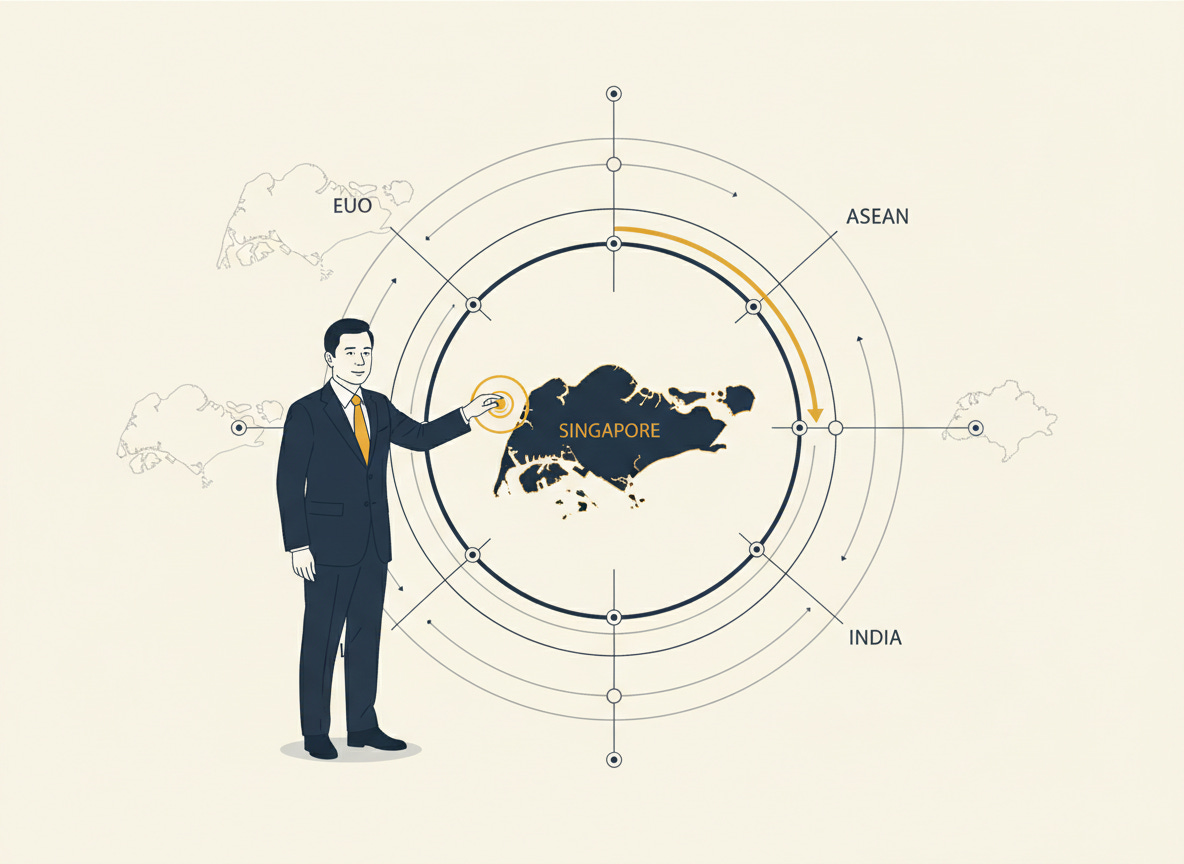
Singapore’s PM Lawrence Wong has been building what the other middle powers depend on: the rules, platforms, and agreements that connect them.
Carney’s strategy is to diversify out of U.S. dependence. Macron’s strategy is to arm and defend Europe out of U.S. control. Modi’s strategy is to play the U.S against other powers for India’s benefit. Wong’s strategy is to create connections that bring the middle power together. He builds the systems that make everyone else's deals actually work: common rules for how data, contracts, and invoices move between countries, faster customs processing, and payment systems that move between countries without delays.
Singapore has no leverage in the traditional sense. It is a city-state of six million people with no natural resources, no agricultural exports, and minimal military strength. What it has is 28 free trade agreements, six digital economy agreements, and membership in both the CPTPP and RCEP, the two largest trade frameworks in the Asia-Pacific. That portfolio makes Singapore the center through which trade flows, whether the US is involved or not.
Wong told the Wall Street Journal in September 2025 that the old “Invented in America, Made in China” model was over. Trade goes on, but “The configuration will be different,” he said. “And so long as there is still trade, there is always going to be a role for a hub like Singapore, and we want to be at the centre of all these trade flows.”
Wong’s approach fits Hornby’s East archetype, the Communicator, whose purpose is helping others resolve their problems by connecting them to useful ideas and resources. The East type does not seek power like the North or impose order like the Blue. It builds networks and focuses on how to help others for its own benefit.
In 2020, most governments buried digital trade inside larger deals. Singapore wrote a standalone agreement with Chile and New Zealand that outlined how businesses should send invoices electronically, how governments should regulate AI, how citizens should have a way to prove their identity across borders, and how data can move between countries without either side blocking it. No previous trade agreement had done any of this. Cambridge researchers tracked every digital trade agreement signed after 2020 and found that Singapore wrote more new rules than any other country, including the United States.
When Trump withdrew from the TPP in 2017, Singapore helped convert it into the CPTPP. When the EU needed its first standalone digital trade agreement, Singapore signed it. When ASEAN needed a Digital Economy Framework Agreement, Singapore chaired the negotiations. Wong designed these agreements to work together, so a company that already meets the rules in one agreement also meets most of the rules in other agreements.
Singapore is a low power distance culture (scoring 20 on Hofstede’s index). Wong does not command; he convenes. At the World Economic Forum in Tianjin, he warned that “global rules are weakening” and that small countries “risk being marginalized,” then outlined Singapore’s answer: deepen cooperation, integrate payment systems, and bring down non-tariff barriers across ASEAN. Singapore partnered with Vietnam to build 20 industrial parks, launched a 3,500-square-kilometer special economic zone with Malaysia, and upgraded its free trade agreement with China to cover services, investment, and digital standards.
This is what separates Wong from the other leaders; these are not bilateral deals, defensive tools, or stacked agreements for bargaining leverage. Wong creates systems that make it possible for a Canadian exporter to reach an Indonesian buyer without Ottawa and Jakarta negotiating a separate deal. Singapore's agreements already cover how invoices are processed, how goods are cleared through customs, and how payments are received. Wong is building the systems that keep trade moving as the old order falls apart.
Saturday’s Core Brief pulls all four leaders together: what the horizontal network they are building actually looks like, where it holds, and where it breaks.
Sidebar: Singapore’s Network Architecture
Trade Agreements: 28 implemented FTAs across Asia, Europe, and the Americas;
Digital Economy Agreements (pioneered by Singapore):
DEPA with Chile and New Zealand (2020): first standalone digital trade agreement; South Korea acceded 2024
Digital Economy Agreement with Australia (2020)
Digital Economy Agreement with UK (2022)
Digital Partnership Agreement with South Korea (2023)
EU-Singapore Digital Trade Agreement (2026)
China-Singapore FTA upgrade (2024)
Regional Infrastructure:
20 industrial parks with Vietnam (targeting 30 by 2026)
Johor-Singapore Special Economic Zone with Malaysia (2025)
ASEAN Digital Economy Framework Agreement: Singapore chaired negotiations
If you enjoyed this article, help support my work by becoming a paid subscriber or “buying me a coffee.”


