Rise Of The Middle Powers: Modi and India’s Leverage Play. Thursday’s Edition
Four leaders building faster than Trump destroys. Series 18 #4
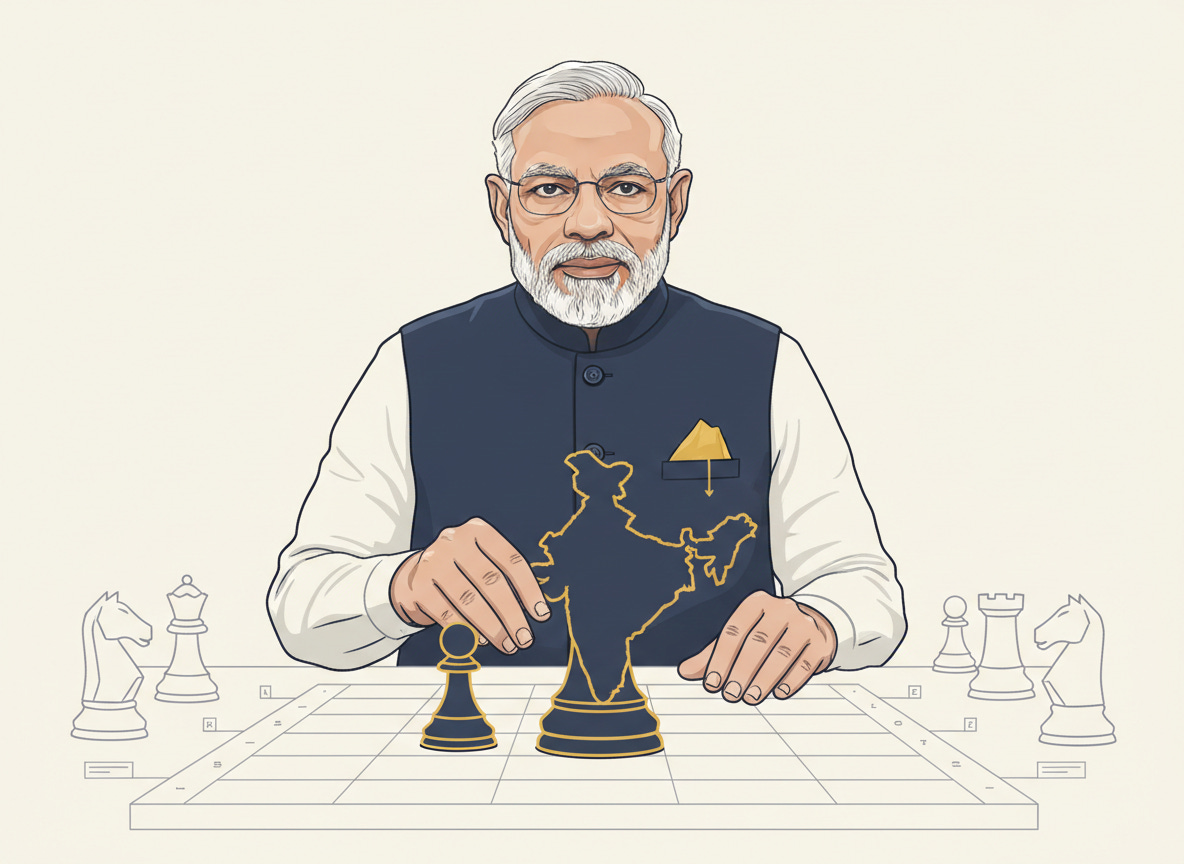
No leader has moved faster to turn Trump’s tariff chaos into bilateral leverage for his own country than Narendra Modi. He plays every side. He signs with Europe, then uses Europe to force better terms from America. He buys Russian oil until Washington pays him to stop buying it. Every deal India closes becomes a bargaining chip for the next one.
On January 27, 2026, Modi signed the EU-India free trade agreement at Hyderabad House in New Delhi. The deal covers two billion people and roughly 25% of global GDP. India will cut tariffs on almost all goods from the EU, including dropping car import duties from 110% to as low as 10%. Von der Leyen called it “the mother of all deals,” and Modi agreed. Six days later, Trump called. By February 2, Modi had Trump on his knees, and the US had cut its tariffs on Indian goods from 50% to 18%.
In May 2025, Modi concluded a free trade agreement with the UK, the largest bilateral deal Britain had signed since leaving the EU, making virtually all Indian exports to the UK duty-free. That deal was signed in July. By January 2026, the EU agreement followed. Within a week, Washington came to the table. Each deal raised the cost of not dealing with India.
The US remains India’s top trade partner, but EU and UK deals opened European markets enough that American tariffs started hurting American exporters as much as Indian ones. Modi did not need to match US trade volumes with Europe; he just needed Europe as a credible alternative.
When Trump piled a 25% tariff on top of the existing 25% tariff on Russian oil, Modi neither capitulated nor confronted Trump. He signed with Europe instead. When Trump called, the price of India’s cooperation had gone up.
Modi personally drives trade negotiations. He chose the summit timing for maximum effect and invited EU leaders to India's Republic Day celebrations the day before signing the biggest deal in Indian history. That is the North archetype, the power-seeker, someone who understands power is part performance. He also governs from an inner certainty about India's thousands year role in creating civilization. He shields agriculture and dairy from every trade deal and maintains relationships with Russia, the US, and Europe simultaneously. That is the Blue archetype, the guardian. India's tradition of strategic autonomy predates him by millennia, and he treats it as non-negotiable.
India scores high, 77, on Hofstede's power distance index, which means Modi can make these calls with minimal domestic pushback. He treats every relationship as circumstantial, applies rules when they serve India, and bends them when they do not. Trompenaars calls that particularism; Modi calls it foreign policy. When the US demanded India stop buying Russian oil, Modi cut purchases from 1.2 million barrels per day to 800,000 before calling Trump, enough to claim compliance without actually cutting off Moscow.
Leverage only works as long as every partner believes India might choose someone else. Modi is not anti-American. He greeted Trump as “one of my greatest friends” and committed to $500 billion in US purchases over five years. He is not pro-European. He kept agriculture largely off the table in the EU deal and will phase in tariff cuts over a decade. He is pro-India, and every deal shows it.
The risk is that if any of India’s partners stop believing that India has other options, India's bargaining power will disappear. The strategy fails the moment Washington or Brussels stops competing for India. For now, Trump's chaos keeps both sides bidding.
Friday’s Edition examines Lawrence Wong and Singapore’s network design, where the goal is not to leverage or defend but to build the connection that holds the post-American trade system together.
Sidebar: India’s Trade Deal Stack
India-EFTA (signed March 2024): Iceland, Liechtenstein, Norway, Switzerland; India’s first FTA with European nations
India-UK CETA (signed July 2025): 99% of Indian exports duty-free; $56B bilateral trade, target to double by 2030
India-EU FTA (concluded Jan 27, 2026): 2 billion people, ~25% of global GDP; India cuts tariffs on 96.6% of EU goods
US-India Interim Agreement (announced Feb 2, 2026): US tariffs cut from 50% to 18%; India commits to $500B in US purchases over 5 years; additional 25% Russian oil penalty removed
If you enjoyed this article, help support my work by becoming a paid subscriber or “buying me a coffee.”


