Rise Of The Middle Powers: Macron and the European Independence. Wednesday's Edition
Four leaders building faster than Trump destroys. Series 18 #3
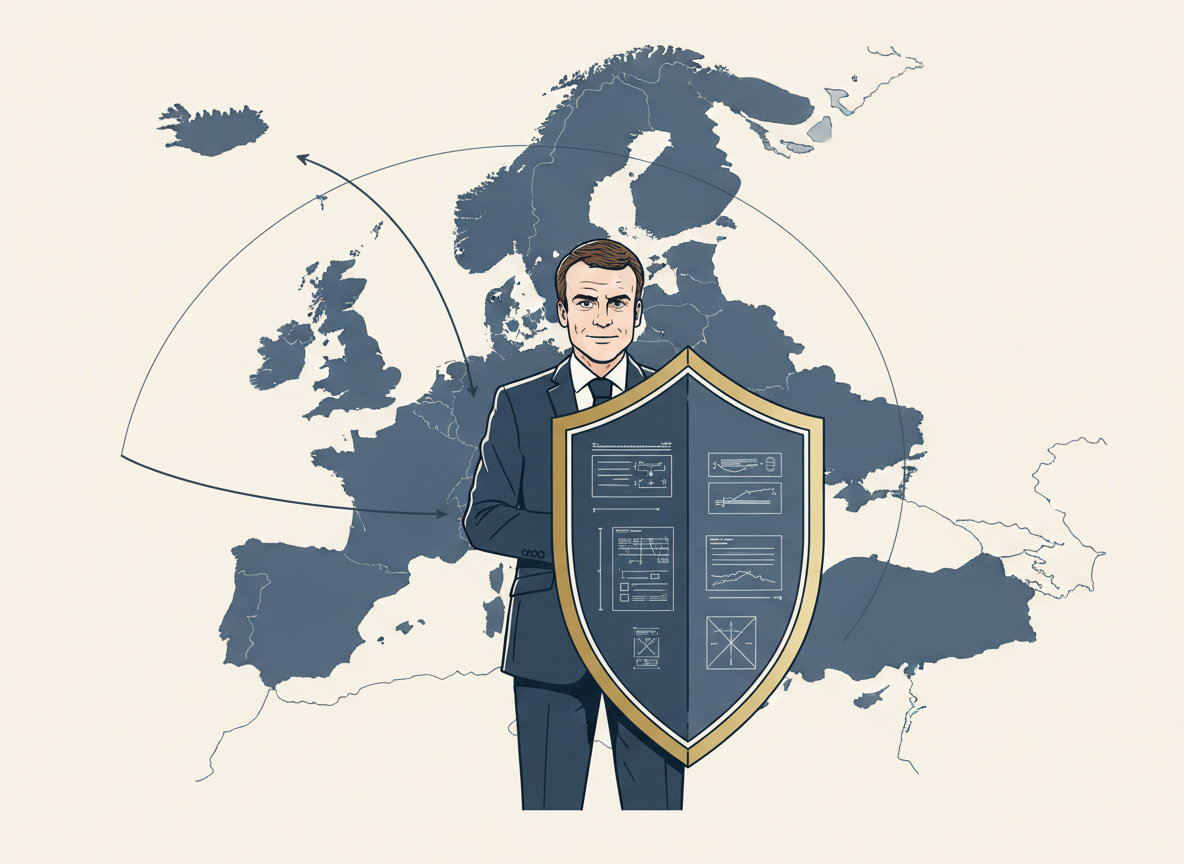
Two days before Mark Carney told Davos the rules-based order was a fiction, Emmanuel Macron took the same stage and said something sharper. Europe, he warned, will not “passively accept the law of the strongest, leading to vassalization.” Europe would no longer be a pawn of the U.S.
The trigger was Trump’s threat of 25% tariffs on eight European nations unless they backed his push to acquire Greenland. But Macron was not reacting to a single provocation. He was announcing Europe's future plans for the world, and they did not include the US. At least not as it had in the past.
The EU exported €2.8 trillion in goods in 2024, of which 20.6% went to the United States. Europe does not need to diversify its trade as Canada does; it needs to defend what it already has, deepen the partnerships with other nations, and be independent of U.S. control.
That is exactly what Macron, alongside European Commission President Ursula von der Leyen, is calling for and has been building. In September 2025, the EU finalized a trade agreement with Indonesia covering €27 billion in bilateral trade and eliminating tariffs on 98% of goods. In January 2026, it concluded deals with both the Mercosur bloc and India. The India agreement alone covers two markets with a combined population of 1.9 billion people, and the Commission expects it to double EU goods exports to India by 2032. These were not spontaneous breakthroughs. The Mercosur negotiation lasted 25 years; India took nearly 2 decades. What changed was urgency. Trump’s tariffs, support of Putin, threats to invade Europe, and work to dismantle the EU made it clear that the EU must come together to fight the common enemy, the United States.
Macron is calling for both an offensive and a defensive strategy to protect Europe from the U.S. The Anti-Coercion Instrument can restrict US access to EU public procurement, limit foreign direct investment, and reduce imports and exports. It was designed as a deterrent, originally aimed at China after Beijing punished Lithuania for deepening ties with Taiwan. Macron redirected it to Washington. Additionally, he and German Chancellor Friedrich Merz are developing a “European preference” framework that would give EU producers priority in procurement, mirroring the Buy American provisions that have protected US industry for decades.
Both Carney and Macron fit Hornby’s North archetype: Power-seekers who lead through ideas rather than feelings. But the expression is fundamentally different. Carney’s North expression is entrepreneurial. His orientation is achievement-based (Trompenaars): status flows from what you have done.
Macron’s North is institutional. A product of France’s elite civil service pipeline and a former Rothschild investment banker, he governs in a high power distance culture (Hofstede), where the presidency carries inherent authority. His orientation is ascription-based (Trompenaars): authority comes from who you are and the position you hold. When Macron texted Trump directly to say, “I do not understand what you are doing on Greenland,” he was not negotiating. He was telling Trump that France answers to its own interests. France’s nuclear arsenal, its permanent UN Security Council seat, and its G7 presidency gave him the authority.
That cultural perspective explains why Macron builds bloc-level architecture while Carney builds bilateral deals. Macron does not sign trade agreements. He drives the EU's negotiators to sign trade deals covering 450 million people, then arms the bloc with tariffs, procurement bans, and market restrictions that can shut American companies out of Europe. “We prefer respect to bullies,” he told Davos. “We prefer the rule of law to brutality.”
Macron cannot act alone. Every trade deal and every retaliatory measure needs approval from at least 15 of the EU's 27 member governments. Macron sets the direction, but 26 other governments decide whether to follow. Right now, the strongest force pushing them together is Trump, and the strongest leader for European independence is Macron.
In Thursday’s Edition, Narendra Modi shows a third model: using the same agreements Europe offers to extract competing concessions from the United States.
Sidebar: The EU’s New Trade Architecture
Deals concluded or signed since Trump’s tariff escalation:
Indonesia CEPA (Sept 2025)
EU-Mercosur Partnership (signed Jan 2026)
EU-India FTA (concluded Jan 27, 2026)
EU-Mexico (updated 2025)
EU-Singapore Digital Trade Agreement (entered force Feb 1, 2026)
Defensive tools activated or proposed:
Anti-Coercion Instrument
European Preference Framework
€93B retaliatory tariff package:
Negotiations resumed or accelerated:
Malaysia
Philippine
UAE
Thailand


