Rise Of The Middle Powers: Four Leaders Leading The Change. Monday's Edition
Four leaders building faster than Trump destroys. Series 18 #1
The American wrecking ball swings daily. The country that built the global trading system, guaranteed its stability, and invited allies to depend on it is now turning on those very nations that trusted it. Trump imposes 50% tariffs on India for making its own energy purchasing decisions. He threatens 100% tariffs on Canada for conducting its own foreign policy. He dangles Greenland seizure over a NATO ally. Republicans frame this as a strength, but it’s coercion: comply with Trump’s demands or the U.S. will punish you. Is it any wonder why nations no longer want to engage with the U.S?
The message to every middle power is that Trump is the Master, not an ally or partner. Every relationship is conditional on compliance with demands that shift overnight based on Trump’s mood.
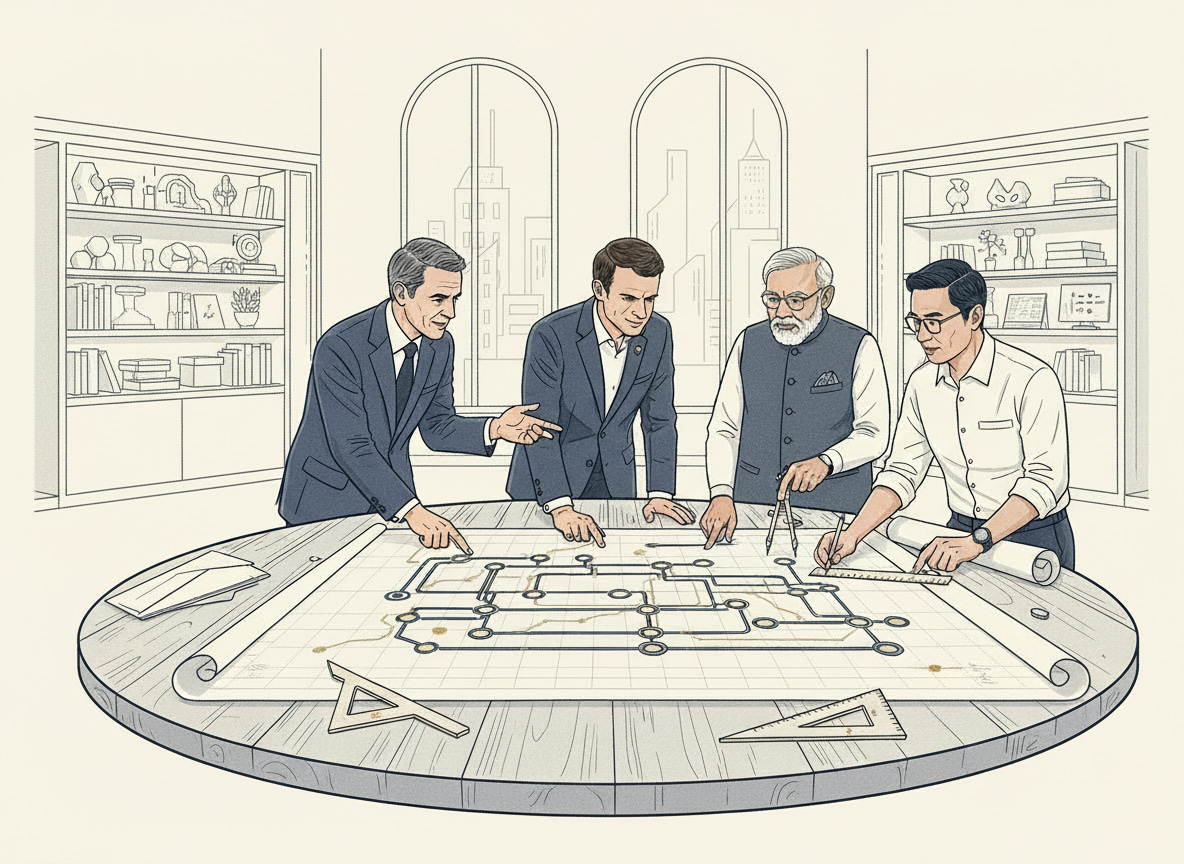
But four leaders on four continents are building a new system, and they are building it faster than Trump and the Republicans and destroying the old system.
The numbers make the case. The EU concluded more major trade agreements between January 2025 and January 2026 than in the previous decade combined: Mercosur after 25 years of stalled negotiations, India after 19 years, and Indonesia after 9. Canada’s Mark Carney signed 12 new trade deals across four continents in six months. India’s Narendra Modi opened his country’s famously protected markets for the first time in decades, creating a two-billion-person free trade zone with the EU covering 25% of global GDP. Singapore’s Lawrence Wong organized 14 nations into a new trade facilitation partnership. Deals that had languished for a generation suddenly closed in months, because Trump’s aggression made the U.S. an adversary.
We are watching four leaders who reached the same conclusion independently, simultaneously, and on different continents: the US-led order is not coming back; it is not a temporary disruption; it is a permanent structural change, and it requires a permanent structural answer.
Leaders who treat this as temporary accommodate and wait. Britain's Keir Starmer cut a deal with Trump and celebrated the special relationship. Australia's Anthony Albanese absorbed the tariffs and kept requesting phone calls with the White House. Both are managing the damage, hoping a change in U.S. leadership will right the ship. It won't; Trump and the Republicans have created a situation from which the U.S. can not recover. Another group of leaders understands that while the storm will pass, the damage will require a new build, not a repair.
Canada’s Carney, France’s Macron, India’s Modi, and Singapore’s Wong are not waiting. They are building.
What connects these four leaders is a shared cultural perspective. All four operate from:
Internal direction (Trompenaars): the conviction that they can shape the future rather than submit to forces imposed on them.
Low uncertainty avoidance (Hofstede): a willingness to move forward into unknown territory.
Long-term oriented (Hofstede): accepting short-term economic pain for long-term gain.
Universalism (Trompenaars): rules-based systems with consistent terms applied equally to all participants.
But the cultural perspective that best explains what they are building, not just why they are building it, is specific orientation: trade, security, political alignment, and cultural influence are separate. This is in contrast to the US-led diffuse order, which bundled everything together. Nations traded with the U.S, hosted American bases, aligned with American foreign policy, and accepted American leadership as the price of participation. No one could separate a trade deal from a security guarantee.
These four leaders are unbundling that package. Carney signs trade deals with the UAE and China without security alliances. Macron builds European defense autonomy on a separate track from EU trade agreements. Modi opens India’s markets to Europe while buying energy from Russia and maintaining an adversarial security posture toward China. Wong constructs trade partnerships that carry no political obligations beyond their contractual terms. Each agreement stands alone, serves a defined purpose, and requires no alignment with anything outside its scope.
The monolithic days of American all-or-nothing and Trump’s obey or be punished are over. The old system was vertical: a superpower at the top, middle powers arranged beneath, and weak nations crushed below. The new system is horizontal: middle powers connect directly with each other, no superpower dictates terms, and smaller nations are welcome. These four leaders are at the forefront of making the new system a reality.
This week, we look at each leader and what they are building.
Tuesday’s Edition: Carney and Canada’s clean break.
Wednesday’s Edition: Macron and the European third pole.
Thursday’s Edition: Modi and India’s leverage play.
Friday’s Edition: Wong and Singapore’s network design.
Saturday’s Core Brief: What this brave new world looks like when the pieces connect.
Trump’s wrecking ball keeps swinging, but the builders are faster.
Sidebar: Nine Leaders Leading
Mark Carney - Canada’s clean break.
Emmanuel Macron - the European third pole.
Narendra Modi - India’s leverage play.
Lawrence Wong - Singapore’s network design.
Ursula von der Leyen - Europe’s deal machine.
Lula da Silva - Brazil’s southern pivot.
Prabowo Subianto - Indonesia’s all-sides gambit.
Shigeru Ishiba - Japan’s multilateral shield.
Cyril Ramaphosa - South Africa’s continental market.
If you enjoyed this article, help support my work by becoming a paid subscriber or “buying me a coffee.”


