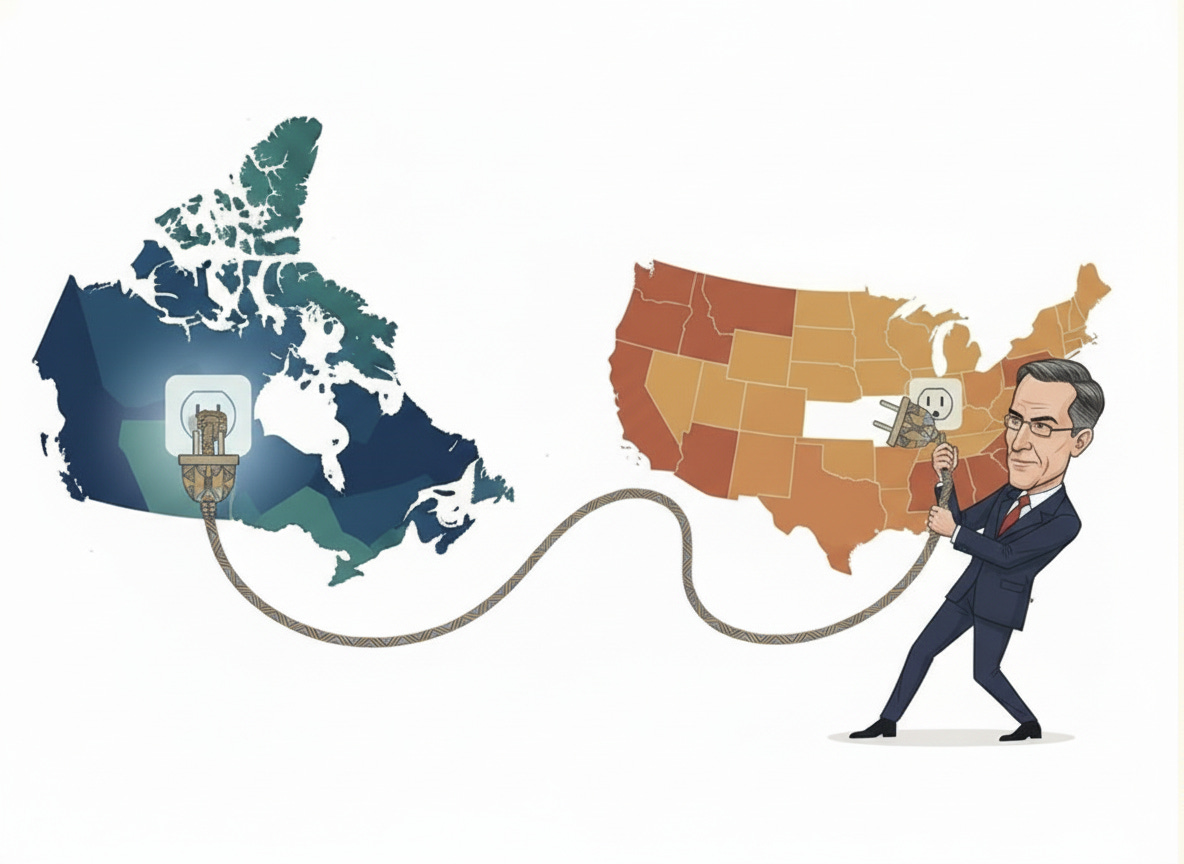
Rise Of The Middle Powers: Carney Pulls The Plug. Tuesday’s Edition
Four leaders building faster than Trump destroys. Series 18 #2
Canada’s PM, Mark Carney, directly and publicly declared that the American rules-based international order is over. At the Davos summit, he said, “We knew the story was partially false, that the strongest would exempt themselves when convenient, that trade rules were enforced asymmetrically.” That imperfect system held the world together until Trump and the Republicans terminated it. Now, as Carney said, “Middle powers must act together, because if you are not at the table, you are on the menu.” After hearing this, the Trump administration panicked and lied. Treasury Secretary Scott Bessent told Fox News that Carney had “aggressively walked back” his remarks in a private phone call. Carney responded in front of cameras: “I meant what I said in Davos.” He then told reporters he had explained to Trump that Canada was building 12 new economic and security agreements across four continents in just six months.
Canada sends 75% of its exports to the United States. No other major economy carries that level of single-market dependency with the U.S. Carney set a target to double Canada’s non-US exports by 2035, and his trade minister put the pace in perspective: “Normally, the government of Canada signs one trade agreement a year.” Carney compressed a decade of work into months.
This is how Carney is building a new system: for decades, American trade agreements bundled economic access with political and security obligations. Washington used free trade agreements as tools to promote democracy, coordinate military alliances, and align partners with US foreign policy goals. Close allies aligned their policies with Washington’s as a condition for favorable trade with the U.S., including Canada. For example, after the Biden administration raised tariffs on Chinese electric vehicles from 25% to 100% in 2024, Canada announced a 100% surtax on Chinese-made EVs, describing it as consistent with a broader move led by the U.S. (and the EU).
Trade with Washington has never been just about trade.
Under Carney’s new system, the conditions tied to trade are stripped out. Every deal serves a single contractual purpose and carries no obligations beyond its terms. The Indonesia CEPA agreement eliminates tariffs and opens $825 million in cross-investment financing; the separate Indonesia defense cooperation agreement, signed the same day, handles security and is unrelated. The UAE commits $50 billion in Canadian investment under a foreign investment protection agreement that requires no political alignment and no endorsement of Emirati foreign policy. The EU partnership bundles trade expansion with Europe’s $237 billion REARM defense program, but on terms negotiated between Ottawa and Brussels, independent of NATO command structures. And China gets tariff reductions on Canadian canola, lobster, and peas without Canada adjusting its positions on Taiwan, human rights, or anything else.
Additionally, Canada no longer coordinates with the U.S. For example, in January, 2026, Canada reversed the 100% tariff on Chinese EVs and agreed to allow up to 49,000 Chinese EVs per year to enter Canada at Canada’s normal “most favoured nation” rate of 6.1%.
The structural difference is that none of these deals requires Canada to be on anyone’s side about anything other than the deal itself.
Carney’s approach tracks his career: Goldman Sachs, Bank of Canada governor, Bank of England governor, and prime minister. Each position earned through results. This is achievement orientation (Trompenaars) and Hornby’s Power-seeker, North archetype, in action: idea-driven decision-making, institutional ambition, and a refusal to accept external agendas that do not serve his strategic goals. North types at the highest level reshape systems; they do not manage decline. Internal direction (Trompenaars) and low uncertainty avoidance (Hofstede) explain the speed: Carney broke with Canada’s largest trading partner without a guarantee of success, because he operates from the conviction that he can shape outcomes rather than react to them. His specific orientation led him to unbundled Canada’s international relationships into discrete components, each serving Canadian interests and requiring nothing beyond its contractual scope.
Canada still sends 70% of its exports south. The dependency will take years to unwind, unless Trump accelerates it. Carney’s own trade experts acknowledge the math is brutal: reducing US exports by just 10% would require doubling sales to six other countries. But no other leader of a US-dependent economy has moved this far, this fast, with this much clarity about why.
In Wednesday’s Edition, we look at how French President Macron is positioning Europe as a third power, independent of the U.S.
Sidebar: Carney’s 12 Accords - Six Months, Four Continents
Europe
EU “Enduring Partnership” and Security and Defence Partnership (June 2025)
EU SAFE defence procurement admission (Dec 2025)
Middle East
UAE Foreign Investment Protection Agreement (Nov 2025)
Qatar defence, investment, and AI cooperation (Jan 2026)
Indo-Pacific
Indonesia Comprehensive Economic Partnership Agreement (Sept 2025)
Indonesia defence cooperation agreement (Aug 2025)
Japan Security of Information Agreement (July 2025)
Japan Equipment and Technology Transfer Agreement (Jan 2026)
South Korea Security and Defence Cooperation Partnership (Nov 2025)
Malaysia energy and investment Letter of Intent (Oct 2025)
China tariff reductions and energy partnership (Jan 2026)
Americas
Ecuador free trade agreement (2025)
Chile (signed at APEC in Gyeongju) renewed Strategic Partnership Framework (Nov 2025)
Mexico Comprehensive Strategic Partnership (Sept 2025)
Next in line: Thailand, Philippines, Canada-ASEAN, India, Mercosur, Saudi Arabia
Canada normally signs one trade agreement per year.


And the beat goes on.
This Prime Minister
Leads with clarity and conviction.
Moves like a juggernaut.
Will not stop.
And the beat goes on.
I so appreciate Carney! Wishing so hard we had leaders like him in US and wondering so hard why we don't