

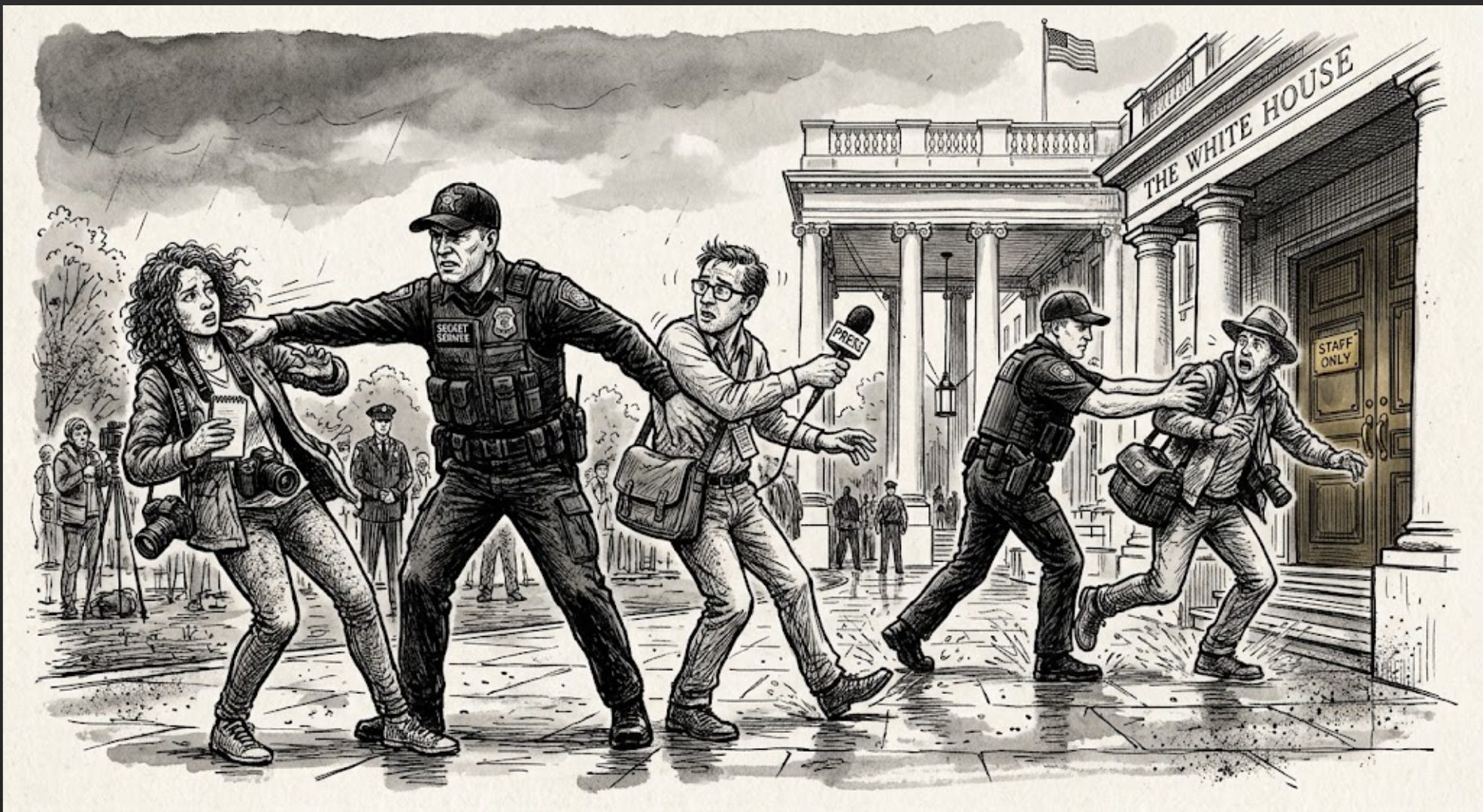
Americans are familiar with part of their Fifth Amendment. You see it in movies when a witness or defendant “takes the Fifth,” meaning they are protected from being forced to testify against themselves.
But there are four other stipulations in the American 5th Amendment that most Americans are unaware of:
Requiring a grand jury to formally charge a person with a federal felony before trial
Barring “double jeopardy,” which is trying a person twice for the same crime
Requiring fair payment when it takes private property for public use
Requiring fair legal procedures before the government takes your life, liberty, or property - the Due Process Clause.
The Due Process Clause is a key component that keeps Americans free, and it is at the center of the lawsuit CNN, MS NOW, and Politico filed after Trump revoked their reporters’ press passes. Supreme Court decisions interpreting the Due Process Clause hold that once the government grants a benefit (press credentials, in this case), it cannot take it away without notice, a stated reason, and a chance to contest it. It has implications far beyond a free press or free speech for the Americans.
The Due Process Clause protects ordinary Americans when the government takes away something it has already given them. The same words appear in the Fourteenth Amendment, which applies the rule to state and local governments. Under this rule, the Supreme Court has held that the government cannot cut off a family’s welfare benefits without a hearing first (Goldberg v. Kelly, 1970), cannot suspend a driver’s license without a chance to contest it (Bell v. Burson, 1971), cannot suspend a student from public school without telling the student the charge and hearing their side (Goss v. Lopez, 1975), and cannot fire a public employee who has job protections without notice and a chance to respond (Cleveland Board of Education v. Loudermill, 1985). The same principle covers federal benefits like Social Security and veterans’ payments, and professional licenses. The government is not required to let an individual keep the benefit forever, but it is required to:
Tell the person why it is taking the benefit away.
Follow published rules.
Allow the person to respond before it acts.
These are exactly the procedures that dictators and authoritarian regimes cannot allow. It’s not surprising that Trump and the Republicans want to take them away from the Americans.
The Trump-Republican regime failed to provide advance notice and a way to challenge the decision. Trump’s explanation for taking the benefit away is a problem in itself. He called the outlets' reporting "unfavorable coverage," a weak argument at best.
Now it’s up to the courts to decide the outcome. Will the American justice system support Trump or the Constitution?
Wednesday’s Edition: What happens if the upper courts uphold Trump's press ban? It’s not good for America’s freedom.
If you enjoyed this article, help support my work by becoming a paid subscriber or “Buy me a coffee.”
Get a solid understanding of Trompenaars’ cultural dimensions by purchasing the guide or subscribing to Cultural Perspective (free or paid) and receiving the guide for free.
