Liberal Constitutional Democracy - The Rules Based Model: Wednesday's Edition
Four government systems the deliver results
In some countries, the law is a suggestion. Police work for bribes. Courts rule based on who you are. Constitutions exist on paper but not in practice. Personal power determines outcomes.
In Liberal Constitutional Democracies, the opposite holds. The rules apply to everyone. A prime minister can be prosecuted. A corporation can be sued by an ordinary citizen, and he or she may win. Judges rule against the government that appointed them. The system works not because people are virtuous, but because the system keeps the rich and powerful in check
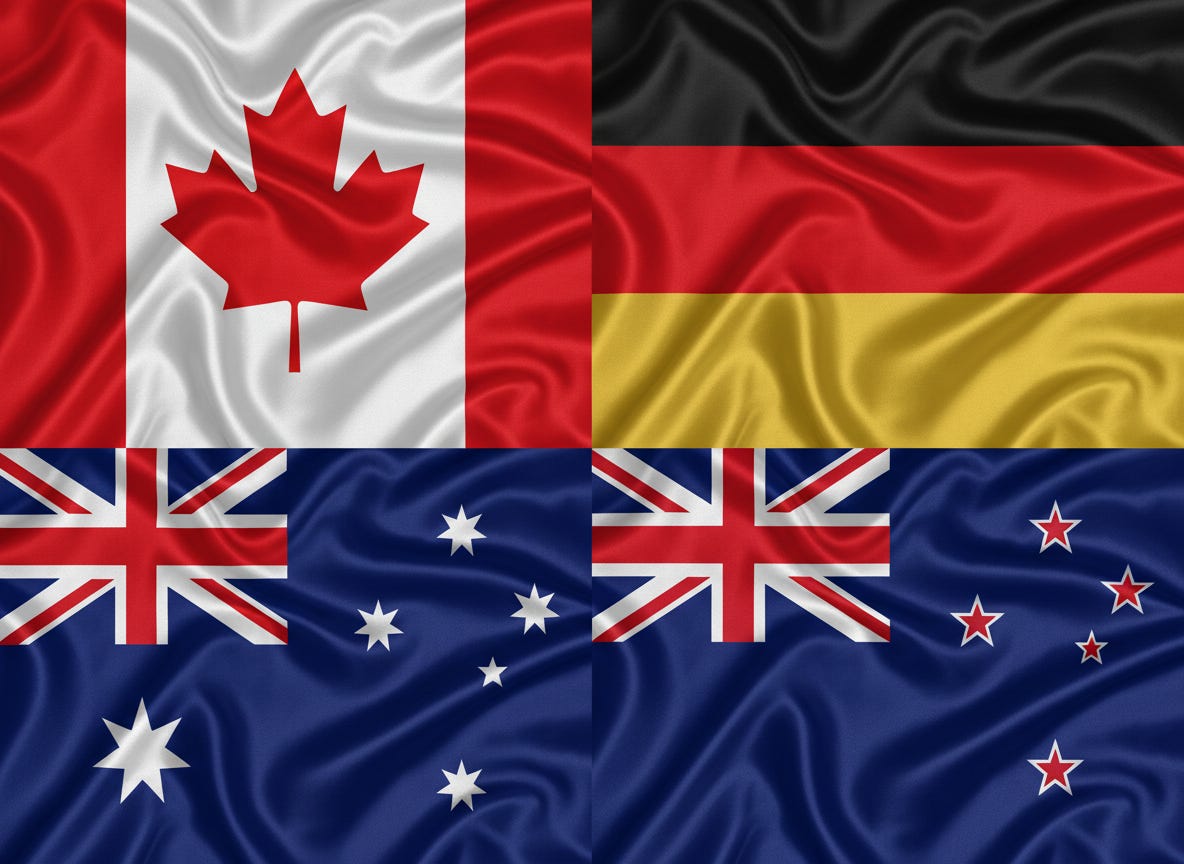
Canada, Germany, Australia, and New Zealand operate this way. So do several others. What defines them is not elections alone, as many countries hold elections but remain corrupt or unstable. What defines them is that written rules actually control behavior, and independent institutions enforce those rules even when those in power push back.
The outcomes show up in daily life. Low corruption means permits are granted based on qualifications, not bribes. Independent courts mean contracts are enforced, and property is secure. Press freedom means scandals get exposed. Citizens can plan their lives because the rules tomorrow will be the rules today. And just as equality is the defining factor in Social Democracies, stable predictability is the defining factor in Liberal Constitutional Democracies
These countries rank high on rule of law indices, press freedom, and control of corruption. Germany rebuilt from rubble into Europe’s largest economy under this framework. Canada maintains stability across a vast geography and linguistic division. Australia and New Zealand consistently score among the world’s most livable nations.
The cultural foundation is universalism, which Trompenaars defines as the belief that rules should apply equally regardless of relationships. In universalist cultures, the brother of the Chief of Police does not get special treatment from the police. A contract means what it says, even if circumstances change. Exceptions to the rules undermine the system; they are not seen as flexibility.
This contrasts with particularist cultures, where relationships determine rules. Context matters more than contracts. Loyalty to people outweighs loyalty to the law. Neither orientation is superior, but they produce different governments.
Liberal Constitutional Democracies also score low on Hofstede’s power distance scale. Leaders are employees of the public, not rulers above it. Angela Merkel did her own grocery shopping. Canadian prime ministers face aggressive questioning in Parliament. New Zealand’s Jacinda Ardern was known for accessibility. When leaders are seen as equals with temporary authority, holding them accountable feels normal rather than disrespectful.
Hall’s low-context communication pattern reinforces the system. Rules must be explicit because implicit understanding cannot be assumed. Constitutions spell out rights in detail. Contracts run dozens of pages. Court decisions explain reasoning at length. What is written matters more than what is understood. This feels bureaucratic to high-context cultures, but it makes the rules enforceable by those who have no personal relationship.
Hofstede’s individualism dimension also applies, but with nuance. These societies value individual rights and freedoms, yet accept that those freedoms require collective protection through institutions. The individual matters, but so does the system that protects the individual. Personal liberty and collective rule-following coexist because the rules exist to protect personal liberty.
Hornby’s archetypes illuminate the pattern. The West (Sage) archetype values knowledge, precision, and explicit reasoning. Constitutions, legal codes, and judicial opinions are the Sage’s work product: careful, detailed, built to withstand scrutiny. The Blue (Guardian) archetype provides structure and insists on doing what is right. In Liberal Constitutional Democracies, the Guardian is in institutions rather than individuals. The constitution, not the leade,r is the guardian.
The model has trade-offs. Institutions move slowly. Checks and balances create gridlock. Courts take years. Legislation requires compromise. Polarization can paralyze the system when factions refuse to cooperate. The same rules that constrain abuse also constrain speed.
This is the point. Liberal Constitutional Democracy works where the culture already expects written rules to bind everyone equally. The institutions did not create universalism. Universalism created the institutions.
Liberal Constitutional Democracy works where the culture already expects rules to bind everyone, where leaders are seen as public servants rather than superiors, and where explicit procedures feel like protection rather than bureaucracy. Export the institutions to a culture that expects flexible interpretation, personal loyalty, and strong leaders, and the machinery seizes up or gets hollowed out.
Tomorrow: Consensus Democracy, where everyone gets a seat at the table.


