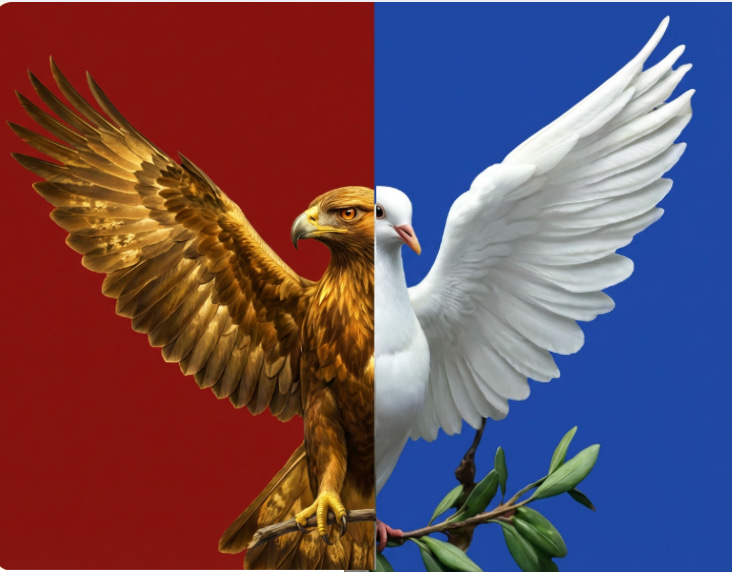
Left Wing - Right Wing: Why They Will Fight To The End.
Spain’s Pedro Sánchez and Brazil’s Lula da Silva hosted about 3,000 left-wing leaders in Barcelona last weekend, including Cyril Ramaphosa of South Africa and Claudia Sheinbaum of Mexico. The goal was to defend democracy against the far right. That assumes, correctly, that there is a divide between the two, but what actually is the divide?
The Cultural Difference
Cross-cultural psychologist Schwartz developed two value frameworks, one for individuals and one for societies. Both map onto the right-left split.
At the individual level, Schwartz identifies four broad value categories. The right wing draws on Conservation (tradition, conformity, and security) and Self-Enhancement (power and achievement). The left wing draws on Openness to Change (self-direction and expression) and Self-Transcendence (universalism and care for others).
At the societal level, Schwartz identifies three opposing pairs. The right wing leans toward Embeddedness (group identity, tradition, social order), Hierarchy (acceptance of inequality in power and authority), and Mastery (control, ambition, and dominance over others). The left wing leans toward Autonomy (individual expression, curiosity, self-direction), Egalitarianism (equality and concern for all), and Harmony (fitting into the world and protecting it).
These differences can be seen with Donald Trump’s appeal to conservative religious voters, threats against NATO, war with Iran, and mass arrests without due process across America by ICE. On the other hand, Sanchez and Lula da Silva promote cross-border talks, global climate policy, and reforms that extend beyond their own nations and treat outsiders as people whose welfare matters. This is why Sánchez and Lula frame Barcelona as a defense of democracy worldwide, not just in their nations, and Trump frames his goals as “America first.”
Backlash and Brahmins
Since the 1970s, according to Norris and Inglehart, Western societies have shifted away from traditional values and “the way things have always been done” toward new values and new ideas. Older, less-educated, and rural voters have pushed back against younger, educated, urban progressives whom they see as forcing new values on them.
Piketty adds the class layer. Western lefts have become parties of the highly educated, what he calls the "Brahmin Left," referring to the Indian caste system. The wealthy continue to vote right, what he calls the "Merchant Right." Meanwhile, the working class has fractured, with much of it moving to nationalist parties.
Hooghe and Marks argue a new divide has emerged on top of the old class divide: the GAL-TAN axis: Green-Alternative-Libertarian against Traditional-Authoritarian-Nationalist. The 2024 surge of the European far right mapped cleanly onto it.
The Archetype Divide
The same split shows up in psychological archetype. Using Hornby’s map, the Barcelona group leans towards the Green-Caregiver (care, foreign aid) and East-Communicator (flat networks, side-by-side work). Sánchez and Lula are the communicators calling on people to work together for the greater good.
The right-wing cluster is the North Power-Seeker (status, dominance, and power). It is also more Blue-Guardian (tradition, sovereignty, and looking to the past for answers). South-Red, the Labor and Mother, focuses on tangible outcomes, family, and us-versus-them framing.
Where It Leaves Us
What all this makes plain is that the split between left and right in 2026 is not a fight over tax rates or immigration; it is a clash of cultural perspectives, class blocs, and archetypes. It’s unlikely any one of those can be bridged, much less all three. The only answer is what the answer has always been: progress too slow for the left and too fast for the right. But always progress.
If you enjoyed this article, help support my work by becoming a paid subscriber or “buy me a coffee.”


